
Catching Bonito

There have been continued catches of Australian bonito (Sarda australis) in the Bay of Islands over last summer and autumn, reports Craig Worthington. He wonders if these are now becoming ‘NZ bonito.’
The spring capture of two of these supposedly rare bonito in 2021 by Rob and Pam Scheirlinck was reported in the November 2021 issue of NZ Fishing News. Now it looks like these Australian immigrants are more common than previously thought, as there have been ongoing reports of bonito captures all over the upper North Island.
Dane Hawker sent me a photo of one of two bonito he caught trolling near Ninepin Rock in the Bay of Islands in early March of this year. He says he dropped a third fish and converted the bonito he did land into some very nice sashimi.
Allan Anderson also reported catching a bonito in March in six metres of water near Urupukapuka Island, in the Bay of Islands, and a large school of bonito were seen at the Mercury Islands around the same time. There were also Facebook posts about bonito being caught in other locations and reports from divers who had seen them underwater.
Not to be outdone, my son Jack also showed me a picture of a good-sized bonito he witnessed being caught on a kabura jig at the Cavalli Islands in mid-March. This was at night.
No doubt there have been numerous other bonito captures around the coast that have not been talked about on social media. Add the ongoing misidentifications of bonito as odd-looking skipjack tuna and you begin to realise there could be a lot of Australian bonito out there.
The temperature tolerance of bonito puts them right at home in our waters. They could happily over-winter in our seas anywhere north of East Cape. The only mystery, perhaps, is why they have been so rare in the past.
Many bonito caught in previous years may have been confused with skipjack tuna. It was never quick and easy to get a fish identified in years past. Only since the advent of social media and modern picture-taking mobile phones can we easily tell others about the unusual fish we catch and get a proper identification done on them in real-time. This has helped settle the confusion between the two species and highlight the fact that both species do swim in our waters. Hopefully, most people will now use the ‘bonito’ name only in reference to Australian bonito and not skipjack tuna. The fact that skipjack tuna is sold through the bait shops branded as ‘Bonito’ will not have helped matters.

The difference between bonito and skipjack tuna is plain to see. In these pictures, you can see that the skipjack tuna’s stripes never go above the lateral line.
It has been a bit of a slow process to get this far. Official recognition of the species occurring in New Zealand waters only happened in 1979 with Te Papa formally identifying several bonito that were caught in an inshore net in the Bay of Islands.
And it is this ‘inshore’ nature of those 1979 captures that points to a major habitat difference between Australian bonito and skipjack tuna. Skipjack tuna ride the world’s ocean currents and are seasonally abundant in summer, autumn and early winter. They are much more of an offshore fish than the bonito.
The Australian bonito is by contrast, an inshore pelagic species. It likes to swim close and fast to the shore. In countries where they are caught frequently, catching them off the rocks is not uncommon. Recent New Zealand captures have highlighted that this species loves the edge of the whitewater that comes off headlands and islands when a good swell is running. It is also known for swimming right up into the green water of harbours.
This may help to explain some of the more unusual bonito/skipjack tuna land-based capture reports that have been talked about over the years. Places like the wharf at Whakatane, the old Marsden Point wharf on the Whangarei Harbour and a wharf inside Hokianga Harbour all seem like unusual land-based locations from which to catch skipjack tuna, but these are places that skipjack tuna have rumoured to have been taken in the past. Possibly these were misidentifications.
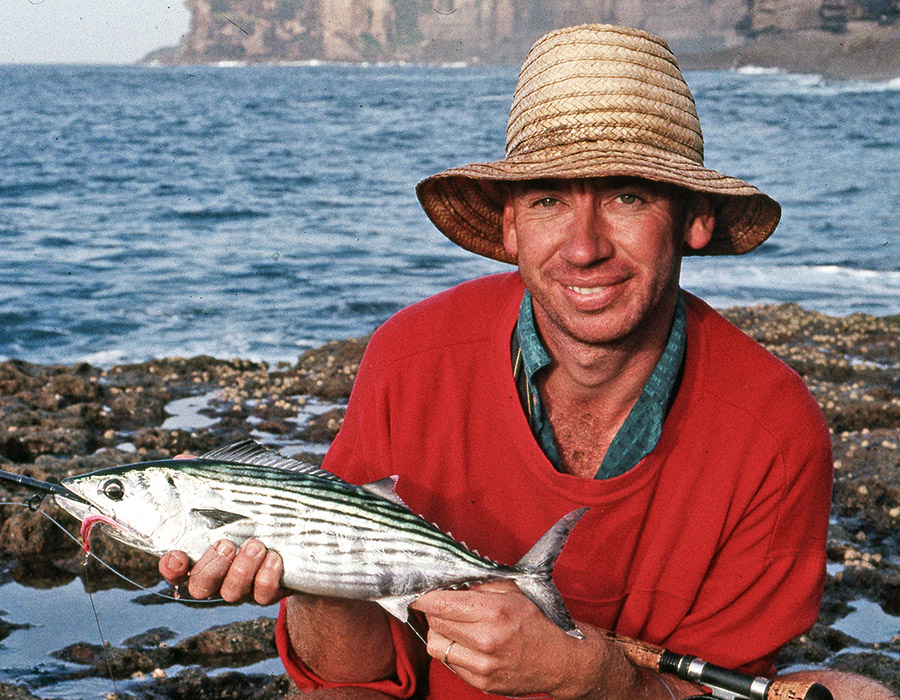
Wayne Wells with a fly-caught bonito from the rocks in New South Wales, Australia a few years back. Compare the smaller stripes and the stripes going all the way up to the dorsal fin against the belly-only stripes in a skipjack tuna.
Now we know that the tuna caught in these odd locations were more likely to have been Australian bonito than skipjack tuna. Unfortunately, there is no photographic proof from which to set the record straight. Few people wasted photographs on unusual fish back in the ‘good old days’.
The reality appears to be that Australian bonito have been here a long time, that they are often found swimming close to shore, and they have been caught on a rare to occasional basis over the years. The only mystery would be why they are not more numerous than they are, and why has 2022 been such a great year for them?
Their breeding requirements do appear to be a limiting factor. New Zealand’s coastal sea temperatures are a little bit too cool during the main period of their breeding cycle (spring to early summer). They can happily live and grow here but obviously require a warmer coastal environment to breed more effectively. Some reproduction will occur in our waters, but they won’t be spawning for the entire length of spring and early summer like they do in warmer climes.
There is a good population of Australian bonito at Norfolk Island. The level of warmth in the seas around Norfolk is just right for their successful reproduction. They appear to be common. Scott Greenwood of Greenwood’s Fishing Adventures in Norfolk Island tells me they are caught off the rocks there and big fish right up to six or seven kilos are sometimes taken.
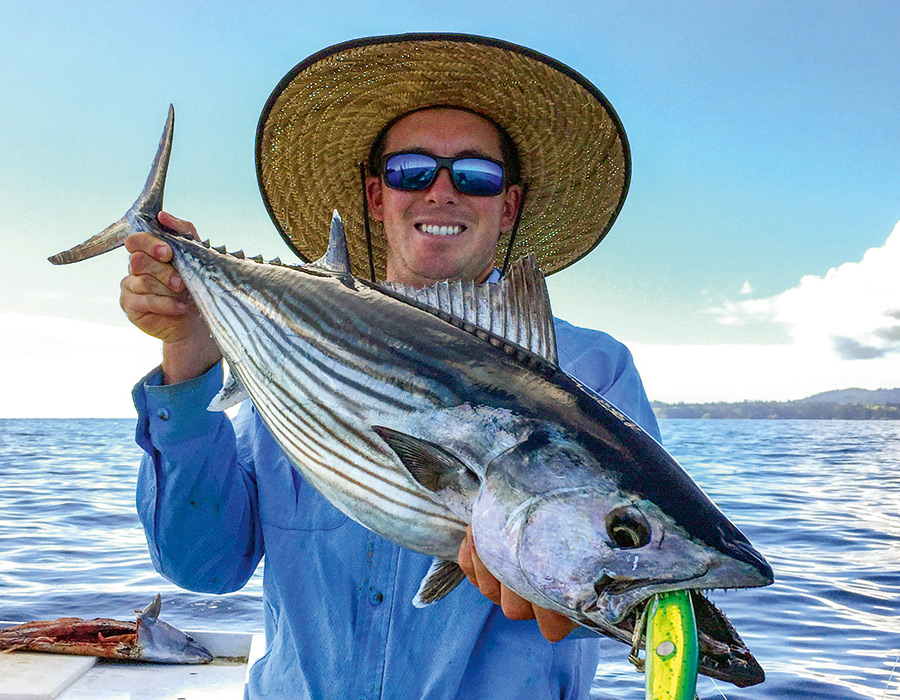
Bonito are a regular catch in the waters surrounding our near neighbour, Norfolk Island. Photo: Scott Greenwood – Greenwood’s Fishing Adventures.
Whether some of these Norfolk Island bonito migrate to northern New Zealand or whether eggs and larvae are washed down from Norfolk Island is unknown. Possibly there is a bit of both going on, along with a small amount of spawning in our coastal waters. The Sheirlinck’s bonito captures in September in sixteen degrees of water would suggest that many New Zealand bonito stay here all year round.
For such a fast-growing fish (they reach full size in two to three years) this would suggest that the population of Australian bonito in New Zealand has been historically small and has been kept that way by limited spawning in our waters. Because of this, any coastal sea temperature rise is likely going to be of great benefit to them.
This appears to be what we are seeing. We used to catch large numbers of barracouta in the Bay of Islands, but these days we hardly see any. Water temperatures are increasing, and people are catching Australian bonito instead. This could be the way our fishing future unfolds.
I wonder what other warm northern species we’re going to see next?

November 2022 - Craig Worthington
New Zealand Fishing News Magazine.
Copyright: NZ Fishing Media Ltd.
Re-publishing elsewhere is prohibited
Recent Forum Posts Visit Forum

Shane Jones
in Fisheries Management1 hour ago
Pcj
But reality is maybe 4 from legasea and the NZSFC .Rather than asking what fishos want they blindly go ahead with their own ideas and...

Trailer wheel clamp
in The Boat Shed12 hours ago
Mc Tool
either crc long life or 556 marine are way better ...

Foton tunland v9
in The Briny Bar28 hours ago
Ho Dee
not fishing related and delete if required but was wondering if any has one of these or someone who has just wanting so e real world...

Bluefin Tuna at the cavs.
in The Briny Bar74 hours ago
smudge
Despite my years of fishing I haven't really fished many places, my focus has always been on Auckland's west coast and out toward Great Barrier. I...
Casting gloves
in Popper and Topwater Fishing119 hours ago
Mc Tool
100 bucks for a lure 😬. Watching one of them flying over the horizon without the line attached would be " character building " for sure...
I thought Id post some nice photo's , join...
in The Briny Bar170 hours ago
Alan L
That is a very cool pic Krow.The Far North is very cool, the Far far North even cooler. Mint looking day.Alan...

Mc Tools berley mincer
in The Briny Bar178 hours ago
SaltyC
Good size, they scrap well. Got an 18kg one up in Vava'u back a few years ago fishing off squeaky Going's boat. That was quite a...
Out with the "Twelves"
in Fishing Reports232 hours ago
Pcj
I should be able to get out end of October. The nephew been out virtually every weekend over winter and has done well. It seems the...
Manukau Harbour & West Coast fishing
in Fishing Reports240 hours ago
smudge
Nice work Schecter, I think snapper may be around sooner than you think. Well I am hoping so...

Whangarei Harbour report.
in Fishing Reports672 hours ago
krow
180 +m is where I've had to be lately. A lot less low foul around these parts and some of it shallower that looks like Tarakihi...

Popular Articles

Softbait Fishing - Part 1 - gear selection
John Eichlesheim writes an article about selecting the right equipment for softbait fishing... Read More >
Softbait fishing Pt 2 - tips and tricks
Techniques, tips and tricks of softbait fishing – getting the most from your soft baits.... Read More >

Surfcasting - setting yourself up
Gary Kemsley helps sort out the necessary gear for intending surf fishers.... Read More >

Squid - How to catch them
Squid fishing is a rapidly growing aspect of fishing - Paul Senior shares some hints and tips to get started.... Read More >
Fishing Reports Visit Reports
Outer Hauraki Gulf Fishing Report 17/09/26
Spring wind the handbrake. Spring is starting to make its presence felt in the outer... Read More >
Top of the South Fishing Report - 17/09/26
Early snapper in Tasman Bay. Well, spring is finally here, and the days are getting... Read More >
Bream Bay Fishing Report - 17/09/26
Good snapper catches reported. After Tangaroa turned off the fish tap for a month or... Read More >
Bay of Islands Fishing Report - 17/09/26
Pacific bluefin tuna for the lucky few. The last fortnight has seen more fishable days... Read More >
Comments