
Catching Blue Marlin on Spin
 The evolution of technology is constantly changing many aspects of our lives, including the sport we love – fishing.
Equipment has become lighter, stronger, sometimes cheaper, and easier to use. Boats have become faster, more manoeuvrable, and a lot easier to fish out of, while crews are more knowledgeable due to all the information readily available via the internet, DVDs etc.
But one thing that has not changed a lot in the last decade is the heavy tackle used to land the giants of the sea. Don’t get me wrong, there will always be a place for this tackle – it’s required to catch billfish most of the time – but read on if you’re looking for a different spin on the art of catching billfish.
Jigging and top-water tackle seems to be leading the way in rod and reel design now, resulting in smaller and lighter but stronger rods and reels that can handle a 37kg chair outfit’s drag settings.
Braided line has also had a big part to play in this change; these smaller diameter lines mean much smaller reels now have sufficient line capacity to cope with the long, blistering runs made by large game fish such as marlin.
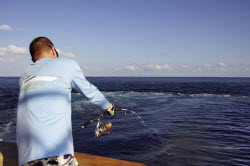 This season it was one of the crew’s goals to catch a marlin on a spinning rod using the tease-and-switch technique. We spent the first couple of days trying to master the technique of pitching baits using a spinning reel to the smaller cousin of the marlin, the sailfish – a perfect fish to learn on before the main event.
Then came the time we had all been waiting for: an amazing window of flat-calm seas and a seamount that was firing with large numbers of blue marlin. It was time to go and chase our goal.
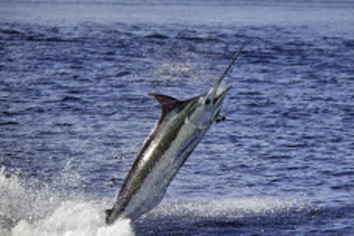
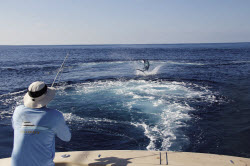
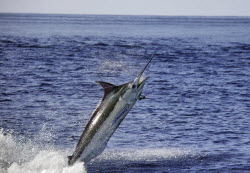
On this particular day in Costa Rica we ended up catching and releasing three blue marlin from 90kg to 145kg, all on spinning gear. Although NZ blues tend to be much bigger than this, the techniques trasfer to our similar-sized striped marlin. Consequently, my entire view and ‘spin’ on game fishing has changed. Sure, there will always be a place for the traditional techniques and tackle for catching billfish, but after using a medium-weight spinning outfit loaded with braid, everything was taken to a whole new level, completely changing the game.
Picture this: you pitch the bait to an angry, teased-up marlin. You now have direct contact with the fish and the bite. As you are using braid with a very, very small diameter, when the fish turns and runs the line cuts through the water like a knife. Consequently, the belly in the line is almost non-existent, so when the fish starts jumping, the line is direct from the rod to the fish, with less in the water. Reduced line drag on the fish means the runs are incredible, and the entire time you have a direct line to the fish, enabling you to feel all the movements, power and speed. The only way I can try to describe this scenario is to say it’s like being towed on roller skates behind a Formula 1 racing car, and somehow never being able to fall off.
The tackle
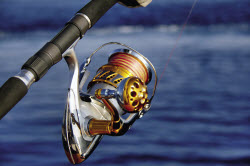 On this particular mission the rod we used was the new Jigging Master Evolution Titanium 400g Spinning Jig rod. We chose this because it was short (1.6 metres) and gave us the leverage just in case the marlin sounded and we needed to put some heat on it to bring it to the surface. We thought its parabolic action would absorb some of the shock on the non-stretch braid when the fish jumped or started head shaking while trying to dislodge the hook.
We paired this rod up with the Shimano Stella 20000 spinning reel – an amazingly high quality reel that can handle up to 20kg of smooth drag and holds 450m of PE8 (37kg) braid (450 metres of line is the absolute minimum required when targeting blue marlin).
The leader is in two parts: the first four metres of 130lb wind-on leader are connected to the braid with a PR knot, and then tied onto a high quality swivel connected to a further four metres of 250lb leader. At the business end of the leader we snelled on a circle hook.
The circle hook is a very important ingredient, as once it has found a hold it seems to hang on better than a ‘J’ hook. Since there is no stretch in the braid and it is so thin compared with monofilament nylon, there is not the usual belly in the line to maintain pressure on the hook and keep it lodged firmly in the correct place.
The circle hook works well, especially when the fish starts jumping and changing direction, times when it’s easy to be left with loose line.
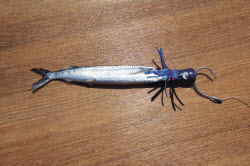
The bait we used was a ballyhoo (garfish) with a small chugger head stitched in front of it, attached to the circle hook with rigging floss. A small jack mackerel would be a great substitute.
The hook-up
 This needs to be practiced and discussed with the crew before just charging into a hook-up. Our plan was to run four teasers, two per side, knowing that the fish would be teased on one side, so we’d already have cleared two lures from the water before hooking the fish, leaving just two to clear after the hook-up.
Before the fish bites, it is all pretty standard tease-and-switch stuff: tease the fish up, place the bait in the correct place, and get the teaser out of the water quickly. Then comes the moment of difference: we have a bail-arm to contend with when the fish strikes and runs. We call the technique we’ve adopted ‘double clutching’: lift the rod high to present the bait, bail-arm open with your hand over the spool to stop line peeling off. When the fish strikes, quickly lower the rod tip with your hand clear of the spool, which should be spilling line freely. Then, when the fish turns and runs, lift the rod again, still with the bail arm open, before dropping the rod tip very quickly to provide a split second’s worth of slack line, allowing you to close the bail arm (the drag has to be set very light to assist with engaging the bail-arm). Tighten the drag knob to set the hook.
The two main things to master are dropping the rod tip quickly and closing the bail arm, and knowing how many turns of the drag knob are needed to ensure the correct drag pressure is set.
Our first hook up was intense, and with that feeling of not really knowing what was going to happen, it was like catching my first marlin all over again. However, while I might have got my marlin virginity back once more, man, did I lose it fast!
The fight
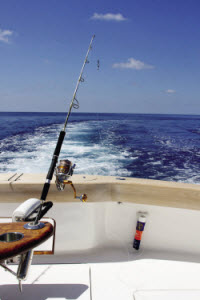 The only way you’re going to catch a blue beast on spin tackle is by adopting ‘aggressive driving’ or what we call ‘transmission fishing’. Having only 450m of line on a marlin gives you no room to sit around, have a cup of tea, clear the gear, and then work out which way to drive. The second the fish is hooked, the skipper has to make an instant decision whether to gun the boat forward or go into a turn and chase the fish. The remaining two teasers can be cleared while manoeuvring.
During our fights we lost no more than half a spool of line – it was amazing having an angry fish so close to the boat. We also had to exercise an element of caution, because marlin can be very unpredictable and will change direction without notice. In all the fights we had, the marlin seemed to spend a lot more time jumping and crashing around on the surface than usual, and we think this is due to the reduced line pressure that’s normally created by a belly in the nylon line – something that doesn’t occur to nearly the same extent with the much thinner braid.
We did not use gimbal belts, as they are too restricting: the rod needs to be lowered or bowed when the fish jumps – or, if the fish takes to the air and is coming towards you, the rod has to be lifted quickly and any slack line wound in. Crazy directional changes by the fish means the rod has to be put at all sorts of angles, just like light tackle fishing.
Once we (and the fish) were under control, the rest of the fights were comparitively normal. The first four metres of the leader had to be pinched because it was only 60kg, but once the last four metres were in reach the mate could take wraps to subdue the fish boatside.
Add a bit of spice
 This may not be for everyone, but if you have caught a few already and want to add a bit of spice to your marlin fishing, or you are a top-water or jigging junkie and want to try something else with your equipment, then give it a go.
Personally, I feel as if I’ve just had a game-fishing mid-life crisis, and traded in my big, old, heavy game outfit in for a new, prettier, lightweight spin version. Better still, I can use the rod for jigging and the reel for top water fishing as well.
 |
This article is reproduced with express permission of Originally published in New Zealand Fishing News |
Recent Forum Posts Visit Forum

Manukau Harbour & West Coast fishing
in Fishing Reports5 hours ago
smudge
Just a heads up. Sunday through to Tuesday next week is looking ok for over the coast. at this stage. If it is fishable I will...
Knife sharpeners
in The Briny Bar5 hours ago
smudge
I'm a big fan of Jason Abbot. A real down to earth approach. My son is a butcher and can put a mean edge on a...

Wanted to Buy
in Buy Sell Trade or Exchange8 hours ago
Mc Tool
https://www.fishing.net.nz/forum/forum_posts.asp?TID=140153 Doin' it ...
Trailer wheel clamp
in The Boat Shed13 hours ago
610gc
Thanks team ill give that a goif that doesn't work is the a better option of the wheel clamp that people recmend...

Shane Jones
in Fisheries Management33 hours ago
Pcj
Taking my limit. Not high grading legal it comes home...

Foton tunland v9
in The Briny Bar79 hours ago
Ho Dee
not fishing related and delete if required but was wondering if any has one of these or someone who has just wanting so e real world...
Bluefin Tuna at the cavs.
in The Briny Bar126 hours ago
smudge
Despite my years of fishing I haven't really fished many places, my focus has always been on Auckland's west coast and out toward Great Barrier. I...
Casting gloves
in Popper and Topwater Fishing171 hours ago
Mc Tool
100 bucks for a lure 😬. Watching one of them flying over the horizon without the line attached would be " character building " for sure...
I thought Id post some nice photo's , join...
in The Briny Bar222 hours ago
Alan L
That is a very cool pic Krow.The Far North is very cool, the Far far North even cooler. Mint looking day.Alan...

Mc Tools berley mincer
in The Briny Bar230 hours ago
SaltyC
Good size, they scrap well. Got an 18kg one up in Vava'u back a few years ago fishing off squeaky Going's boat. That was quite a...
Popular Articles

Softbait Fishing - Part 1 - gear selection
John Eichlesheim writes an article about selecting the right equipment for softbait fishing... Read More >
Softbait fishing Pt 2 - tips and tricks
Techniques, tips and tricks of softbait fishing – getting the most from your soft baits.... Read More >

Surfcasting - setting yourself up
Gary Kemsley helps sort out the necessary gear for intending surf fishers.... Read More >

Squid - How to catch them
Squid fishing is a rapidly growing aspect of fishing - Paul Senior shares some hints and tips to get started.... Read More >
Fishing Reports Visit Reports
Outer Hauraki Gulf Fishing Report 17/09/26
Spring wind the handbrake. Spring is starting to make its presence felt in the outer... Read More >
Top of the South Fishing Report - 17/09/26
Early snapper in Tasman Bay. Well, spring is finally here, and the days are getting... Read More >
Bream Bay Fishing Report - 17/09/26
Good snapper catches reported. After Tangaroa turned off the fish tap for a month or... Read More >
Bay of Islands Fishing Report - 17/09/26
Pacific bluefin tuna for the lucky few. The last fortnight has seen more fishable days... Read More >
Comments