
Captain Rick Pollock: Part 2
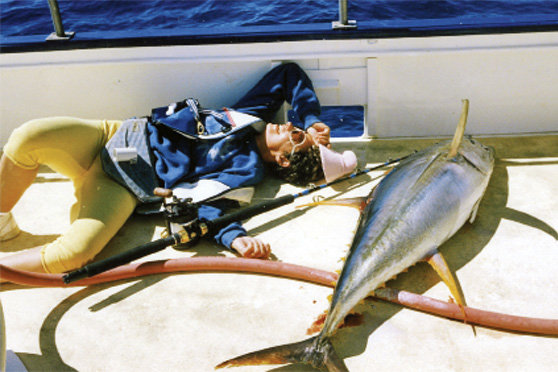
In Part 1, writer Mark Kitteridge spoke to New Zealand’s renowned charter fisherman, Captain Rick Pollock, about the early years prior to his arrival here. In Part 2, Mark continues to reveal the huge impact this man has had on the local sport-fishing scene..
MK: When your fellow countryman Zane Grey came over many years earlier, he ruffled a few of the locals’ feathers with his radical techniques, beliefs and ideas. How did the Kiwi charter operators react to you?
RP: Not too badly at all really, probably because there weren’t many others in the area at the time, reducing the potential for conflict. In fact, there was really only Colin Warrington, who I got on with well – and it was the same for the Tauranga charter fleet. However, a bit later on, when overnighters started to prove very popular for our operation (something unheard of in this country prior to my arrival), a Bay of Islands skipper said to me: “You’ve created a monster in this country, and now we all have to live with it!”
MK: What aspects of the local BoP fishery excited you most early on?
RP: The yellowtail kingfish – we found so many big ‘dumb’ ones at White Island! As already mentioned, the first yellowtail I ever brought on board here was 10 kilos heavier than the biggest I’d ever encountered before in the US. These big fish weren’t very fussy either. Early on we generally made three big kingfish baits cut from skipjack and albacore tuna: the two fillets, and the frame. Not surprisingly, the frames generally attracted the biggest fish.
The typical rigs used were not very subtle: 200lb wire trace connected to a 10/0 game hook. One of my anglers even caught a nice one on a trace made from dog-leash chain!
Obviously, a lot of things have changed since then, but I’m very proud of the fact that kingfish remain abundant in White Island to this day. I believe this is due to the widespread adoption of the Voluntary Code of Practice, a set of guidelines designed so kingfish have a better chance of surviving following release or if they get away during the fight. In particular, the code ensures the kingfish reach breeding maturity, so new recruits are always coming through to bolster the overall population. That’s why we never take any kingfish under a metre long.
In fact, even the NZ Sport Fishing Council supports these recommendations and won’t recognise any kingfish measuring under a metre, for weighing.
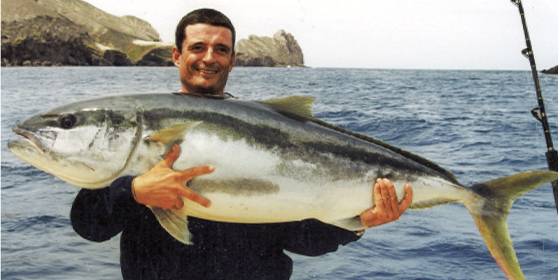
Scott Lloyd-Jones hefts one of many large kingfish caught aboard Pursuit over the years.
MK: You’ve been responsible for, or played a significant part, in pioneering several sport-fishing concepts, techniques and tactics that hadn’t been seen or used here before. You’ve already mentioned introducing multi-day stay-away trips; what other contributions have you made or helped introduce that turned out to be game-changers in those early years?
RP: I guess livebaiting for kingfish came first. As mentioned earlier, we initially used the skipjack and albacore tuna caught while trolling our way over to good effect, creating three good cut baits from each fish. However, this all changed with the introduction of overnight charters, as trolling for tuna was no longer the most obvious option available to us. That’s when having a live-bait tank on board (a legacy of my earlier times spent charter fishing in the States) came into its own and soon proved invaluable. We could now catch a bunch of mackerel and keep them alive for extended periods of time. Better still, we discovered that flying fish could often be scooped up at night, especially during the warmer months, augmenting our bait supply.
As an aside, we also used primitive forms of baitfish flies to catch the mackerel. These rigs lacked the lumo beads, Krystal Flash and fluorescent qualities of today’s sabikis, with the long-shanked hooks simply adorned with alternating strands of red/yellow yarn. Mimicking tube worms, which you often see being chowed down on by mackerel at night, they did the trick nicely. Eventually, the Japanese-made ones took over and made these obsolete. I’ve still got many of them in packets I brought over in 1978!
As can happen, one thing often led to another in those early years: in the process of catching fresh bait at White Island, we also discovered that some great kingfish-catching sessions could occur during the hours of darkness, especially when the flying fish were around in good numbers. Anglers, therefore, had to be very disciplined at times, or risk having little or nothing left to use the following day!
Unsurprisingly, those livebaits that did survive through to the daylight hours proved incredibly effective – and not just on kingfish: we frequently tangled with resident White Island bass early on, with two or three big specimens around 50-70kg featuring amongst our catch some days. As you can imagine, this scenario could not go on forever, and I reluctantly put up my hand for virtually eliminating these fish from White Island’s nearby surrounding waters.
I also helped the early jigging scene along, due to the fact I’d bought a heap of Salas metal jigs over with me. These lures came in a wide variety of shapes, weights and colours, and all were armed with a large treble hook hanging off the rear.
I can still remember the looks from my customers upon suggesting they try a jig, with many looking extremely dubious and declaring: “Kingfish won’t want to eat metal!”
But, of course, most proved extremely effective on the very naive White Island kingfish (and, later on, yellowfin tuna), resulting in some great catches and many enthusiastic converts.
However, it would be wrong of me to claim I was first to try them out here, as around the same time there were some very clued-up Aussies who used to participate in the Bay of Islands Swordfish Club International Yellowtail Tournament. These guys were well ahead of Kiwi anglers when it came to innovative techniques: they came equipped with specialised jigging outfits, and Australian-made lures called Irons hanging off them.
Next came the yellowfin tuna. As I’d had previous experience with these exhilarating, stubborn fighting, and often exasperating fish, I knew that modest-sized trolling lures (the Zuker ZTWG and ZTWF ranges are great examples) could be very effective on them. Interestingly, they’re still just as lethal on tuna today, many years later.
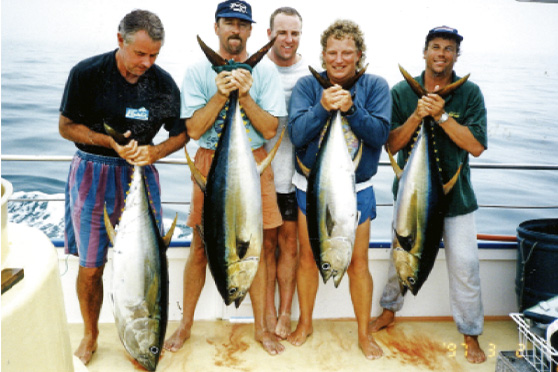
A successful end to a quadruple hook-up on yellowfin on light tackle (8-15kg).
Which brings me to outriggers, and why I’ve never had them fitted. I’ve always felt that they’re great for flying underwear and bras, but they can also be cumbersome and tend to get in the way of anglers fighting big fish on walk-around vessels like mine.
While there’s no doubt they might well have benefitted my anglers’ fishing success at times, in general, we did pretty well without them. There was one hurdle to overcome though: how do you get all your anglers fishing when there are only three rod holders spread across the stern? The answer involved adding two lanyards to the stern railing in between the rod holders. Tied off short with a clip at both ends, these were clipped to the trolling outfit’s harness lugs then left free-swinging. They really paid off, leading to greatly improved catches, but I must admit that some anglers needed to be convinced they were safe!
Another addition also proved worthwhile: adding a shotgun lure from the upstairs wheelhouse. We called this the ‘Moose’ position on Pursuit, and it was responsible for hooking up a heap of wonderful sportfish of all species. It was also a system that cost us in missed potential records though, because the rapidly unloading outfit had to be passed down to the waiting angler, immediately disqualifying the catch from ever being a legitimate record.
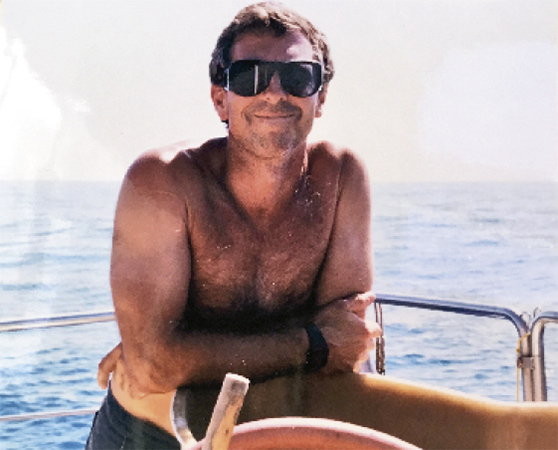
Capt. Rick Pollock overlooks Pursuit's large livebait tank.
Eventually, well-known angler Sam Mossman suggested using an up-rigger with a tag-line, allowing the process to be done legally. This worked okay but was generally only deployed when fishing to IGFA rules was imperative, such as when fishing some contests or chasing records.
Later on, we added live-baiting, jigging and cubing to our yellowfin repertoire. These techniques were made possible once we found out that we could quietly move onto a ‘meatball’ of baitfish (usually pilchards and/or anchovies massed together densely in response to pressure from nearby predators) and have them cluster around our hull for protection, especially around the prop and rudder. This meant we became the centre of the baitfish and tuna activity at times, sometimes for hours on end!
Initially we used whatever we could scoop from the meatballs – generally anchovies but pilchards too sometimes. Because they tended to be quite small, the skipjack tended to hoover these morsels down before the yellowfin had a chance, so we made ‘Christmas trees’ – several baitfish threaded up the trace with three or four more dangling off the hook. However, it didn’t take long for us to realise that mackerel made much better baits, and fishing the bait meatballs really took off after that.
In a similar vein, we knew that yellowfin frequently accompanied dolphins, so on days when no work-ups were happening, if we saw pods of dolphins, we would get up ahead and drop some livebaits in. It worked surprisingly often.
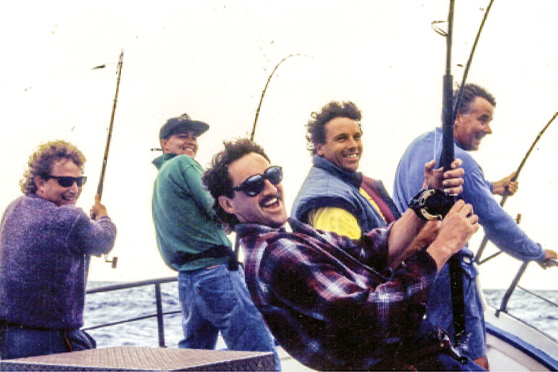
A five-way hook-up on yellowfin - some days the work-ups lasted all day.
It could be frustrating to run out of bait in the work-up situations, but we soon found out that tuna would take jigs if deployed correctly. Unfortunately, not many of our anglers had the skills to do this, but I had some great deckies who did!
However, we did have some pretty competent anglers on board at times, too, and it was great to be able to pass on what we were learning; in fact, I can remember demonstrating to you and your friends how to jig for tuna on an early trip, Mark!
(MK: I vividly remember the time, too: we’d already hooked a yellowfin on a trolled lure, when Rick grabbed a pre-rigged jigging outfit – a freespool of some sort – and, with a smooth action born of repetition, hurled it out. A 20- to 30-second pause allowed the lure to descend, before being wound in fast, occasional sharp rod lifts making the retrieve more erratic. Just moments later Rick gave a grunt and lifted the rod, causing it to bend deeply. Then line started smoking from the reel. “Okay, who wants it?” he said with a grin!)
The only disadvantage was the treble hook, which was prone to bending out or losing hold. So I swapped them over to Siwash-style hooks; these have straight points and barbs that are parallel to the shank, and also take better hold, but can still be prone to occasionally straightening.
MK: And of course there was cubing for tuna, too, Rick! That was another skill I learned while on your boat and which proved useful for a wide variety of fish all over the Pacific for me! It seems weird that it works so well – dropping a trail of little ‘cubes’ is a far cry from the livebaits and imitations generally deployed, yet it can be more effective than anything else!
RP: Yes, absolutely! While the basic method of chunking didn’t change much when translated from overseas to our waters, I believe we increased the number of hook-ups enjoyed by our anglers here by recommending they use lighter fluorocarbon leaders – typically just 50-80lb – and reducing the hook size so it was easily hidden within the ‘loaded’ chunk.
Also, we used to have a lot of problems with birds eating the chunks, preventing the chunk trail from developing and attracting the fish in. Our solution was simple (and I’m quite proud of it): by dropping the chunks close to the boat’s leeward side, they were forced downwards and under the hull by the moving boat. Then, when they emerged on the other side, they were too deep to be easily grabbed by the birds, leaving them free to drift away and attract the always hungry tuna in for our anglers.
MK: Those yellowfin were amazing. What do you think happened to them?
Their sudden disappearance came as a massive shock and disappointment as they were a highlight of each new season.
RP: It was a bit like the American buffalo roaming around in Wild West times: the early inhabitants thought those majestic beasts were so abundant they could never be wiped out – but they were. I believe the massive purse seine boats working the South Pacific waters are responsible for the yellowfin’s demise here, thanks to their deployment of electronically-monitored FADs. Unfortunately, this method has proved extremely efficient.
|
|
This article is reproduced with permission of |

Recent Forum Posts Visit Forum

Shane Jones
in Fisheries Management1 hour ago
smudge
Who else do we have? 100,000 rec fishers all wanting something different? Ohhh and 900,000 that couldn't care less....

Trailer wheel clamp
in The Boat Shed10 hours ago
Mc Tool
either crc long life or 556 marine are way better ...

Foton tunland v9
in The Briny Bar25 hours ago
Ho Dee
not fishing related and delete if required but was wondering if any has one of these or someone who has just wanting so e real world...
Bluefin Tuna at the cavs.
in The Briny Bar72 hours ago
smudge
Despite my years of fishing I haven't really fished many places, my focus has always been on Auckland's west coast and out toward Great Barrier. I...
Casting gloves
in Popper and Topwater Fishing116 hours ago
Mc Tool
100 bucks for a lure 😬. Watching one of them flying over the horizon without the line attached would be " character building " for sure...
I thought Id post some nice photo's , join...
in The Briny Bar167 hours ago
Alan L
That is a very cool pic Krow.The Far North is very cool, the Far far North even cooler. Mint looking day.Alan...

Mc Tools berley mincer
in The Briny Bar175 hours ago
SaltyC
Good size, they scrap well. Got an 18kg one up in Vava'u back a few years ago fishing off squeaky Going's boat. That was quite a...

Out with the "Twelves"
in Fishing Reports229 hours ago
Pcj
I should be able to get out end of October. The nephew been out virtually every weekend over winter and has done well. It seems the...
Manukau Harbour & West Coast fishing
in Fishing Reports237 hours ago
smudge
Nice work Schecter, I think snapper may be around sooner than you think. Well I am hoping so...

Whangarei Harbour report.
in Fishing Reports669 hours ago
krow
180 +m is where I've had to be lately. A lot less low foul around these parts and some of it shallower that looks like Tarakihi...
Popular Articles

Softbait Fishing - Part 1 - gear selection
John Eichlesheim writes an article about selecting the right equipment for softbait fishing... Read More >
Softbait fishing Pt 2 - tips and tricks
Techniques, tips and tricks of softbait fishing – getting the most from your soft baits.... Read More >

Surfcasting - setting yourself up
Gary Kemsley helps sort out the necessary gear for intending surf fishers.... Read More >

Squid - How to catch them
Squid fishing is a rapidly growing aspect of fishing - Paul Senior shares some hints and tips to get started.... Read More >
Fishing Reports Visit Reports
Outer Hauraki Gulf Fishing Report 17/09/26
Spring wind the handbrake. Spring is starting to make its presence felt in the outer... Read More >
Top of the South Fishing Report - 17/09/26
Early snapper in Tasman Bay. Well, spring is finally here, and the days are getting... Read More >
Bream Bay Fishing Report - 17/09/26
Good snapper catches reported. After Tangaroa turned off the fish tap for a month or... Read More >
Bay of Islands Fishing Report - 17/09/26
Pacific bluefin tuna for the lucky few. The last fortnight has seen more fishable days... Read More >
Comments