
Can we eat that??? Part Two

At a time when financial pressures are starting to strain some household budgets, and the price of food (including fish) seems to be increasing relentlessly, it is a good time to get past the old standards and continue our look at alternative table-fish.
For most, harvesting high-quality kaimoana for the table is almost indivisible from the other motivations for fishing. With the high price of store-bought fish being further pushed by the steadily rising cost of fuel, this nutritious dish is starting to get into the 'luxury food' bracket - something that some families can no longer afford, unless they catch their own.
With the increasing importance of 'bringing home a feed', it is timely to consider the table qualities of species other than those traditionally offered. When the popular target species are not playing ball, a wider approach will make it easier to put fish on the table.
Parore
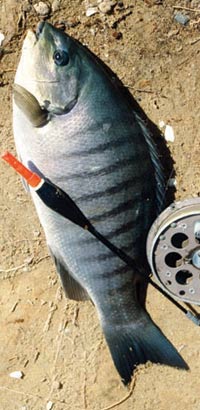 This member of the drummer family is most common in the northern half of the North Island, but is seen as far south as Cook Strait. Across the ditch they are known as luderick or blackfish and are popular with recreational anglers, but despite being common here they have never really caught on as a mainstream sportfish.
This may be partly because they are largely herbivorous and specialist techniques are (sometimes) needed to catch them; partly to do with their unsavoury habit of hanging around sewerage outfalls (which has seen them saddled with the less-than-flattering name of 'shitfish' in some areas); and partly because, unless they are handled correctly, they don't taste too flash - more of this in a minute.
Common in estuaries (especially around wharves) and along rocky coastlines, they have a bit of a Jekyll and Hyde mentality. Although they feed mostly on several species of seaweed and algae, they will also take other food items such as shellfish, crabs, shrimps and worms. I have had them feeding in berley trails of minced fish, caught them on tiny fish baits, and they are certainly susceptible to shellfish like tuatua. You might liken them to a vegetarian who weakens occasionally on smelling frying bacon.
To catch parore, a small bait of shellfish fished off a wharf is one way to go. I have caught a few on flies, too - rough-dubbed nymphs in both green and grey colours. A year or so ago, Bay of Islands writer Craig Worthington wrote a piece on catching them using frozen mixed veggies from the supermarket for bait. And there is always the Australian method of using weed (sea lettuce on open coasts or green hair-like algae in estuaries) under a float which, although seldom used here, works very well in local waters.
The trick with preparing parore for the table is to kill them and fillet them immediately, being sure to remove the black lining from the stomach wall. This taints the flesh if allowed to remain. These fish are common in the north and easily accessible to shore fishermen.
Maomao
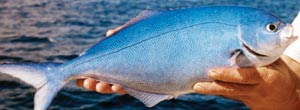 Most people think that maomao come in three colours: pink, blue and grey. In fact the pink maomao is a member of the perch family, while the blue maomao and its grey cousin, the sweep, are members of the drummer family. The three species are all midwater and surface plankton feeders. All three species are most common in the north half of the North Island.
Having tried all three species on the plate, many years ago, I found blues to be good, but didn't like pinks or sweep. However, the pinks I tried then may have been poorly looked after (you need to chill them quickly), as I recently smoked some and found them to be truly excellent with, like the blues, a very high oil content.
That just leaves the sweep, which I am still not sure about; after all, I was wrong about pink maomao for all these years.
All three species respond to berley and are easily caught on light tackle and small baited hooks with minimal weight. Of the three, pink maomao are the most aggressive and will regularly hit small jigs and soft-plastics, but I have caught a few blues on small flies.
Blues, in particular, are great fighters on light tackle (1-3kg), especially the XOS versions found around White Island. These fish are often available even when the more popular species are not on the bite, and can provide a meal and some light-tackle fun when times are tough.
Rays bream and rubyfish
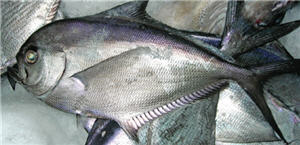 Rays bream are a common by-catch when deepwater fishing for hapuku, bluenose and so on. There have been a lot of them caught in the Bay of Plenty and Cook Strait regions in recent years. Freshly caught, they look as if they are made from stainless steel, with a purple back - something that the guys at Weta Workshops might have dreamed up.
These mid-water feeding fish grow to about two kilos and are so aggressive they will even nail knife jigs and big 'puka baits meant for much larger fish. If you see big clouds of mid-water sign over deep reefs on your sounder, it may well be rays bream.
They are white fleshed and excellent eating, although narrow in the body - the smaller specimens just about need to be filleted with a scalpel.
Rubyfish are another mid-water species that are encountered in similar situations to rays bream, especially in the Bay of Plenty. They are pretty fish and will take a modest-sized cut bait in mid-water, especially if rigged on a 'snapper snatcher' or similar.
Their flesh looks much like that of a kahawai, and they are a reasonable table fish, but better smoked.
Frostfish and gemfish
Like the last two, frostfish and gemfish are usually a deepwater bycatch, especially in the winter months. Both will take jigs as well as baits, and while there is a passing resemblance between them, the frostfish is our member of the cutlassfish family, while the gemfish is a snake mackerel, related to barracouta.
Frosties have skin like chrome and no scales. For some reason they sometimes cast themselves ashore on calm, frosty nights, and there are those who check the beaches at dawn to beat the seagulls to this top eater.
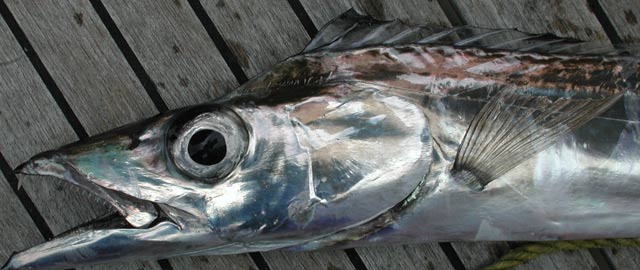
Frostfish are so slender that it is not feasible to fillet them - I just cut the body into sections, dust them in flour and fry them like a flounder. The flesh is magnificent, with a rich, creamy flavour, but it is very dense, so needs to be cooked longer at a lower temperature than usual. Pick it off the frame with a fork.
Sometimes I have found frostfish to have parasitic infestations like barracouta, and I think that the answer to this is to head and gut them immediately on capture, and then chill them quickly. This delicious fish is well worth the effort.
Gemfish are strong, aggressive predators that look like a stocky barracouta with a big eye. One difference is the pelvic fins - 'couta have a modest pair, but they are almost absent on gemmies, reduced to a small filament.
Gemfish are free of the heavy parasitic infestations often seen in barracouta, and although the flesh seems mushy and indifferent when filleted, they are magnificent when smoked - one of the best.
In passing, barracouta are actually not a bad eater, and one of the most common species found in ancient Maori middens. They are caught commercially and are probably, more than any other, an overlooked tablefish - if you can deal mentally with the worms in the flesh (which I can't.)
Trevally, kingfish and kahawai
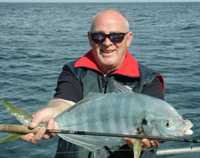 These species are all excellent table-fish, as well as being great sport-fishing species. I actually prefer eating trevally or smaller kingfish to snapper. They also make great sashimi. Bigger kingfish usually end up in the smoker.
Some people consider kingfish to be a 'dry' fish, but I don't agree. I think this comes from some people cutting kingfish into 'steaks' vertically through the backbone. This leaves a very short fibre in the steak, and when you drop it in the pan or on the BBQ, the heat goes on the bottom, driving most of the moisture straight out the top, leaving the fish 'dry'. If you fillet kingfish then cut the fillets in long diagonals, the long fibres hold the moisture much better. Trim off the red muscle from the flesh before cooking.
Kahawai are also a great table-fish if you like a good strong flavour in your fish and they are treated right. Bleed them on capture by cutting the throat-latch, and then ice them down. I like to cook them in garlic butter or smoke them.
Last Resorts
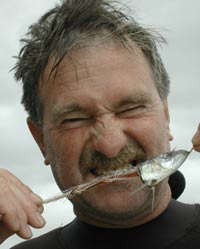 As a last resort, you can always eat the bait! A few years ago I was on a charter to the Three Kings with Bruce Martin on Predator. We got pinned down by weather for a few extra days, which put a bit of a strain on the food supplies. As we had been light-tackle marlin fishing, there was no take-home table-fish on board either, and on our last night, in passage back to Houhora, dinner was a bit problematic.
Our deckie, for all his faults, was a damn fine cook, and proud of the excellent meals he turned out - no tinned or dried rations from him. I was unaware that the cupboard was bare when I noticed him digging around in the live-bait tank, and paid little attention, thinking he was releasing excess baits - big Three Kings koheru - that we no longer needed.
When dinner was served, the starter was sashimi koheru, and the main dish curried koheru on rice. It tasted great, but I never miss an opportunity to rib Bruce about the time he fed his charter the bait!?
 |
This article is reproduced with permission of |
Recent Forum Posts Visit Forum

Shane Jones
in Fisheries Management1 hour ago
Pcj
But reality is maybe 4 from legasea and the NZSFC .Rather than asking what fishos want they blindly go ahead with their own ideas and...

Trailer wheel clamp
in The Boat Shed13 hours ago
Mc Tool
either crc long life or 556 marine are way better ...

Foton tunland v9
in The Briny Bar28 hours ago
Ho Dee
not fishing related and delete if required but was wondering if any has one of these or someone who has just wanting so e real world...

Bluefin Tuna at the cavs.
in The Briny Bar74 hours ago
smudge
Despite my years of fishing I haven't really fished many places, my focus has always been on Auckland's west coast and out toward Great Barrier. I...
Casting gloves
in Popper and Topwater Fishing119 hours ago
Mc Tool
100 bucks for a lure 😬. Watching one of them flying over the horizon without the line attached would be " character building " for sure...
I thought Id post some nice photo's , join...
in The Briny Bar170 hours ago
Alan L
That is a very cool pic Krow.The Far North is very cool, the Far far North even cooler. Mint looking day.Alan...

Mc Tools berley mincer
in The Briny Bar178 hours ago
SaltyC
Good size, they scrap well. Got an 18kg one up in Vava'u back a few years ago fishing off squeaky Going's boat. That was quite a...
Out with the "Twelves"
in Fishing Reports232 hours ago
Pcj
I should be able to get out end of October. The nephew been out virtually every weekend over winter and has done well. It seems the...
Manukau Harbour & West Coast fishing
in Fishing Reports240 hours ago
smudge
Nice work Schecter, I think snapper may be around sooner than you think. Well I am hoping so...

Whangarei Harbour report.
in Fishing Reports672 hours ago
krow
180 +m is where I've had to be lately. A lot less low foul around these parts and some of it shallower that looks like Tarakihi...
Popular Articles

Softbait Fishing - Part 1 - gear selection
John Eichlesheim writes an article about selecting the right equipment for softbait fishing... Read More >
Softbait fishing Pt 2 - tips and tricks
Techniques, tips and tricks of softbait fishing – getting the most from your soft baits.... Read More >

Surfcasting - setting yourself up
Gary Kemsley helps sort out the necessary gear for intending surf fishers.... Read More >

Squid - How to catch them
Squid fishing is a rapidly growing aspect of fishing - Paul Senior shares some hints and tips to get started.... Read More >
Fishing Reports Visit Reports
Outer Hauraki Gulf Fishing Report 17/09/26
Spring wind the handbrake. Spring is starting to make its presence felt in the outer... Read More >
Top of the South Fishing Report - 17/09/26
Early snapper in Tasman Bay. Well, spring is finally here, and the days are getting... Read More >
Bream Bay Fishing Report - 17/09/26
Good snapper catches reported. After Tangaroa turned off the fish tap for a month or... Read More >
Bay of Islands Fishing Report - 17/09/26
Pacific bluefin tuna for the lucky few. The last fortnight has seen more fishable days... Read More >
Comments