
Boating Basics

Pete McGregor shares his tips and trips for staying safe on the water...
While eating breakfast on my deck recently, I observed a bloke on a jetski hooning back and forth in front of our property. Not only was the noise annoying, but he was also really close to the shore. The yachts moored in the blind channel in front of us are exactly 200 metres from shore. I know this because of my fishing drone exploits from our jetty using an electric reel that shows distances. This guy was probably only a third of the way out to the first of the moored boats – 60 metres from shore and doing 70km/h easily, his wake smashing against the cliff face. Shortly after, a large diesel-powered trailer boat also roared through about 100 metres from the shore, creating a huge wake.
This made me think about the rules of the sea (and safety on the boat) and motivated me to put pen to paper (or, more accurately, fingers to keyboard!).
The Maritime NZ rules relating to speed
You must not exceed a speed of 5 knots (a fast walking speed) if you are:
• within 200m of the shore
• within 200m of any structure
• within 200m of a boat displaying a diver’s flag
• within 50m of any other boat
• within 50m of a person swimming
on a power boat if any person has any part of their body outside the rails or edge of the deck.
Look ahead
You must keep a good lookout at all times. You are responsible for staying alert for other boats, swimmers, dive boats, kayaks, hazards and obstacles. Keep focused on the water ahead, especially when travelling at speed.
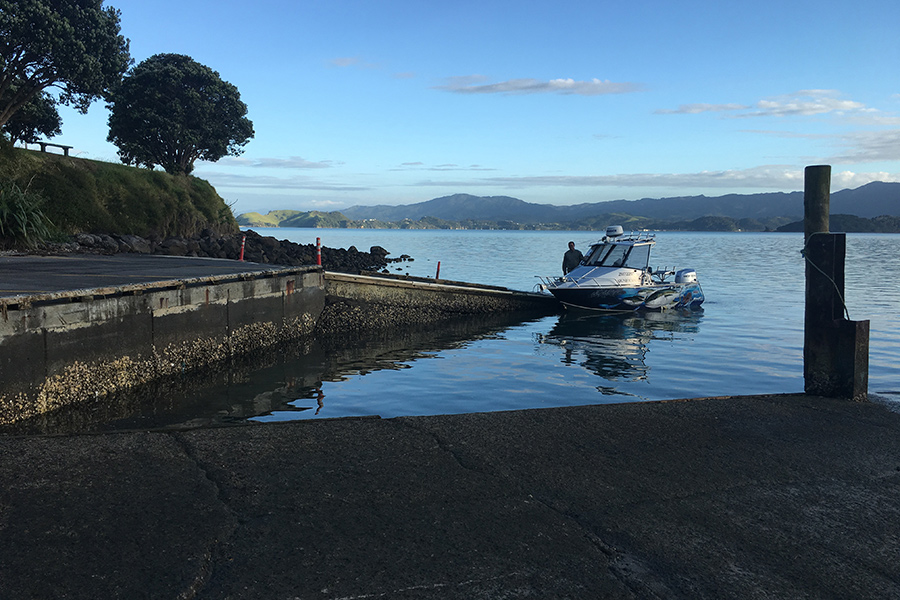
Pete suggests people shouldn’t be complacent when launching or retrieving.
Learn the give way rules
Power boats must give way to vessels on their starboard (or right-hand) side. So, a boat converging on your left-hand side must give way to you. But don’t rely on it! If meeting head-on, give way by turning to starboard (right). Power boats always give way to boats under sail, give way when overtaking and keep clear of large ships.
Harbour or channels
Up here in the ‘middle north’, we laugh during the holidays at the obvious influx of outsiders (read: Aucklanders!) with poor knowledge of the rules of the sea in our harbour. If you are in a channel or harbour, you must:
• keep to the starboard (right) side of any channel
• keep clear of larger vessels that are restricted by channels
• not anchor in a channel or anywhere that could be dangerous to other craft
• stay at least 500m clear when ahead of any large ship
• stay 200m away from the sides and stern of tankers
While diving for scallops is no longer on the menu in my area, there are still divers hunting for crays and spearfishing for kingies and the like. While a diver is below, the dive boat must display the blue and white alpha dive flag. Other boats must keep clear or operate at a maximum speed of 5 knots within 200 metres of boats displaying this flag.
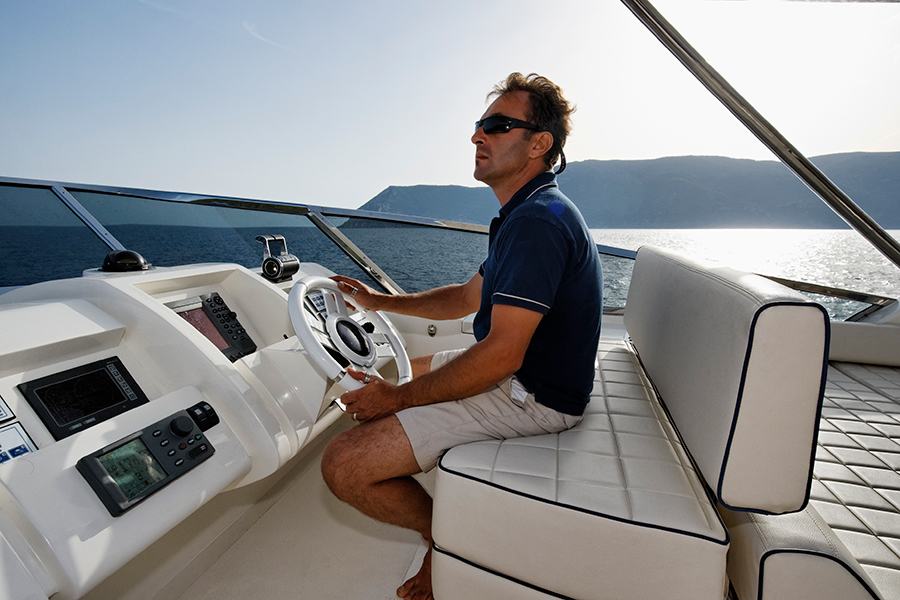
The skipper is responsible for the safety of everyone on board.
Safety on your boat
NZ Coastguard suggests five key rules for boating safely:
1. Lifejackets
Take them. Wear them. Boats, especially ones under 6m in length, can sink very quickly. Wearing a lifejacket increases your survival time in the water. In some marine areas (like the Hauraki Gulf), wearing lifejackets in any boat under 6 metres is compulsory unless the skipper deems it safe to remove them. Lifejackets must also always be worn when crossing bars.
I add another personal rule here: lifejackets are always to be worn on my boat when gamefishing. Modern inflatable lifejackets have been a huge game-changer. They are light, cool and comfortable; there is no reason not to wear one now. Give consideration to lifejackets that will inflate automatically when they go into the water. This could be a lifesaver if the wearer is unconscious.
Also, make sure lifejackets are correctly adjusted for fit. Children should wear specifically designed child lifejackets – never put an adult lifejacket on a child.
2. Skipper responsibility
The skipper is responsible for the safety of everyone on board and for the safe operation of the boat. Stay within the limits of your vessel and your experience. There are legal penalties when a skipper fails to meet the rules and a tragedy occurs.
3. Communications
Take two separate, waterproof ways of communicating so the Coastguard can help you if you get into difficulty. I have a dashboard-mounted VHF plus a floating handheld one. Be aware that handhelds are only 5w, so have a limited range. I keep a laminated copy of the marine VHF channels in all areas in my boat. Learn to use your VHF, do the Coastguard VHF course and make sure you log your trips with them. Apart from anything else, this means that you know it works when/if you need it.
Mobile phones can be an option but must be in a waterproof bag, and obviously, reception at sea is often inadequate. Another communication option is flares, but you must regularly check their expiry date as they have a relatively short lifespan.
EPIRBs are a great safety tool. These, when activated, will advise the authorities of an emergency and provide GPS coordinates for your whereabouts. I have two on my boat – one mounted on the boat and another small personal locater beacon which I keep on my person. I figure if the boat goes down, especially on a bar crossing, I may be thrown out. I wish all lifejacket manufacturers included a facility to attach a personal locater beacon.
4. Marine weather
New Zealand’s weather can be highly unpredictable. Before you go, check the local marine weather forecast and expect weather and sea state changes. Some great phone apps are available: I prefer Swellmap and Windfinder Pro, but my local newspaper, the Northern Advocate, also gives reliable marine weather advice.
5. Avoid alcohol
Safe boating and alcohol do not mix. Things can change quickly on the water, and you need to stay alert and aware. My own policy is to take only one beer for each person when gamefishing, to be consumed on the way home after success (or as commiseration!).
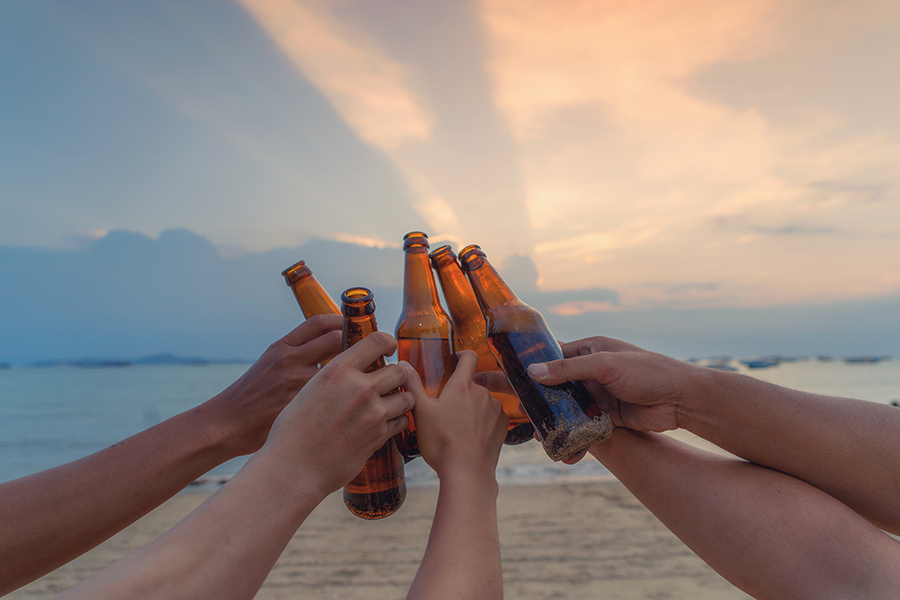
Safe boating and alcohol do not mix.
Some other personal observations
What happens if the skipper has a medical problem, such as a heart attack? Make sure you teach others on your boat how to use the VHF. I have my VHF callsign printed on my dashboard. It’s a good idea to teach others how to display and read the boat’s position on the chart plotter. While on it, teach them how to start the boat, haul in the anchor and drive it! Oh yes, a good rule is always to wear lifejackets while anchored up and fishing… think about how long it takes to get the anchor in and chase down a man overboard.
Boating accidents are like aeroplane accidents. Most happen when landing and taking off! Ensure everyone is holding on before you accelerate. Keep everyone seated and stationary while coming into a jetty. Make them wait until you give the go-ahead before disembarking. Errol Flynn made it look easy to leap off the boat. But all three accidents I have experienced on my own boat have been through people jumping off while it was still coming into a jetty, including falling between the boat and jetty and skidding on the nose on a concrete-topped pontoon. Fair to say I’m pretty hot on this now.
I recommend not using zip wakes or trim tabs when coming in across a bar. They can cause the boat to veer off point if you accidentally come over the front of a wave.
Ensure your boat engine is regularly serviced. I love gamefishing and do many hours a year and thus get my motor serviced every 100 hours. You might only do 20 hours a year, but I suggest you still get it serviced at the start of each boating season. While you are on it, get the mechanics to check and lube your anchor winch and steering system. Ensure your battery (batteries) is charged up and in good condition. If your motor is old, consider an auxiliary motor. But first, try using it to drive the boat – can it move the boat against a current? Can you see forward when operating it? Sometimes a tiller extension is required. Keep a pair of paddles on board.
Regularly check all the safety items on your boat: service inflatable lifejackets, check flares, and inspect ropes. Have a fire extinguisher handy and ensure it is suitable for fuel fires.
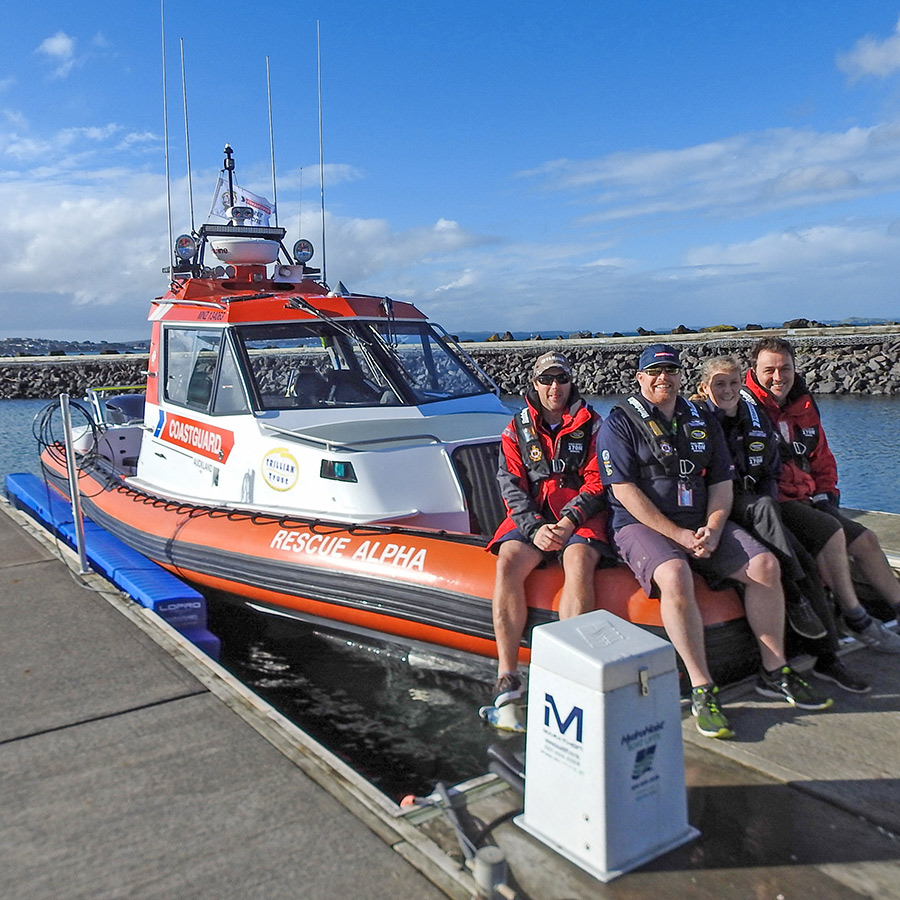
Join the Coastguard; it’s a cheap insurance policy.
I keep a spare set of warm clothes in a vacuum-sealed pack under a bunk – always available should someone take a cold plunge. Weatherproof ponchos and spare hats might also come in handy.
Keep a good quality first aid kit on board, sunscreen, and heaps of fresh water. Bottled fresh water will keep nice and cool if stored under a bunk.
Keep a box of tools onboard. The most important thing is a pair of pliers (keep them lubed so they work, though!). These have a variety of uses but are invaluable should a hook get introduced to a finger (push it through until the barb is exposed, then use the pliers to squeeze the barb closed and it will come back out without too much drama).
Last (but not least), join the Coastguard!
Stay safe out there.

May 2023 - Nick Jones
New Zealand Fishing News Magazine.
Copyright: NZ Fishing Media Ltd.
Re-publishing elsewhere is prohibited
Recent Forum Posts Visit Forum

Trailer wheel clamp
in The Boat Shed2 hours ago
krow
I like the SAS wheel clamp. I've had no issues with the lock....

Shane Jones
in Fisheries Management5 hours ago
Fish Addict
The recreational sector can expect no favours from politicians. They know all too well who butters their bread and it ain't the recs. No different over...

Foton tunland v9
in The Briny Bar5 hours ago
Ho Dee
not fishing related and delete if required but was wondering if any has one of these or someone who has just wanting so e real world...

Bluefin Tuna at the cavs.
in The Briny Bar52 hours ago
smudge
Despite my years of fishing I haven't really fished many places, my focus has always been on Auckland's west coast and out toward Great Barrier. I...
Casting gloves
in Popper and Topwater Fishing97 hours ago
Mc Tool
100 bucks for a lure 😬. Watching one of them flying over the horizon without the line attached would be " character building " for sure...
I thought Id post some nice photo's , join...
in The Briny Bar148 hours ago
Alan L
That is a very cool pic Krow.The Far North is very cool, the Far far North even cooler. Mint looking day.Alan...

Mc Tools berley mincer
in The Briny Bar155 hours ago
SaltyC
Good size, they scrap well. Got an 18kg one up in Vava'u back a few years ago fishing off squeaky Going's boat. That was quite a...

Out with the "Twelves"
in Fishing Reports209 hours ago
Pcj
I should be able to get out end of October. The nephew been out virtually every weekend over winter and has done well. It seems the...
Manukau Harbour & West Coast fishing
in Fishing Reports217 hours ago
smudge
Nice work Schecter, I think snapper may be around sooner than you think. Well I am hoping so...
Whangarei Harbour report.
in Fishing Reports649 hours ago
krow
180 +m is where I've had to be lately. A lot less low foul around these parts and some of it shallower that looks like Tarakihi...
Popular Articles

Softbait Fishing - Part 1 - gear selection
John Eichlesheim writes an article about selecting the right equipment for softbait fishing... Read More >
Softbait fishing Pt 2 - tips and tricks
Techniques, tips and tricks of softbait fishing – getting the most from your soft baits.... Read More >

Surfcasting - setting yourself up
Gary Kemsley helps sort out the necessary gear for intending surf fishers.... Read More >

Squid - How to catch them
Squid fishing is a rapidly growing aspect of fishing - Paul Senior shares some hints and tips to get started.... Read More >
Fishing Reports Visit Reports
Outer Hauraki Gulf Fishing Report 17/09/26
Spring wind the handbrake. Spring is starting to make its presence felt in the outer... Read More >
Top of the South Fishing Report - 17/09/26
Early snapper in Tasman Bay. Well, spring is finally here, and the days are getting... Read More >
Bream Bay Fishing Report - 17/09/26
Good snapper catches reported. After Tangaroa turned off the fish tap for a month or... Read More >
Bay of Islands Fishing Report - 17/09/26
Pacific bluefin tuna for the lucky few. The last fortnight has seen more fishable days... Read More >
Comments