
Boat propellors 101

Most powerboats rely on a propeller to move them through the water. But selecting the right propeller is not always easy, writes John Eichelsheim: each boat is different, engines vary in type, power and torque, while propellers vary in material, diameter, pitch, number of blades and blade profile.
For outboard-powered trailer boats, as with any other vessel, propeller selection plays a major role in overall performance, fuel consumption and engine life.
Most outboard motors are sold with a propeller in place. Boat manufacturers and dealerships work closely with outboard suppliers to ensure a good combination of boat, engine/s and propeller/s. Most manufacturers and dealers are experienced in choosing particular boat-engine combinations and the most suitable propeller. They aim to prop the engine for optimum performance and fuel economy in most conditions and specify a propeller that will meet the needs of most users, most of the time.
But occasionally an owner is looking for more: more top-end speed, more hole shot, more throttle response.
A boat-motor combo that might perform just fine with a particular propeller when it’s lightly laden may not cut the mustard when asked to transport four sport divers and all their scuba gear.
The same may hold true for a boat originally set up for family excursions that’s regularly used to tow skiers and wake-boarders, cross river bars or launch through the surf. In those instances, strong acceleration to get out of potentially dangerous situations is more important than top speed.
The answer is to have two or more propellers that each accommodate a different set of circumstances. Water-skiers regularly change boat propellers to improve their ability to pull skiers out of the water, while boat racers change propellers according to race course conditions, choosing acceleration over speed on tight courses and speed over acceleration on more open events.
Acceleration vs Speed
Fixed-blade propellers deliver either low-end torque or faster top speeds, but you can’t have both. If you use your boat for fishing, cruising and tow-sports, it’s unlikely you’ll find one prop that does all three things equally well.
Propellers are classified according to size (diameter) and pitch, both measured in inches. For a 14 x 19” propeller, the first number designates diameter and the second pitch.
Mercury Marine’s Everything You Need to Know About Propellers manual states that, “Choosing the propeller’s size [diameter] is determined primarily by the rpm at which it will be turning and how much power will be delivered to it [the propeller].”
Propeller diameter is the distance across the circle made by the blade tips. According to Mercury Marine’s Dean Villis, determining the right propeller for a particular boat combines theory, experience and trial and error.
Dean starts with a propeller calculator program which uses Crouch’s Formula to suggest diameter and pitch.
When trying to find the best propeller for a customer, he routinely tests five or six propellers on the water to find exactly the right one.
In general, larger diameter propellers are used on slower boats and smaller diameter props for faster boats. Slow boats running low-revving engines – think displacement craft – tend to swing large propellers, and the slower the revolutions, the larger the propeller can be.
High-speed planing craft, on the other hand, including outboard-powered trailer boats, run smaller diameter props. That said, propeller diameter increases as power increases, which is why a 250hp outboard has a much larger propeller than a 50hp outboard.
Outboard manufacturers recommend a certain diameter propeller for each of their engines and often only offer propellers in a limited range of diameters, so it’s usually propeller pitch (and sometimes the number of blades) people can experiment with.
To quote the Mercury manual, pitch is defined as: “the distance a propeller would move in one revolution if it were moving through a soft solid, like a screw through wood.” For example, a 21-inch pitch propeller would move forward 21 inches in one revolution, a 19-inch 19 inches, and so on.
Propeller pitch determines the torque or ‘pulling power’ available at the propeller. The lower the pitch, the better the hole-shot – acceleration from a standstill – but this comes at the cost of top speed. A lower pitched propeller allows the engine to reach maximum rpm at slower speeds, while a higher pitch means a higher top speed, but slower acceleration.
If you need more speed, a higher pitch is the way to go. However, if you use a propeller with too high a pitch, the motor simply won’t have enough horsepower to turn it adequately, so the revolutions per minute will drop. This is called over-propping, which overloads the engine, causing excessive wear.
Conversely, under-propping – fitting a propeller with too low a diameter and/or pitch – can damage your engine through over-revving. It will also adversely affect fuel consumption.
Ideally, an outboard engine under load should reach the manufacturer’s recommended maximum revolutions at wide open throttle (WOT), usually given as a range spanning a few hundred rpm. The trick is to find a propeller that delivers acceptable acceleration and top speed while still allowing your outboard to reach its recommended revs at WOT.
The choice of propeller material – aluminium or stainless steel – also has an impact on performance.
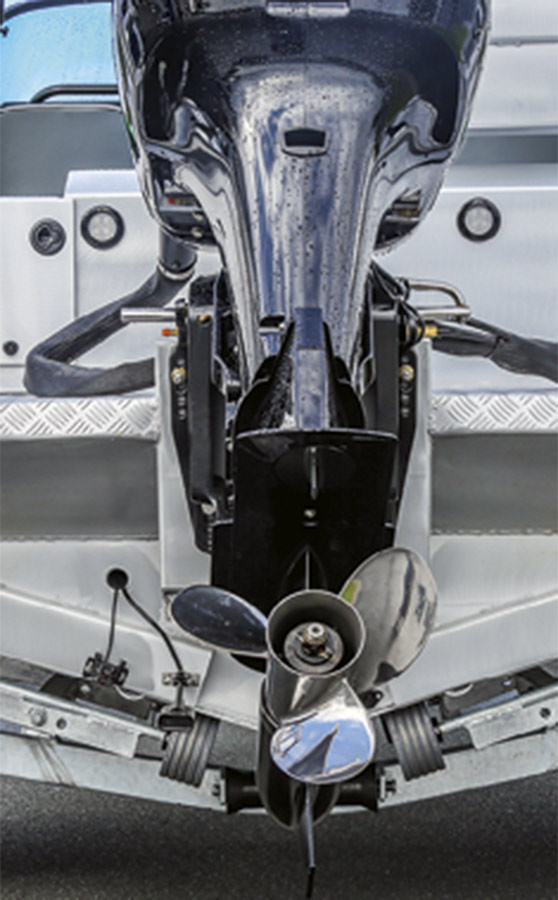
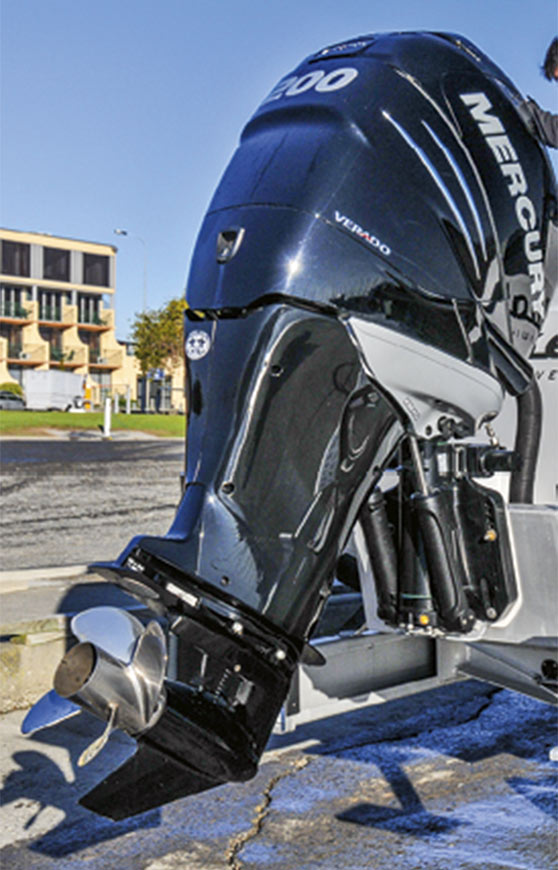
Props are manufactured from alloy or stainless steel - both have their advantages.
In the end, says Villis, it’s a juggling act. A small change in pitch or cup or rake will each have an effect on performance. Two propellers with the same diameter and pitch, but with different cupping, will perform differently.
Three Blades or More?
Most outboards are fitted with three-bladed propellers, which are perfectly adequate for most trailer boat applications, but outboard propellers come in four and five-bladed versions too.
These were developed for modern, high horsepower outboards which tend to be mounted higher up on the transom than smaller motors. With the propellers running close to the water’s surface, the extra blades help to provide bite and stability at high speed.
Honda Marine’s Cameron Burch explains that propellers with extra blades often provide quicker take-offs and hold the boat on the plane at lower revs, which is useful in many boating applications. The trade-off is top-end speed: a good three-blade propeller is normally a couple of knots faster at the top end than a multi-blade propeller of the same pitch.
If your boating includes regularly launching through the surf or negotiating a dangerous river bar, a propeller with extra blades might be very useful.
Up or Down a Hole?
Where the outboard is mounted on the transom – or rather, how deep the propeller is running under the surface of the water – affects a boat’s performance. Where speed is the goal, the motor is usually bolted higher up on the transom so that the propeller spins closer to the surface. That way, less of the outboard leg is travelling through the water, so there’s less drag.
The trade-off is reduced high-speed stability, restricted engine trim range and greater risk of ventilation and/or cavitation (see side bars).
Mounting the engine too low on the transom reduces top speed and adversely affects fuel economy. It also makes the boat harder/heavier to steer and negates some of the benefits of trimming the motor.
Manufacturers and their dealer set up outboards on the transom to provide a compromise between speed/efficiency and safe handling, but not every installation is perfect. Raising or lowering the engine is a relatively simple process that can make a big difference to your boat’s handling and performance.
Multiple Engines
Larger trailer boats are increasingly powered by two (or more) outboards. Multiple outboards offer some advantages over single installations, including engine redundancy, but as with all things boating, there are trade-offs.
In general, because there is more propeller blade area in the water, multiple engines provide better acceleration. But because the surface area of two lower units is greater than the surface area of one, they also produce more drag. Depending on the engine brand and leg design, a 200hp leg will typically be about 20-30% greater in surface area than a 100hp leg, but considerably less in total area than two 100hp legs. A single rig creates less drag which translates into a faster boat.
A major advantage of a twin installation is manoeuvrability: for close-quarters operation, docking, steering and control in big seas, twins have the edge. Two legs and propellers in the water provide better control than one, and many boats equipped with twins seem to ride better too, perhaps because of extra weight at the stern.
Of course, purchase and servicing costs for multiple engines are higher than for a single engine, and fuel consumption is marginally greater as well.
When propping multiple outboards, the same principles of selecting diameter and pitch apply as for single outboards – they should reach the manufacturer’s recommended maximum revolutions at wide open throttle (WOT).
For best performance and handling, twin installations should have counter-rotating propellers to eliminate torque-steer and the tendency for the boat to lie over on one side under acceleration.
Damaged Propellers
Propeller damage – nicks, chips, rolled edges, bent blades or distortion of any sort – adversely affects boat performance. Blade erosion from cavitation or wear that reduces blade size will allow the outboard motor to rev too high, risking engine damage. In addition, distorted blades cause vibrations that can damage the engine and drive train.
Propellers regularly sustain damage by striking objects in the water or contacting the bottom. Unless distortion is unusually severe, aluminium and stainless-steel propellers can be repaired, but it’s a skilled job best left to experts. In many cases, it’s cheaper to fit a new propeller than to repair an old one, particularly aluminium props which cost less than half as much as their equivalents in stainless-steel.
Rake is the angle of the propeller blades perpendicular to the hub, which can vary from -5 to +30 degrees. An average rake angle for most outboard propellers is 15 degrees. Rake can be progressive, meaning it increases as you move out from the propeller hub to the blade tips.

No amount of beer is going to make this damaged alloy prop any better - time to get a new one!
Cupped propellers
Outboard motor propellers usually have cupped blades. The curved lip along the edge of the propeller blades affords them a better bite on the water, resulting in less ventilation and less propeller slippage. This provides better acceleration.
Cupped propellers also perform well when the propeller is trimmed out close to the water’s surface, offering higher top speeds, but replacing an un-cupped propeller with a cupped model of the same pitch will reduce engine revolutions by around 200rpm.
Aluminium or stainless steel?
Many outboards are shipped with cheaper aluminium propellers, but most larger engines come with stainless steel propellers.
Aluminium propellers are fine for smaller outboards and a good choice where frequent propeller damage is likely. Striking an object with an aluminium propeller is less likely to damage the engine’s drive chain because the relatively soft propeller absorbs most of the shock.
But the blades of aluminium propellers bend so much when the propeller is in use that the overall size of the propeller can reduce by approximately one pitch size. Propellers that flex are less efficient, which impacts on vessel performance, making aluminium propellers less desirable for high-powered engines.
Stainless steel is a stronger, more durable material than aluminium. As such, stainless propellers flex much less and deliver a better performance. Stainless propellers provide more bow lift than equivalent aluminium propellers, giving a smoother high speed and rough water ride. They also come in larger pitch sizes.
Ventilation
Ventilation and cavitation are often confused, but are different.
Ventilation is caused by air being drawn into the propeller blades from the water’s surface or by exhaust gases being drawn in from the exhaust outlet. When ventilation occurs, the boat slows and the engine rpm climbs rapidly. Ventilation occurs most often with engines mounted high on the transom, when engines are over-trimmed, or during sharp turns.
Cavitation
Cavitation results from an extreme reduction of pressure on the back of the propeller blade, causing the water to vaporise. Cavitation is often confused with ventilation. Some propellers are designed to partially cavitate during normal operation, but excessive cavitation can result in metal erosion or ‘cavitation burn’ to the propeller’s blade surface. Cavitation is often caused by poor propeller choice – too small or the wrong type for the application. It also can be caused by incorrect pitch, or damage to the blade edges.
Changing Your Prop
With a few simple tools, changing a propeller is easy enough, but choosing the best replacement can be more difficult.
Outboard manufacturers supply a range of propellers to suit their engines, as do independent propeller manufacturers. But with so many propeller options, it can be tricky to choose the right one.
Every boat is different, and every operator has different performance parameters, so getting it right can involve numerous propeller changes. Sometimes it’s best left to the experts.
If you’re keen to change the boat’s propeller yourself, there are a few things you need to know before you start:
• The outboard type and horsepower rating.
• The boat’s weight and hull style (deep-vee hulls are harder to push through the water than flatter-bottomed designs).
• The type of propeller you are currently running, including the number of blades, its diameter and pitch (usually stamped somewhere on the prop).
You’ll also need to run the boat with a typical load, trimmed for best speed, to discover the engine’s rpm at WOT with your current propeller.
Using the outboard manufacturer’s recommendations as a starting point (specifically propeller diameter), experiment with propeller pitch. As a simple rule of thumb, increasing the propeller pitch reduces engine revolutions by roughly 200rpm for every inch of pitch at WOT. In other words, when switching from a 23 to a 25-inch pitch prop, the maximum revs will drop approximately 400rpm. The reverse is true when going down in pitch size.
If you want more torque for better acceleration and faster hole shots, or your current propeller is not allowing the engine to reach its recommended rev range, look to reduce the propeller’s pitch.
On the other hand, if the propeller you use is allowing the engine to over-rev, fit a propeller with a higher pitch. The correct propeller choice will prevent the engine from over-revving, but still allow it to reach the minimum revolutions where maximum horsepower is produced.
In some cases, choosing a propeller with extra blades may be the right solution.
Incidentally, fitting a lower-pitched propeller to an over-propped engine that’s not achieving its recommended maximum revolutions can sometimes result in a higher top speed, as well as better acceleration, since the re-propped motor can now reach higher revolutions.
|
|
This article is reproduced with permission of |

Recent Forum Posts Visit Forum

Mc Tools berley mincer
in The Briny Bar118 hours ago
Mc Tool
The update is that some neighbourhood kids arrived with a 5 hoss 2 stroke mercury that didnt go .........and yeah ...badly side tracked ( it really...

Whangarei Harbour report.
in Fishing Reports355 hours ago
krow
180 +m is where I've had to be lately. A lot less low foul around these parts and some of it shallower that looks like Tarakihi...

Manukau Harbour & West Coast fishing
in Fishing Reports461 hours ago
gurnard
I use mono predominantly. I do have a jigging setup for use in the deeper channels when the current starts motoring. Definitely helps to get the...

Whangarei Harbour Scallops
in Fisheries Management465 hours ago
Pcj
Reopening WhangÄ쳌rei Harbour to recreational scallop fishingTÄ“nÄ쳌 koeFisheries New Zealand is seeking feedback from tangata whenua, stakeholders, and the public on whether WhangÄ쳌rei Harbour should be...

SNA1 Recc fishing cops the blame.
in Fisheries Management561 hours ago
Tzer
What Liegasea won’t tell you is that some of their own fisheries contractors were co-authors of this study for fear of being called hypocrites, one of...

here is one for you Tonto
in The Work-Up604 hours ago
Tonto2
Boat maintenance happening as we speak, hoping to get into late November...

Out with the "Twelves"
in Fishing Reports609 hours ago
Bullet
Cheers mate. My partner works weekends so might take you up on that offer....

Fish Bat, Waddie, Priest - Blackwood (Sold)
in Buy Sell Trade or Exchange645 hours ago
smudge
Puriri is the stuffs alright...
Rod building gear for sale
in Rod Building702 hours ago
Buggar-me
There may be some photos or items i missed....

Inox or tackle guard
in The Briny Bar848 hours ago
Schecter
I've been using Inox to clean all my reels and rods. I simply spray it on a cloth and rub. There are no issues as far...

Popular Articles

Softbait Fishing - Part 1 - gear selection
John Eichlesheim writes an article about selecting the right equipment for softbait fishing... Read More >
Softbait fishing Pt 2 - tips and tricks
Techniques, tips and tricks of softbait fishing – getting the most from your soft baits.... Read More >

Surfcasting - setting yourself up
Gary Kemsley helps sort out the necessary gear for intending surf fishers.... Read More >

Squid - How to catch them
Squid fishing is a rapidly growing aspect of fishing - Paul Senior shares some hints and tips to get started.... Read More >
Fishing Reports Visit Reports
Canterbury Fishing Report - 03/09/26
Whitebait season underway. Spring is here, and along with it, the good old Canterbury nor-Wester!... Read More >
Bream Bay Fishing Report - 03/09/26
Fishing hard, weather conditions trying. Cold winds and lots of rain have made for testing... Read More >
Outer Hauraki Gulf Fishing Report 03/09/26
Workups building as spring approaches. Spring is starting to show its hand in the outer... Read More >
Bay of Islands Fishing Report - 03/09/26
Pacific bluefin tuna return. The day after I submitted the last report, we were out... Read More >
Comments