
Bluefish (Girella Cyanea) Profile

The scientists must have run out of inspiration when it came to naming the species featured in this issue. The ‘bluefish’ is indeed a blue coloured fish, and is one of the three species of nibblers found in New Zealand waters, including the more commonly encountered parore (Girella tricuspidata). This distinctive bright blue species can be encountered all year round in New Zealand in small schools or as solitary fish in shallow water.
Bluefish are distributed throughout the sub-tropical Pacific and Tasman from Brisbane to Wellington. Within New Zealand bluefish are most common on the eastern coasts between North Cape and the Bay of Plenty, as well as around offshore islands; however, sporadic sightings also occur along north-western New Zealand and one individual was even found as far south as Wellington. Outside of New Zealand they are common around Middleton Reef, Lord Howe and Norfolk Islands, and are also found at the Rangitahua/Kermadec Islands. Within their native range, bluefish generally inhabit shallow rocky reefs down to about 10m depth and in New Zealand are more common at offshore islands. Bluefish are omnivorous; they will often be seen grazing algae or invertebrates off the rocks but will also eat salps in the water column when they are plentiful. Research suggests that bluefish were traditionally herbivores but have started eating higher energy animal material to supplement their low nutrient algal diet. You are most likely to see them feeding at dawn and dusk when they are most active.
So, you caught a blue fish when chasing snapper in the shallows or noticed a blue fish during a free dive – how do you know if this blue fish is indeed a ‘bluefish’? Firstly, bluefish are large; they can grow to 76cm in length and have bright golden spots on their flanks. Smaller fish are a greeny-grey colour with paler yellow spots. They have a small beak-like mouth and large scales and are typically not scared of divers; however, juveniles can be a bit shyer. Bluefish of every life stage have been recorded in New Zealand, but it is still not known if this species breeds in New Zealand waters or if larvae are arriving from offshore populations.
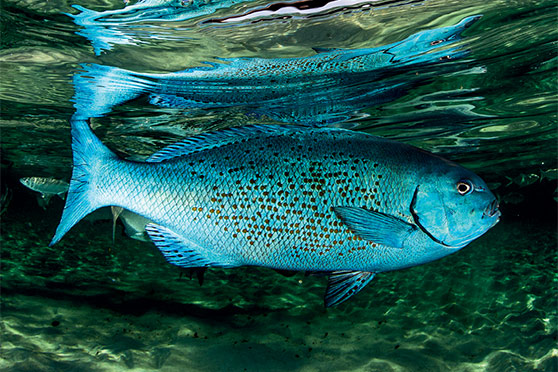
A mature bluefish cruises in shallow water in Lord Howe Island.
Scientists believe that the recruitment of bluefish in New Zealand may be very sporadic and numbers will fluctuate year-to-year; however, overall it seems bluefish numbers have decreased in New Zealand recently. Historic anecdotal reports describe large schools of 50-100 bluefish, similar to the schools of parore that are still encountered nowadays. Bluefish in these numbers are no longer seen in New Zealand, or Australia for that matter. In parts of Australia bluefish numbers have dropped so much they are now fully protected in some states.
To help us track changes to bluefish populations in New Zealand we are interested to hear about sightings of bluefish in nearshore coastal areas, the west coast of New Zealand and south of East Cape. Bluefish are likely long-lived species and sightings in known locations (i.e. offshore islands like the Poor Knights) may just be a case of the same fish being re-sighted multiple times. However, sightings outside of the known range may suggest bluefish populations are recovering or spreading to new areas. So if you think you have spotted or caught bluefish in any of the areas listed above, send a photograph to WhatsThatFishNZ. We are also particularly interested in photos of small juveniles!
|
|
This article is reproduced with permission of |

Recent Forum Posts Visit Forum

Offshore Power Boats - Gulf Harbour 17 Oct
in The Briny Bar134 hours ago
Phantom Menace
The course goes anti-clockwise and turns around the little island (Kotanui / Frenchmans Cap) just off Gulf Harbour. That turn should make for interesting viewing -...

Manukau Harbour & West Coast fishing
in Fishing Reports169 hours ago
smudge
Thats a great catch Schecter, big fish. I'll post up a report from off the coast a bit later on...


Garmin vs Lowrance
in The Boat Shed262 hours ago
Roscoe C
Hi folksI'm looking at upgrading the electronics on my Stabi 1450. I've currently got a Lowrance Eagle 7 which I'm not especially impressed with. In particular...

Shimano 3500 baitrunner
in Buy Sell Trade or Exchange398 hours ago
0nlanders_Nz
Hello, I have come across to on the cash converters website search fishing reels $35 on there...
Manu bay boat ramp
in The Boat Shed403 hours ago
610gc
Hey teamhas any one tried the Manu bay boat ramp since the repairs?Is it any better to use?thank you ...

Out with the "Twelves"
in Fishing Reports407 hours ago
Telecaster
Popped out at about 3:30pm yesterday with a mate, usual zone and method. 10 snapper and 5 gurnard. The biggest snap we got (55cm) was definitely...
Wanted 10500 fin-nor reel
in Buy Sell Trade or Exchange454 hours ago
0nlanders_Nz
I am looking for a fin-nor 10500 fishing reel if any one has, please message me...
Wanted to Buy
in Buy Sell Trade or Exchange477 hours ago
honestbruce
Seen your post and that would work but its not up my alley or ability to make one. Dont have the means to manufacture here in...

Popular Articles

Softbait Fishing - Part 1 - gear selection
John Eichlesheim writes an article about selecting the right equipment for softbait fishing... Read More >
Softbait fishing Pt 2 - tips and tricks
Techniques, tips and tricks of softbait fishing – getting the most from your soft baits.... Read More >

Surfcasting - setting yourself up
Gary Kemsley helps sort out the necessary gear for intending surf fishers.... Read More >

Squid - How to catch them
Squid fishing is a rapidly growing aspect of fishing - Paul Senior shares some hints and tips to get started.... Read More >
Fishing Reports Visit Reports
Manukau/West Coast Fishing Report - 15/10/26
Big spring snapper in 60 metres. The El Niño weather pattern isn’t going to be... Read More >
Rotorua Fishing Report - 15/10/26
Solid start to the season! The Rotorua lakes have all started the season well, and... Read More >
Tutukaka Fishing Report - 15/10/26
Big snapper in shallow. Things remain relatively quiet on the fishing front out of Tutukaka,... Read More >
Tauranga Fishing Report - 15/10/26
Bait and temperature on the rise. It’s been great to get out and see some... Read More >
Comments