
Black Marlin in NZ
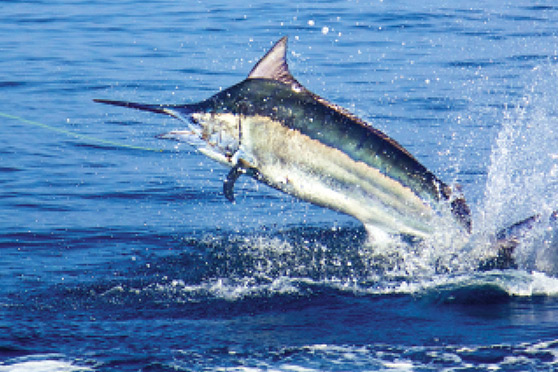
Of all the billfish that arrive in NZ each year, black marlin are notably the hardest to catch. This is likely due to the lack of these fish in our waters, but also their tendency to bite baits rather than NZ’s more commonly used lures. Alistair Arkell sat down with former-charter skipper and NZ black marlin expert, Mark Hoare, to find out more...
There is one captain in New Zealand that, to my knowledge, has caught considerably more blacks than any other skipper in NZ. Mark Hoare, former skipper and owner of the well-heeled charter boat Reel Passion, caught a staggering 39 blacks over 13 seasons, with his best season being six fish. He is a veteran of 13 seasons of pro fishing at the Three Kings, a previous Nationals tournament winner and has caught every species of billfish and tuna in NZ, to great size and numbers. Although blacks are our least common billfish, he believes there are more around than most people realise.
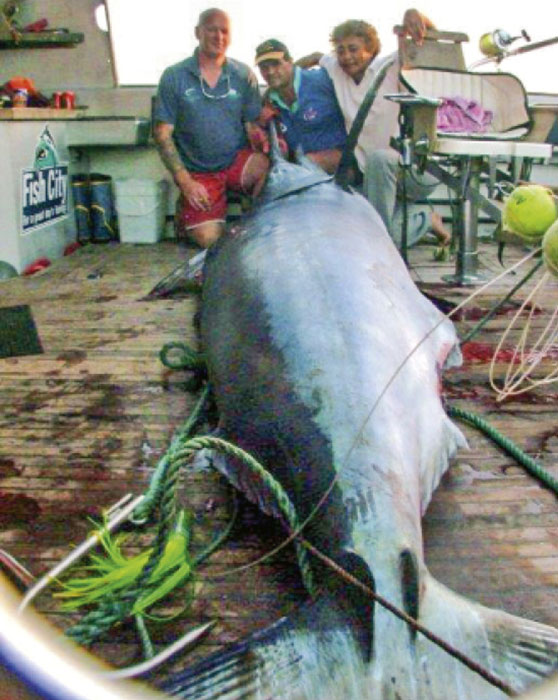
Mark was the skipper for a staggering 39 black marlin captures over 13 seasons.
Fortunately for me, Mark lives not far from my house and he invited me round for a cold beer, an afternoon of cricket-watching and some good old-fashioned yarns about fishing.
For the last five years we have seen ten blacks per season, or less, caught by the whole fleet (keep in mind this doesn’t include non-club anglers). Without knowing the exact numbers of blacks caught in prior years, we could estimate that roughly ten blacks were being caught each season. With an average of three each year, this puts Mark in good stead to claim 30% of NZ’s recreationally-caught black marlin over his fishing career. Good luck? Good Boat? Good Crew? Different techniques?
We all know there is no such thing as luck in fishing; just excellent preparation, and putting yourself in the right areas.
Reel Passion was a great boat, and I have spent many a good day and night on her. After all, she has seen some of NZ’s biggest billfish, including a blue of over 1000 pounds. She has a good pedigree, and some suggest the specific harmonics of Reel Passion attracted the blacks.
Having a good crew will make a difference, there are no doubts about that – and Mark had a fantastic deckie.
More importantly, you need a good skipper, and Mark Hoare has been catching a lot of black marlin in NZ over a long period of time. Considering some of NZ’s best game fishermen have never caught a black marlin in NZ waters, I knew he was the man to talk to.
Mark is a wealth of information. As well as his high score on black marlin, he has also caught several bigeye tuna, normally after a night’s swordfishing. Luckily there is still some life in the cricket season, and there are always cold beers in the fridge – I might just have to pop round and see Mark for an afternoon yarn on bigeye next...
Over the course of the afternoon, Mark filled me in on some of the key details of catching black marlin in NZ, the first of which is that 95% of the fish caught (the bulk tagged and released) were caught on live skippies, which was Mark’s preferred method of fishing. He did, however, catch one magnificent 329kg black on a lure in 17-degree water while trolling at 10 knots between The Hook and the Compass Rose. Incidentally, when this fish was weighed the bill was still touching the ground and the weighmaster – quoting IGFA regulations – would not weigh the fish again. Looking at the fish in the photo, you would have to suggest it was a lot heavier than 329kg. Nonetheless, the registered weight of 329kg still makes it a magnificent capture, and a fish of a lifetime in NZ waters.
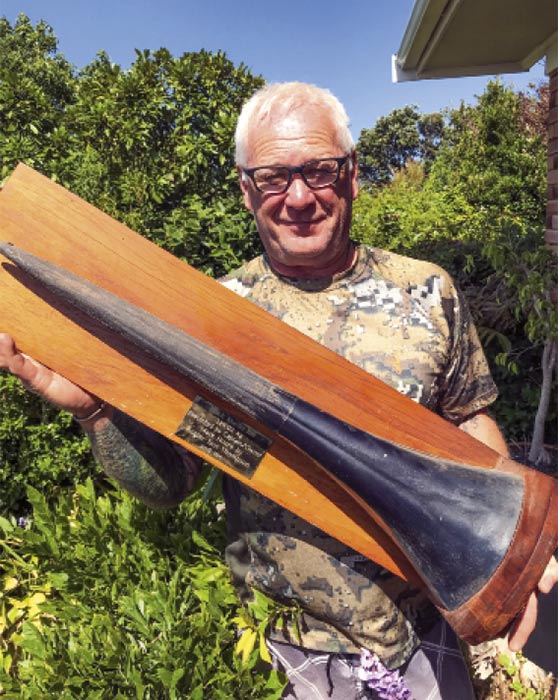
The 329kg black marlin Mark hooked on a lure was well deserving of a trophy.
Mark’s technique for livebaiting blacks was quite simple. Much like any other downrigger system, he set the baitfish about 3-4 metres below the surface, rigged with a #32 rubber band. A key point of difference, however, was dropping back 100 metres of line off the reel as soon as the fish bit to ensure a solid hook-up (if there were lots of boats present, as is often the case at the King Bank, then they would only drop back 50 metres). According to Mark, the black marlin must not feel any resistance or it will spit the bait, and dropping back line is one way to reduce resistance while the fish swallows its meal. Once the fish has run 50 to 100 metres, the angler would ease the reel into gear, pulling the hook out of the fish’s stomach, and into the corner of the mouth.
Importantly, Mark fishes circle hooks – he couldn’t stress this fact enough. Marlin must be swimming away for the circle hook to do its job properly. He doesn’t use J hooks as they invariably gut hook the fish, which greatly decreases the chance of a successful release. It’s also important to note that Mark only uses non-offset hooks as offset hooks tend to catch in the throat of the fish.
Mark’s favourite fishing ground was the King Bank, an area that proved popular for NZ blacks. When fishing the area with livebaits, skippers would have to run across the current lines or their livebaits would not be able to cope with the extra current. Trolling speed was three knots, achieved on Reel Passion by running only one of the two engines – this doubled as a great way to save fuel and extend the time on the fishing grounds!
The hot zones on the King Bank
Mark’s two favourite areas for black marlin were SE of The Squiggles in 150 metres wherever there was current to work, and NW of The Magnet in roughly 150 metres of water – again, in the current and ideally around bait. The blacks were always in the current and around bait schools.
Mark believes that the bulk of the fish he was catching were young females and the fish were in the 100-190kg size range. Of course, Mark wasn’t exclusively fishing for blacks in these areas, as he would catch blue and striped marlin using the same techniques. His single best day on the King Bank was 14 fish and he has had three or four 10-fish days there as well. Historically, a 10-fish-day was considered the benchmark and it’s one that few NZ skippers have achieved. I think Bill Hall was one who achieved the feat back in the early ‘90s, along with Bob Ash and Bruce Smith. Other top skippers have achieved the fabled ten fish day in NZ, but it was and still is the benchmark that separates the hardcore top echelon crews, from the rest of the fleet. Of course, this excludes those venturing to the Wanganellas where ten fish would be a moderately slow day!
Coastal areas
When discussing hunting grounds with Mark, there were a few common trends which continued to surface: moderately shallow water, concentrations of bait, current and foul ground.
This had me thinking about coastal areas which have these same features. First off is my home patch: wide of the Mokes/Bream Knolls area. This area screams moderately deep foul, current and baitfish. Mark couldn’t agree fast enough and said the only reason people aren’t catching blacks there is because they are not fishing for them. However, it must be remembered that actual numbers of black marlin are still low, so a concentrated, sustained effort is what is required to catch a black marlin wherever you fish. Of course, being a pro bill fisherman and being on the water a lot did give Mark an advantage.
Another obvious location that Mark touched on was the area straight north of the Cape Karikari islands called ‘The Shallow Patch’, as well as the 209m area off The Garden Patch. There is also an area off Berghan Point where there is lots of foul ground from 100 metres to the shelf drop off. Mark has managed two blacks off Karikari, three off Berghans and one off Flat Island, just south of Whangaroa.
The gear
The terminal tackle Mark was using was quite specific, consisting of a 37kg mono based outfit running to a 200lb fluorocarbon leader – following the IGFA regulations with leader lengths. When it came to the ‘pointy end’, Mark chose to use custom made stainless steel 10/0 circle hooks or modified versions of them.
The custom hook starts as a regular S/S circle, but the point of the hook gets honed right back to make the gape wider and the tip considerably shorter and sharper. Mark pointed out that the hook in the photo still needs some more work, but the modified style gives an excellent hook-up rate, and yes, the hooks are needle-sharp! If Mark ran out of hooks, he would use the commercial-grade tuna hooks, which also work well. For an out-of-the-packet option, Owner hooks were his go-to. However, these need an anode applied otherwise the hooks will go blunt in the tuna tubes. Not such a big deal if you are deploying baits straight away where you catch them, but if you need to deploy a bait quickly after it has sat for an hour in the tube and the hook tip has gone blunt, then all you’ll end up with is a lost fish and grumpy skipper.
If you’ve struggled to use circle hooks to catch marlin, Mark suggests the following: modify your hooks, strip lots of line and watch your catch rate soar. Anglers and skippers do, however, need to be aware that stripping out the dropback line (if you’re not the angler) could lead your catch to be disqualified if fishing to IGFA rules.
Another aspect to Mark’s bait rigging is that he wraps tape around the eye of the hook and the mono – this is to stop the hook swinging in the tube and damaging the fish. Mark stresses that you can’t take good enough care of your skippies and they need to be handled like babies to keep them in tip-top condition to really turn on the feisty fish.
Mark has a phenomenal record when it comes to black marlin, and if you put the time in and fish the above methods, it’s hard to imagine you won’t at least see some action. Patience is a big thing, and so is the willingness to persist with livebaits.
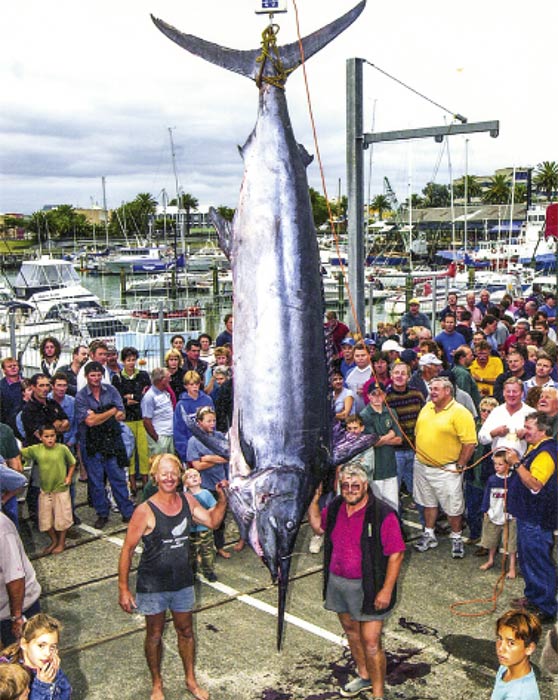
Alain Jorian and crewman David Peach with Alain's 473.2kg black marlin - the current men's all-tackle New Zealand record.
Black marlin by the numbers
According to NZ Sport Fishing Council records, recently recorded captures of black marlin are as follows:
|
Year Fish weighed Fish tagged 2019/2020 (so far) 6 2 2017/2018 4 5 2016/2017 7 3 2015/2016 4 4 2014/2015 5 5 |
|
|
This article is reproduced with permission of |

Recent Forum Posts Visit Forum

Nice photo
in The Briny Bar4 hours ago
Mc Tool
actually 3 different ones No4 mk1 , No1 mk3 and a No5 jungle carbine...

Out with the "Twelves"
in Fishing Reports6 hours ago
Pcj
I should be able to get out end of October. The nephew been out virtually every weekend over winter and has done well. It seems the...

Manukau Harbour & West Coast fishing
in Fishing Reports14 hours ago
smudge
Nice work Schecter, I think snapper may be around sooner than you think. Well I am hoping so...
Mc Tools berley mincer
in The Briny Bar208 hours ago
Mc Tool
The update is that some neighbourhood kids arrived with a 5 hoss 2 stroke mercury that didnt go .........and yeah ...badly side tracked ( it really...

Whangarei Harbour report.
in Fishing Reports446 hours ago
krow
180 +m is where I've had to be lately. A lot less low foul around these parts and some of it shallower that looks like Tarakihi...
Whangarei Harbour Scallops
in Fisheries Management556 hours ago
Pcj
Reopening WhangÄ쳌rei Harbour to recreational scallop fishingTÄ“nÄ쳌 koeFisheries New Zealand is seeking feedback from tangata whenua, stakeholders, and the public on whether WhangÄ쳌rei Harbour should be...

SNA1 Recc fishing cops the blame.
in Fisheries Management652 hours ago
Tzer
What Liegasea won’t tell you is that some of their own fisheries contractors were co-authors of this study for fear of being called hypocrites, one of...

here is one for you Tonto
in The Work-Up694 hours ago
Tonto2
Boat maintenance happening as we speak, hoping to get into late November...
Fish Bat, Waddie, Priest - Blackwood (Sold)
in Buy Sell Trade or Exchange735 hours ago
smudge
Puriri is the stuffs alright...
Rod building gear for sale
in Rod Building793 hours ago
Buggar-me
There may be some photos or items i missed....
Popular Articles

Softbait Fishing - Part 1 - gear selection
John Eichlesheim writes an article about selecting the right equipment for softbait fishing... Read More >
Softbait fishing Pt 2 - tips and tricks
Techniques, tips and tricks of softbait fishing – getting the most from your soft baits.... Read More >

Surfcasting - setting yourself up
Gary Kemsley helps sort out the necessary gear for intending surf fishers.... Read More >

Squid - How to catch them
Squid fishing is a rapidly growing aspect of fishing - Paul Senior shares some hints and tips to get started.... Read More >
Fishing Reports Visit Reports
Tauranga Fishing Report - 17/09/26
Tarakihi fishing well out wide. Perhaps we start with a positive glance at the coming... Read More >
Raglan Fishing Report - 17/09/26
Snapper schools moving shallower. The start of spring is here, and we are seeing better... Read More >
Canterbury Fishing Report - 03/09/26
Whitebait season underway. Spring is here, and along with it, the good old Canterbury nor-Wester!... Read More >
Bream Bay Fishing Report - 03/09/26
Fishing hard, weather conditions trying. Cold winds and lots of rain have made for testing... Read More >
Comments