
Billfish tagging data and reports

In some ways tagging a big fish is like buying a raffle ticket: you may not be doing it to win a prize, but in the back of your mind you are aware that you might just get one if you do everything right and the circumstances work out.
Most people are excited when watching their fish swim away, having enjoyed the experience and wondering if it will be caught again. And if so, where and when? The lucky few will find out when it gets re-caught.
The NZ Gamefish Tagging Programme (NZGTP) is a longstanding cooperative project between New Zealand Sport Fishing Council, the Ministry for Primary Industries and recreational fishers. The programme was established 40 years ago, with the main aim of studying the growth and movement of striped marlin. Researchers were also interested in other key species, such as other billfish, sharks and kingfish.
The tagging of marlin was slow to become established, mainly because at the time New Zealand anglers were accustomed to landing all their catch for food.
Recreational striped marlin catches rose steadily to a peak in 1981, but then fell drastically to a low in 1987. Anglers blamed foreign tuna boats operating under licence in the EEZ.
With little scientific information available, a political solution was reached in late 1987 with the implementation of the Billfish Moratorium. This saw a seasonal closure to the tuna long-line fishery in the upper North Island between October 1 and May 31. In return, it was expected that anglers would tag and release at least 50% of the marlin catch to assist research into migration and stock boundaries. In 1991 this moratorium was changed into a regulation, extending to the whole EEZ for marlin species, but excluding swordfish. Also, New Zealand vessels started replacing foreign licenced long-liners.
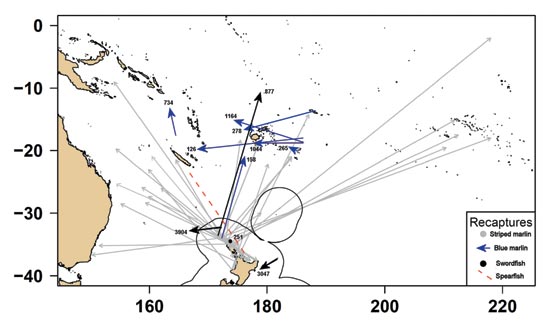
FIGURE 1 shows how catches rose rapidly after the moratorium was introduced and anglers responded positively to calls urging them to tag more marlin. By 1994 the 50% target was exceeded. The average catch (landed and tagged combined) from 1975 to 1985 was 505 striped marlin per year; between 1995 and 2005 it was 1660.
Increased fishing effort, new boats and technology, and the expansion into productive game-fishing grounds on the North Island’s west coast and Three Kings all contributed to higher catches, but protecting billfish from commercial fishing was a huge success for recreational fishers.
Our most recent seasons The 2013-2014 season was the worst for 20 years, but 2014–2015 saw a big improvement in both the total catch of striped marlin and the numbers tagged. Catches were better everywhere (except around the Three Kings), with the fi shing being good on the west coast and the Bay of Plenty having its best year ever in respect of tagged billfish. Fishing in east Northland, however, was patchy.
While 56% of striped marlin were tagged and released (the same as the 10-year average), the New Zealand Sport Fishing Council records say the number of striped marlin tagged (898) was the highest since 2000. In addition, 233 striped marlin were tagged at the Wanganella Banks, but not included in these figures.
Blue marlin and shortbill spearfish were both tagged in greater numbers in 2014-2015, while tagged swordfish numbers were down for the third year running to 27 fi sh. The best season for swordfish tagging was 2011-2012, when 50 were tagged. Interestingly, 2014-15 was not a typical season with respect to when the fish were caught. Sea-surface temperatures were warmer earlier than normal in the Three Kings area, and consequently the best fishing there was in January and early February. Usually the best fishing in the Far North is in March and April. For the rest of New Zealand, February is the peak month for marlin, and this was the case once again. The timing of the New Zealand Sport Fishing Nationals contest in late February is significant in boosting the number of marlin landed and tagged each year.
Why tag and release?
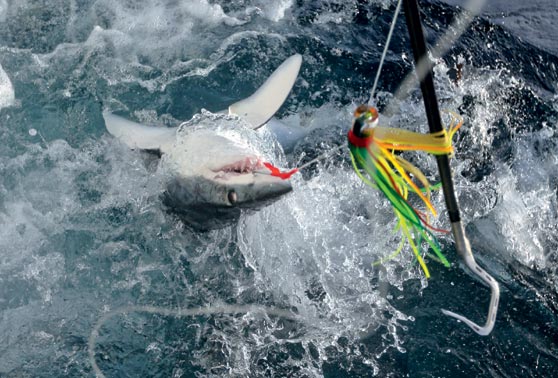
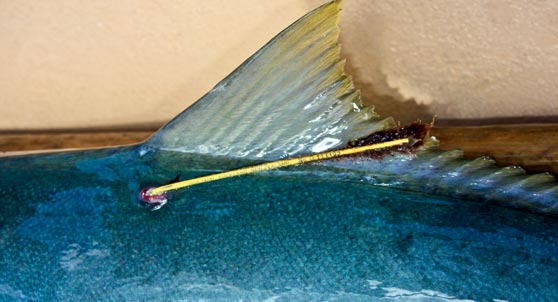
It is important to remember that tagging is not simply a means of recording a catch for the angler and the boat. It needs to be done with the aim of placing the tag so it has the best chance of staying in the fish as long as possible, in a position where it can easily be seen if the fish should be recaptured later.
For some reason striped marlin are particularly prone to shedding tags. Although other species in the tagging programme have provided long-term tag recoveries – almost 15 years of them in the case of yellowtail kingfish, over 11 years for mako sharks, and just under 11 years for swordfish – very few striped marlin have been reported recaptured more than a year after tagging. The longest-term striped marlin recapture in New Zealand was caught in March 2014, after three years and one month of freedom. It weighed 139kg and the tag was only discovered when the marlin was cut up for smoking because it was inside the fish. Another striped marlin was recaptured after two years and nine months. Satellite tagging in New Zealand has proven that striped marlin survive tag and release very well if mouth-hooked, further supporting the belief that tag shedding is a problem.
Successful tag recoveries
Of the more than 70 other striped marlin tag recoveries, only four were caught later than the year/season in which they were released. All the others were relatively short-term recaptures, despite some of these fish travelling considerable distances. One of the most impressive was a striped marlin caught off Tahiti in 2003, 1550 nautical miles from its release point of North Cape, only 95 days after tagging.
Some of the short-term tag recoveries showed how important it is to place the tag correctly. In several cases the tag was on the verge of falling out because it had not been implanted sufficiently deep. It has been suggested that the Billfish Foundation style, nylon-headed tag is superior in bonding with the host fish’s flesh. While there is international evidence from other species, including billfish, of improved tag-retention rates when using the nylonheaded tag, there is not yet convincing evidence of better retention rates in striped marlin. Hopefully, this problem can be overcome in future years.
There have been eight blue marlin recaptures, mostly for fish tagged in Tonga and Samoa moving west, apart from one fish tagged at the King Bank in April that was caught south of Fiji five months later (Figure 2). A blue marlin tagged off Vava’u was re-caught over three years later near Balmoral Reef, Fiji. The plastic coating on the tag was unusually opaque, probably from exposure to the sun.
What has tagging shown us?
New Zealand has excellent records for its recreational billfish fishery. Records began in 1925. These days most of the fish are released, so we only have estimates for the weights of around half the catch. The upside, though, is that we still have accurate numbers of fish, and we now have better records of where each fish was caught. The tagging database can also be used to study the seasonality of the catch.
We also have the data accumulating from recaptures, which has provided evidence of where striped marlin and other species go in our off-season. Tag data has shown that New Zealand striped marlin travel to all three known areas where the species spawns in late spring: the Coral Sea; the Fiji Basin; and near French Polynesia. These migrations appear to be very direct. Once the time comes, these fish seem to move very steadily to their destination, covering considerable distances each day, as evidenced by the short-term, long-distance recoveries like the one in Tahiti. Both striped marlin and mako sharks have recorded similar displacement rates between release and recapture of around 20 nautical miles per day. The straight lines in Figure 2 do not represent the actual migration routes, but do connect the release and recapture points: in other words, a minimum possible distance travelled.
Where to next?
While technology is constantly evolving, conventional tagging is still the most cost-effective way to tag large numbers of fish. It helps us maintain good records of the total recreational catch. It also fulfils an important role in conserving the resource by giving people an incentive to release their catch.
Satellite tagging has taken tag and release to an entirely new level, where massive amounts of fine detail can be gleaned from tagging small numbers of individual fish. However, satellite tagging is expensive compared to conventional tagging, which continues to provide valuable information year after year.
Now another development is on the horizon: stable isotope analysis. Predators at the top of the food chain, like marlin, accumulate a particular isotope signature depending on what they consume and where they do so. Tissue samples can be collected and analysed by Mass Spectrometry to read the isotopes of elements present in each fish. Because there is a large variation in isotope values between New Zealand and the tropics, this technique can be used to infer movements of fish between different areas. This, like tag recaptures, can assist the determination of stock boundaries.
Collecting marlin and tuna tissue samples from around New Zealand will help to fill in gaps in the isotope signature maps of the South Pacific over the next few years. There may well be opportunities for clubs to become involved in collecting samples for this project.
Tagging information and rewards
The species and size of fish suitable for tagging with gamefish tags are billfish, mako, blue and other large sharks, kingfish and tuna over 75cm.
Gamefish tags can be purchased from fishing clubs affiliated to the New Zealand Sport Fishing Council or contact [email protected]
Report recaptures by posting the tag and recapture details (date and location of capture, size, tag number, fishers name, address and shirt size) to: Gamefish Tagging, Ministry for Primary Industries, PO Box 19747, Auckland, NZ.
Fishers reporting a recapture get a GameTag polo shirt and information on where and when the fish was tagged. The tagger also gets a copy of the information and a printed T-shirt.
There’s a $1000 Lucky Draw each year for a person catching and reporting the capture of a tagged fish and providing all the recapture information above.
|
|
This article is reproduced with permission of |

Recent Forum Posts Visit Forum

Shane Jones
in Fisheries Management23 minutes ago
Tzer
From what I see too even commercial in WA aren’t getting any favours from politicians there. I think here our advocacy groups like Liegasea aren’t doing...

Trailer wheel clamp
in The Boat Shed7 hours ago
krow
I like the SAS wheel clamp. I've had no issues with the lock....

Foton tunland v9
in The Briny Bar10 hours ago
Ho Dee
not fishing related and delete if required but was wondering if any has one of these or someone who has just wanting so e real world...

Bluefin Tuna at the cavs.
in The Briny Bar57 hours ago
smudge
Despite my years of fishing I haven't really fished many places, my focus has always been on Auckland's west coast and out toward Great Barrier. I...

Casting gloves
in Popper and Topwater Fishing102 hours ago
Mc Tool
100 bucks for a lure 😬. Watching one of them flying over the horizon without the line attached would be " character building " for sure...
I thought Id post some nice photo's , join...
in The Briny Bar153 hours ago
Alan L
That is a very cool pic Krow.The Far North is very cool, the Far far North even cooler. Mint looking day.Alan...

Mc Tools berley mincer
in The Briny Bar160 hours ago
SaltyC
Good size, they scrap well. Got an 18kg one up in Vava'u back a few years ago fishing off squeaky Going's boat. That was quite a...

Out with the "Twelves"
in Fishing Reports214 hours ago
Pcj
I should be able to get out end of October. The nephew been out virtually every weekend over winter and has done well. It seems the...
Manukau Harbour & West Coast fishing
in Fishing Reports222 hours ago
smudge
Nice work Schecter, I think snapper may be around sooner than you think. Well I am hoping so...
Whangarei Harbour report.
in Fishing Reports654 hours ago
krow
180 +m is where I've had to be lately. A lot less low foul around these parts and some of it shallower that looks like Tarakihi...
Popular Articles

Softbait Fishing - Part 1 - gear selection
John Eichlesheim writes an article about selecting the right equipment for softbait fishing... Read More >
Softbait fishing Pt 2 - tips and tricks
Techniques, tips and tricks of softbait fishing – getting the most from your soft baits.... Read More >

Surfcasting - setting yourself up
Gary Kemsley helps sort out the necessary gear for intending surf fishers.... Read More >

Squid - How to catch them
Squid fishing is a rapidly growing aspect of fishing - Paul Senior shares some hints and tips to get started.... Read More >
Fishing Reports Visit Reports
Outer Hauraki Gulf Fishing Report 17/09/26
Spring wind the handbrake. Spring is starting to make its presence felt in the outer... Read More >
Top of the South Fishing Report - 17/09/26
Early snapper in Tasman Bay. Well, spring is finally here, and the days are getting... Read More >
Bream Bay Fishing Report - 17/09/26
Good snapper catches reported. After Tangaroa turned off the fish tap for a month or... Read More >
Bay of Islands Fishing Report - 17/09/26
Pacific bluefin tuna for the lucky few. The last fortnight has seen more fishable days... Read More >
Comments