
Bait Fishing - Bait Presentation Hints

It is probably more important to pay attention to how baits are rigged and presented than being concerned about what type of bait to use, suggests young angler Hayden Speed.
To best entice a fish to take your bait, it pays to think about how a fish will see and eat your offering. This will give you clues about where to position hooks, whether they should be facing toward the tail of a baitfish, or if some weight is needed to hold the bait in the strike zone.
Getting your hook placement and orientation correct will significantly increase your hook-up rate. The placement of the hook will depend on the rig being used and the size and shape of the bait. When straylining with a ‘fixed’ two-hook rig and using a bait such as a pilchard, I like to position my first hook down by the head (with the hook pointing towards the tail) before wrapping the trace around the bait. This helps strengthen the bait and keep it intact. I will then position my second hook through the tail in such a way that the two hooks are on opposing sides of the bait.

Having your hooks on opposite sides of the bait is a great way to cover the whole bait, giving you the best chance at hooking a fish.
Placing my hooks like this allows me to cover both ends (and sides) of the bait, giving me the best chance of hooking a fish. Additionally, if I’m using a small ball sinker to counter the current, I will rig this in between the hooks and wrap this around the bait, causing it to sink more naturally than if it were running on the trace above the hooks.
Another important idea to note is to have the point of the hooks facing back up the line so that when you pull up on the mainline, the point of the hook pulls directly up too – hopefully setting into the fish’s mouth in the process. If your hook is orientated in the opposite direction, when the trace is pulled (as it would when lifting the rod to set the hook) the hook will rotate, and in the process of doing so, it could easily pull out of the fish’s mouth entirely.
When I’m fishing smaller cut baits and recurve or circle hooks, I will just go through once at the top of the bait. If the bait was less durable, I may need to go through it twice. However, I need to be particularly careful not to overload the hook or bury the hook so deep that the point is no longer exposed and unable to penetrate a fish’s mouth. This is important with circle/recurve hooks as they need to roll into the corner of the fish’s mouth and it’s harder for them to do so with an overloaded hook.

It’s important to leave the point of the hook exposed, particularly with recurve or circle hooks.
The cut baits I prefer to use are long, narrow strip baits that hang neatly off a hook rather than square slabs where the hook can easily get lost. I believe that strip baits sink through the water more naturally and are more easily consumed. On the other hand, a fish may struggle to take a square-shaped bait to a point where the hook is well positioned in the mouth and ready to be set.
Using the correct hook size for your bait and target species is also another factor to consider. When targeting big snapper with big baits I like to use an 8/0 or 9/0 hook. This is a large hook that is harder for the smaller ‘bycatch’ to eat. However, if targeting pannies or other species such as kahawai, gurnard or trevally on a strip bait, I like to use a 5/0 hook, in either a recurve/circle or J hook style.
Then, just to confuse things further, there are times when I will try to completely hide the hook as the fish may be wise to any shiny foreign object. Particularly so when targeting koheru or trevally using softer baits such as a strip of blue mackerel or squid. Ultimately, though, any bait with a hook in it stands a pretty good chance, so just get out there, give it a go and see what works for you!
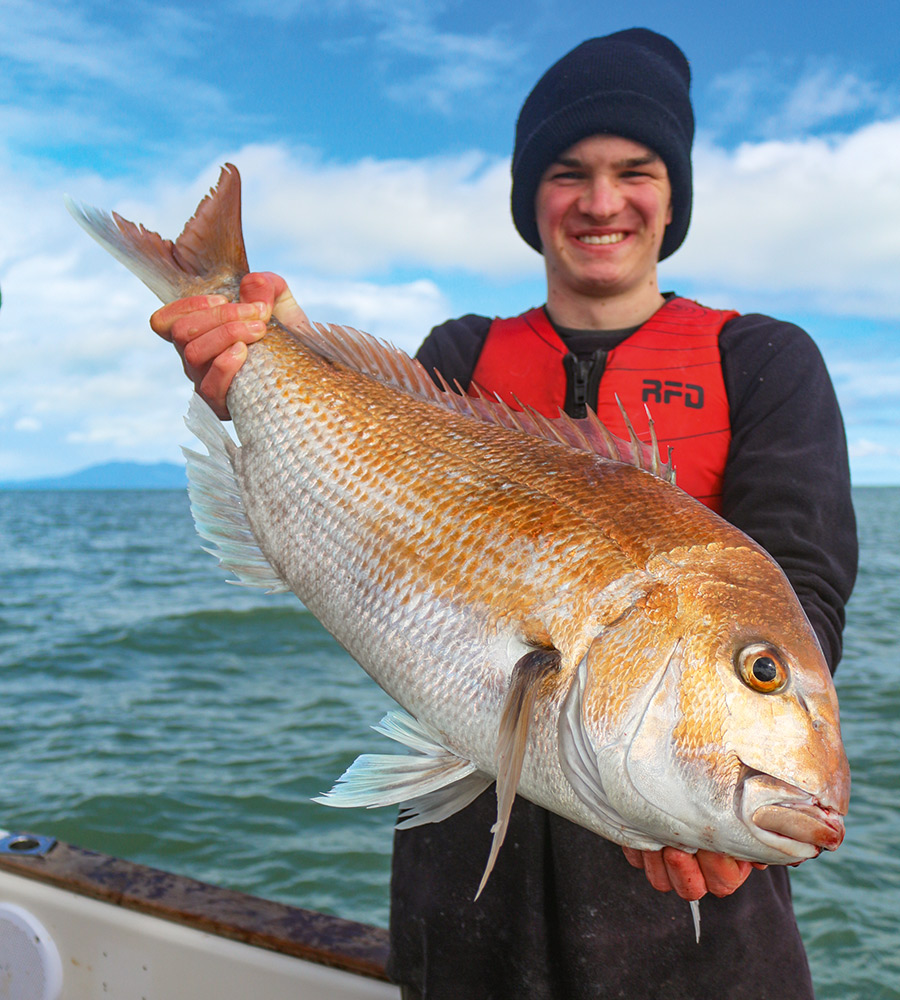
The writer with the result from a nicely presented bait!

January 2023 - Hayden Speed
New Zealand Fishing News Magazine.
Copyright: NZ Fishing Media Ltd.
Re-publishing elsewhere is prohibited
Popular Articles

Softbait Fishing - Part 1 - gear selection
John Eichlesheim writes an article about selecting the right equipment for softbait fishing... Read More >
Softbait fishing Pt 2 - tips and tricks
Techniques, tips and tricks of softbait fishing – getting the most from your soft baits.... Read More >

Surfcasting - setting yourself up
Gary Kemsley helps sort out the necessary gear for intending surf fishers.... Read More >

Squid - How to catch them
Squid fishing is a rapidly growing aspect of fishing - Paul Senior shares some hints and tips to get started.... Read More >
Fishing Reports Visit Reports
Manukau/West Coast Fishing Report - 15/10/26
Big spring snapper in 60 metres. The El Niño weather pattern isn’t going to be... Read More >
Rotorua Fishing Report - 15/10/26
Solid start to the season! The Rotorua lakes have all started the season well, and... Read More >
Tutukaka Fishing Report - 15/10/26
Big snapper in shallow. Things remain relatively quiet on the fishing front out of Tutukaka,... Read More >
Tauranga Fishing Report - 15/10/26
Bait and temperature on the rise. It’s been great to get out and see some... Read More >
Comments