
A 24 hour fishing trip
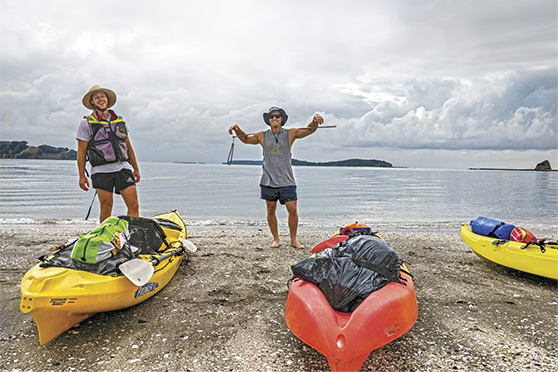
Armed with just their kayaks, fishing gear and basic shelter, Ethan Neville and a group of mates set off for 24 hours of “fishing for survival”…
In my previous two stories for Fishing News, I briefly surveyed the radical changes that have taken place in recreational fishing over the last thirty or so years. From bait to soft-baits to just about everything else imaginable, inshore Kiwi anglers are now more open to new methods of fishing than ever before. One of the more influential factors contributing to this proliferation of techniques was the change of mindset the first soft-baiting boom encouraged: catching snapper was no longer just about putting fresh fish on the table; it became a sport like any other.
Those in my generation who grew up watching Matt Watson catching and releasing twenty-pound fish every other show had no transition to make – our motivation was always to simply have fun. And while I am in no way complaining about this distinctly middle-class mindset we more than happily embraced – fishing is fun (that, I’m sure, we can all agree on) – it is possible to wonder if something has been lost. That something is one of the few remaining elements that connects us modern fishers to those who hunted of necessity; those who perhaps had a connection with the ocean and a relationship with fishing lost in my garage full of gear. Behind lures and graphite rods and electric reels and fish finders and every other gadget decorating our boats, I am sure there remains a primal instinct that drives our natural desire to hunt and fish and survive.
These thoughts are new to me. My mate Jonny was the first of our friends to think along these lines, and his reflections did not conclude without a plan for action. We would rediscover our ancient instincts the only way that’s foolproof – maroon ourselves on a beach for a weekend with no food, no bait, and only a handline to catch fish. Before you point out that two nights away does not count as a survival trip, as well as make the ensuing comments about us being soft Auckland millennials, I will first make both of these admissions myself. Beyond the simple desire to get out on the water with mates, I was not excited about this trip. When Jonny suggested going for 48 hours, I tried to argue him down to 12. We ended up settling on 24, which was a good compromise for both myself and his young family. We chose a time and place, extended the invite to two of our mates, one of which resolutely said no, and all was settled – there was no turning back.
Our journey to find the lost art of fishing started late. I chose to make porridge for breakfast against the instructions of Jonny, who was sharpening his instincts by going without breakfast. With our kayaks on the roof and food safely at home in the pantry, we finally left around nine on a quiet late-March Saturday. It was a half hour drive to Sullivans Bay (Mahurangi West), and a forty-minute paddle to Lonely Bay, the aptly named location for our rendezvous with nature.
It was calm and overcast and would be for the whole weekend. Morale was high as we drew near to the sheltered bay. A flurry of splashing fish welcomed us at the bay’s entrance, which of course meant we wasted the first half an hour running around in the shallows with nets. No thought was given to conserving energy. Kahawai raced within metres of our ankles, always just out of reach – I can only assume they sensed our early desperation. I gave up quickly and turned my attention to pipis and oysters, neither of which I successfully opened. After it became unsettlingly clear that our naïve bait-catching methods were failing, we dragged our kayaks across the fifty metres of mudflats. Morale was still worryingly high. Jonny and Rowan appeared unphased, so I kept my quiet anxieties to myself.
It didn’t take long to set up camp: I erected a two-man tent that went unused, and Rowan and Jonny made a shelter with rope and a tarpaulin. After a moment admiring their handiwork, as well as a few more moments joking at my expense, we set out to find bait. Oysters and mussels were the target, the first of which Lonely Bay provided in bulk. In fact, it was almost as if we were the first ones to wander the rocks desperately searching for molluscs, shirts tied round heads, without the appropriate footwear, knives, or general understanding of what we were doing. Nonetheless, through the use of sharp rocks we managed to open the oysters and collect their meat. As I quickly proved to be a deadweight, I took the first batch and headed for my kayak. Ambitious after seeing the kahawai schooling, I swapped out my 10lb mono on my handline for 30lb line and a fluorocarbon trace – the latter I used without Jonny’s knowledge.
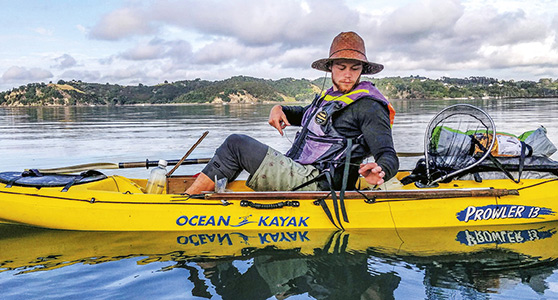
Getting right back to basics, a handline was the only tackle allowed.
The water was glass in the bay so, as it was now mid-afternoon, I paddled a little deeper to try retain some element of stealth. I floated my first oyster bait down on a 3/0 hook and only had to wait a few seconds for the first bite. The excitement I felt was enough evidence that something had indeed been lost in modern recreational fishing: the fish biting was clearly a pannie at best, yet I was buzzing like it was a 20-pounder. When the weight came on, as light as it was, I fought the fish with the fervour of a madman. I also probably looked like a madman – this was my first time using a handline and I was working out the best technique by trial and error (the emphasis on error). It turned out to be a nice-looking 20cm snapper. After sending it home, I shouted to Jonny and Rowan on the shore to rig up. Over the next two hours we raced through all of our oyster baits. We quickly found that the lighter line and smaller hooks were the most effective, even if this meant we lost one or two rigs. By mid-afternoon, we had a trevally and three legal-sized snapper on board between us.
Jonny had brought along a small gas cooker and we wasted no time preparing the fish. We felt like kings that avo – hungry, shirtless kings who had to fish for their survival – but kings none the less. It wasn’t long after eating that we had to get back into action. The sun was getting lower and we were in need of more baits. Even I got involved this time, using any method possible to crack open oysters and salvage their meat. With three of us working hard, it didn’t take long to get what we needed. We had also made the hard decision to keep the trevally for bait in the hope of getting something bigger for dinner. Oyster baits were seemingly irresistible to the snapper, but they certainly weren’t encouraging bites from the bigger fish.
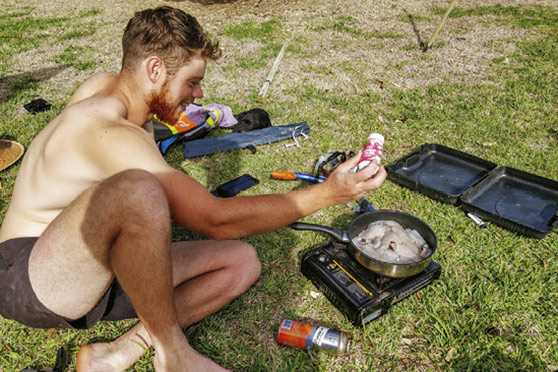
While it might be basic, the fried fish was much appreciated when there was little else on the menu.
This time round we decided to head further inside the harbour to get up close to the muscle farm. The water was even calmer this far up the channel, and with the current still moving beneath us, it looked like we had every chance of getting a feed. Appearances didn’t betray reality: all three of us hooked up on our first cast, but nothing was close to keeping size. As the sun was setting and the fish were clearly biting, I decided to chuck on one of my precious slabs of trevally. It got taken on the drop, and I quickly had to learn a new skill: how to fish a handline when a fish is peeling out nylon. There was no doubt that a solid panny had taken the bait, and, without a drag system, I was torn between letting it run and putting pressure on the fish. I tried to get a couple of winds on and ended up playing cat and mouse with the fish for a couple of minutes. Every time it ran, I let the handline turn freely, but as soon as it started to slow, I whipped a few turns in. It didn’t take long for the fish to tire (I was starting to realise it wasn’t as big as I’d first imagined), and I was getting more and more turns of the handline in between the runs. I had it boatside in under five minutes and, after seeing colour, struggled to contain my excitement. The snapper was probably pushing 40cm. But then the worst happened. As I grabbed the leader and pulled, the fish gave a final shake of its head and flicked the hook. I watched as dinner swam away.
I kayaked back closer to the others, cursing myself as I went, and found they only had one pannie between them. This was when Rowan thought it might be a good idea to paddle to a pontoon a short distance away, and use that as his fishing vessel. Jonny and I laughed and kept fishing off our kayaks. We continued getting snapper almost every drop, but nothing close to keeping. Just when our frustration was peaking and the sun was giving out its last rays, Rowan shouted from his pontoon that he had snagged a decent one. We didn’t believe him, of course, but after paddling over and boarding the pontoon ourselves, we saw a nice pannie sharing the platform with Rowan. Instead of taking a photo (which would have been ideal for this story), we excitedly let the last of our baits drift off the back of the pontoon with the current, managing another two keepable snapper before the sun completely vanished. One fish each for dinner was more than enough in our current state, so we were content as we paddled back to Lonely Bay.
The night was peaceful: we ate our fish, slept soundly under the tarpaulin, and, best of all, survived. Jonny, of course, ventured out for a late-night floundering session, but returned empty handed. Our air of desperation was gone and the maccas on the way home was more than enough reward for surviving the weekend.
The fish were smaller, it took considerably more effort, and it certainly wasn’t without its frustrations, but fishing the way we did definitely opened our eyes to something lost. With the damning stats being produced on fish survival rates after being released, fishing purely for food is something we should at the very least reflect on. If nothing else, it may help us appreciate those slow days typically filled with frustration. We should be thankful for just being able to catch a couple of pannies in our own backyard. What a great place we live where putting dinner on the table for our friends and families isn’t always considered a ‘successful’ day!
|
|
This article is reproduced with permission of |

Popular Articles

Softbait Fishing - Part 1 - gear selection
John Eichlesheim writes an article about selecting the right equipment for softbait fishing... Read More >
Softbait fishing Pt 2 - tips and tricks
Techniques, tips and tricks of softbait fishing – getting the most from your soft baits.... Read More >

Surfcasting - setting yourself up
Gary Kemsley helps sort out the necessary gear for intending surf fishers.... Read More >

Squid - How to catch them
Squid fishing is a rapidly growing aspect of fishing - Paul Senior shares some hints and tips to get started.... Read More >
Fishing Reports Visit Reports
Raglan Fishing Report - 12/11/26
Big spring snapper. With the more settled weather over the last couple of weeks there’s... Read More >
Mercury Bay Fishing Report - 12/11/26
Snapper hit and miss. Most reports have been telling us it’s becoming more difficult to... Read More >
Northland Fishing Report - 12/11/26
The switch has been flicked on! Call it what you want, El Niño, global warming,... Read More >
Tauranga Fishing Report - 12/11/26
Snapper and kahawai in close. Again, we start on a positive note, with some nice... Read More >
Comments