
Which Squid Jig?

Lure selection is critical for squid fishing, or eging, success. However, if you’re just getting into it, the breadth of lure options can be a tad overwhelming. Luckily, we’re here to help!
What’s a squid jig?
Squid jigs are small lures that resemble a prawn (or small fish) with a keel-shaped weight at the front, and rows of sharp barbless prongs at the rear. Squid jigs usually have two layers consisting of the underbody and an outside cloth layer, each typically a different colour.
What colour is best?
A general rule of thumb is to use bright, lumo colours such as pink, orange, and green in for night or low light conditions, and darker, more natural-looking colours (brown, olive, blue/silver) for brighter conditions.
Another factor to consider is the clarity of the water. In clear water, the less ostentatious colours can be more effective at fooling the squid into thinking it's a real prey item like a small fish. In murkier water, a brighter, more visible jig, such as one with a fluorescent color, may be easier for the squid to spot and therefore more effective.
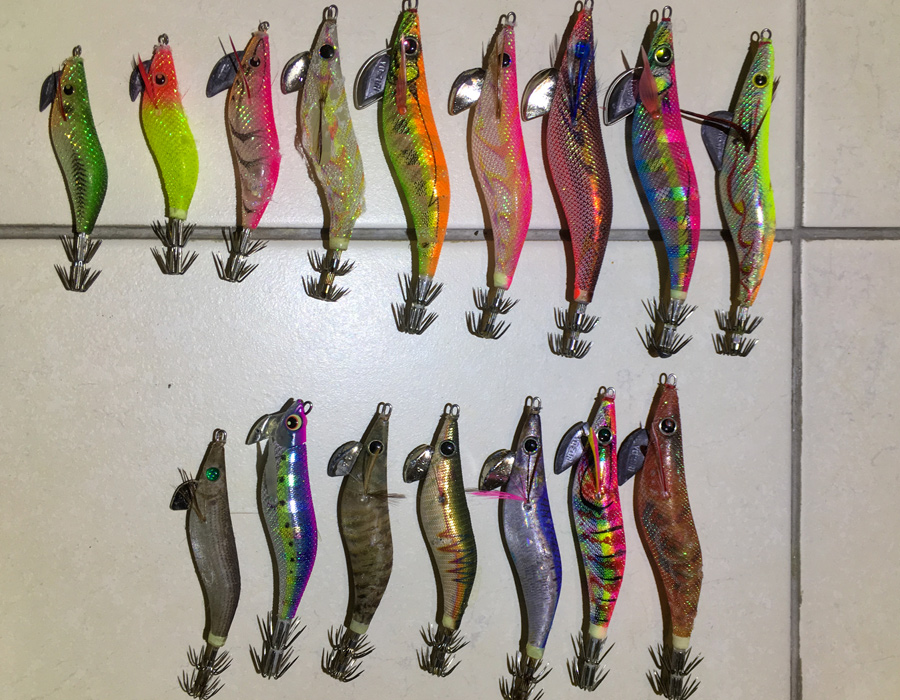 Bright, lumo colours are generally preferred for eging in the dark (top nine), whereas natural colours are preferred for daytime fishing (bottom seven).
It's worth experimenting with different colours to see what works best in your local area. Squid can be finicky and may have specific preferences, so it's always a good idea to have a variety of jigs in different colours and patterns to experiment with. For example, on nights when the squid are particularly shy, excessively lumo or brightly coloured jigs may seem unnatural. In these instances, darker and more natural colours might be worth a crack.
Here's a handy reference for squid jig colour selection:
- Night (no ambient light) – red and lumo
- Night (ambient light from streetlamps or the moon) – gold, rainbow, clear and silver
- Sunrise and sunset – gold, pink and rainbow
- Day (clear sky) – blue/silver, brown, olive, purple, dark yellow
- Day (overcast) – rainbow, red, purple, lumo
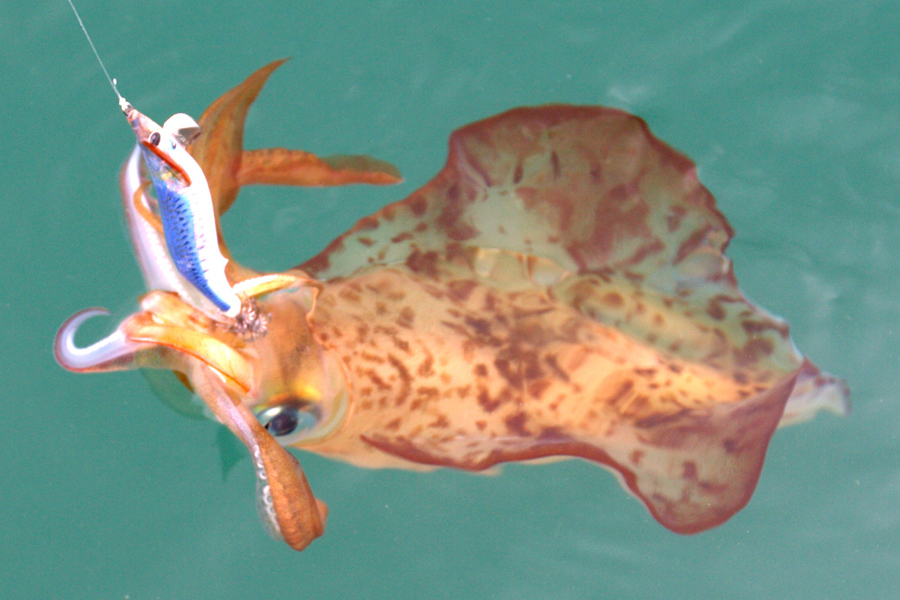 Blue/silver can be an effective option during the day.
Weight
Squid jigs come in a range of sizes, all with weighted keels. The keel on a squid jig will usually have a number stamped into it and/or a number on the packet (usually between 1.8 and 3.5 in NZ stores). The number on the jig is not associated with the weight, but rather the size of the jig. Generally, larger jigs sink faster than smaller ones. However, depending on the brand and type of jig, this can vary. The sink rates are usually written on the packet, too, in seconds per metre.
In autumn and early winter, the squid are smaller, so jigs ranging between 1.8 to 2.5 are recommended. As squid grow rapidly through winter and into spring, using size 2.5 and up is recommended later in the season as the size of squid increases. Bigger jigs also offer the advantage of casting further and thereby covering more area.
Most egi anglers will drop down to a smaller jig when squid are being picky or lethargic. In shallow water, smaller jigs (or slow sinking models) can be useful as they give the squid more time to attack the dropping lure.
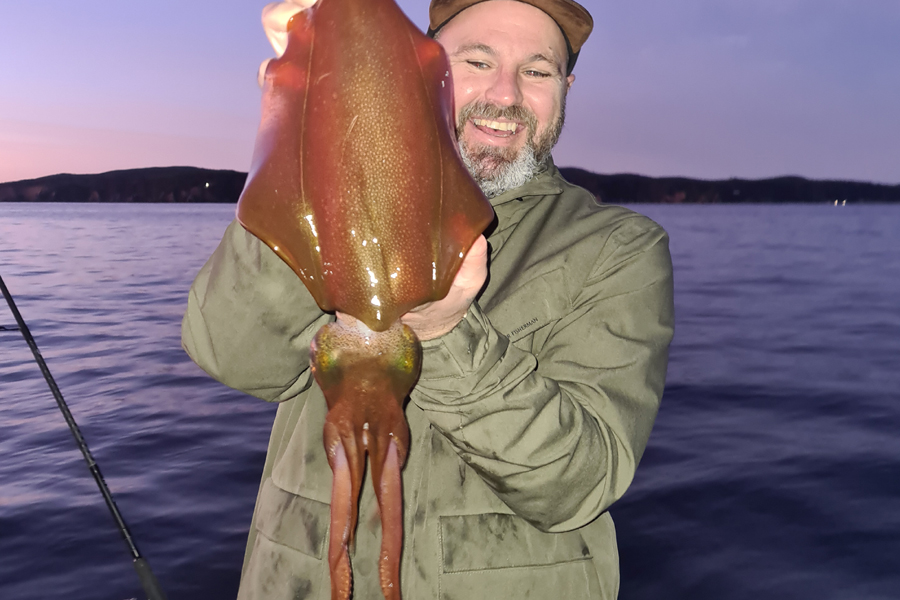 Dawn and dusk are prime squid-catching times – switching out lures as light conditions changed worked a treat for Aaron Styles around Kawau Island.
A popular theory is that during the day, squid typically take cover from predators around weed and rocks and are less inclined to expose themselves in open water. Therefore, larger (or faster sinking) lures are often preferred for daytime squid fishing to spend more time close to the bottom in the strike zone.
One theory is that during the day, they are taking cover from predators, so unless the meal is big enough to be worth the risk of exposing themselves in the open, they will generally ignore it.
Brands
One of the truisms in the tackle world is, “You get what you pay for.”
The price and quality of squid jigs varies considerably, and although any jigs will do the business some days, squid are often finicky and the subtle differences in quality can make a huge difference.
YO-ZURI and Yamashita squid jigs are renowned for product development and cutting-edge technologies. Warm jacket cloths, rattles, ‘490 glow’ and shift-able internal weights for longer casts and more hang time in the water, are some of the unique features these brands offer that can give you an edge. If you’re lucky enough to catch a few squid, you’ll also notice on some of the cheaper brands that the outer cloth layer gets ripped apart easily by squid beaks.
Good luck with your calamari catching!
- NZ Fishing News
Recent Forum Posts Visit Forum

Shane Jones
in Fisheries Management17 hours ago
Tzer
Far cry to the twats at Liegasea/NZSFC were proposing of 5 Tarakihi person in their submission for the central management area and this is what our...

Bluefin Tuna at the cavs.
in The Briny Bar37 hours ago
smudge
Despite my years of fishing I haven't really fished many places, my focus has always been on Auckland's west coast and out toward Great Barrier. I...

Casting gloves
in Popper and Topwater Fishing82 hours ago
Mc Tool
100 bucks for a lure 😬. Watching one of them flying over the horizon without the line attached would be " character building " for sure...
I thought Id post some nice photo's , join...
in The Briny Bar133 hours ago
Alan L
That is a very cool pic Krow.The Far North is very cool, the Far far North even cooler. Mint looking day.Alan...

Mc Tools berley mincer
in The Briny Bar140 hours ago
SaltyC
Good size, they scrap well. Got an 18kg one up in Vava'u back a few years ago fishing off squeaky Going's boat. That was quite a...

Out with the "Twelves"
in Fishing Reports194 hours ago
Pcj
I should be able to get out end of October. The nephew been out virtually every weekend over winter and has done well. It seems the...
Manukau Harbour & West Coast fishing
in Fishing Reports202 hours ago
smudge
Nice work Schecter, I think snapper may be around sooner than you think. Well I am hoping so...

Whangarei Harbour report.
in Fishing Reports634 hours ago
krow
180 +m is where I've had to be lately. A lot less low foul around these parts and some of it shallower that looks like Tarakihi...
Whangarei Harbour Scallops
in Fisheries Management744 hours ago
Pcj
Reopening WhangÄ쳌rei Harbour to recreational scallop fishingTÄ“nÄ쳌 koeFisheries New Zealand is seeking feedback from tangata whenua, stakeholders, and the public on whether WhangÄ쳌rei Harbour should be...
SNA1 Recc fishing cops the blame.
in Fisheries Management840 hours ago
Tzer
What Liegasea won’t tell you is that some of their own fisheries contractors were co-authors of this study for fear of being called hypocrites, one of...

Popular Articles

Softbait Fishing - Part 1 - gear selection
John Eichlesheim writes an article about selecting the right equipment for softbait fishing... Read More >
Softbait fishing Pt 2 - tips and tricks
Techniques, tips and tricks of softbait fishing – getting the most from your soft baits.... Read More >

Surfcasting - setting yourself up
Gary Kemsley helps sort out the necessary gear for intending surf fishers.... Read More >

Squid - How to catch them
Squid fishing is a rapidly growing aspect of fishing - Paul Senior shares some hints and tips to get started.... Read More >
Fishing Reports Visit Reports
Outer Hauraki Gulf Fishing Report 17/09/26
Spring wind the handbrake. Spring is starting to make its presence felt in the outer... Read More >
Top of the South Fishing Report - 17/09/26
Early snapper in Tasman Bay. Well, spring is finally here, and the days are getting... Read More >
Bream Bay Fishing Report - 17/09/26
Good snapper catches reported. After Tangaroa turned off the fish tap for a month or... Read More >
Bay of Islands Fishing Report - 17/09/26
Pacific bluefin tuna for the lucky few. The last fortnight has seen more fishable days... Read More >
Comments