
Herley Commander

Herley Boats is a partnership between Sean Kelly and Nick Herd. Sean has spent a lifetime involved with the sea, including the NZ Navy, commercial fishing, boat brokerage and servicing marine industries, including oceanic survey and salvage.
Nick Herd I first met back in 2014 when he was the newly appointed production manager for a large aluminium boat manufacturer, following on from a background of manufacturing quality alloy boats.
With Sean’s experience of the characteristics that make for the best performance in oceanic hulls and Nick’s manufacturing experience brought together under the banner of Herley Boats, the result was bound to be something interesting.
The aim was to create a hull that was soft-riding, with great ocean-going capabilities, but stable at rest and underway. The result is the Herley Commander, which some of you will have seen the at the last Hutchwilco Boat Show in Auckland. Those who like a raked bow on a boat probably thought it looked a bit odd, but those who prefer classical plumb bow lines and a high-quality finish will have appreciated the Commander’s functional design.
The advantages of the plumb bow include a ‘wave piercing’ effect that makes for a softer, more comfortable ride; greater waterline length, allowing for more efficient performance and higher speed; and more usable internal space in the bow (further increased by use of a drum winch, avoiding the need for an anchor well).
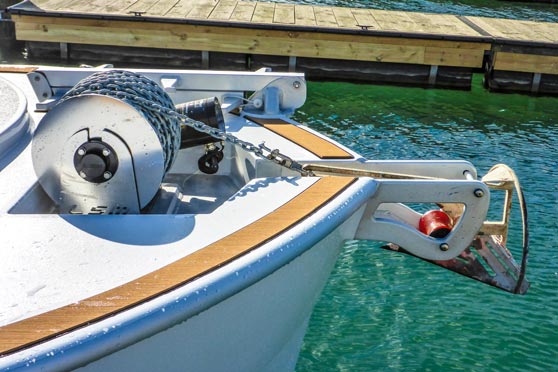
The downsides of plumb bows are usually wet foredecks and issues with the anchor dinging the bow when retrieved. But the Commander design has addressed these by adding steeply rising sheer lines at the bow, along with a ‘false chine’ (where the top-third of the bow sheer starts) and a degree of flare, both helping turn down the spray. The anchor is set out on a bowsprit to help it clear the bow.
The Commander has a solidly constructed hull with 6mm bottom plates and 5mm sides. The framework features six longitudinal girders, seven frames and two full-length topside stringers. The hull tucks in a bit towards the stern, allowing better control of the trim.
The plumb bow starts with a deadrise of 60 degrees at the forefoot and is variable to a modest nine degrees at the stern. This relatively flat aft section adds greatly to the boat’s stability (during testing eight adults were lined up along one side of the hull, which only listed 11 degrees) without affecting the smoothness of the ride. The center of gravity is well judged, so the hull sits nice and flat at rest.
The Commander has 1100 litres of sealed buoyancy and features free-draining decks and over-sized duckbill scuppers that quickly drain the cockpit of any water. Under the deck are two bilges, each fitted with a 1200gph bilge pump with auto and manual over-ride switches.
Herley has done a great job of fairing and finishing the hull. It is fully lined and painted to the chines with high-quality products, the result being almost indistinguishable from fibreglass at first glance.
On the water
Herley Boats is based at Mount Maunganui so I drove down early one winter’s morning to check out the Commander. I was met by Nick Herd, sales manager Lindsay Disher, and highly experienced professional skipper BJ Fitzsimons. After a photo-shoot near the harbour entrance, we headed out wide of Motiti Island.
It was calm initially, but later in the day the wind picked up a bit, lifting a chop of about half a metre. Snug inside the enclosed cabin, we hardly noticed the change in conditions, the fine entry cutting through the sea like an axe-head. The forward-leaning, five-millimetre toughened glass wheelhouse screens gave good visibility and, with the application of a beading product like Diamond Fusion, negated the need for wipers, also adding to cabin space, so allowing more room in the cockpit.
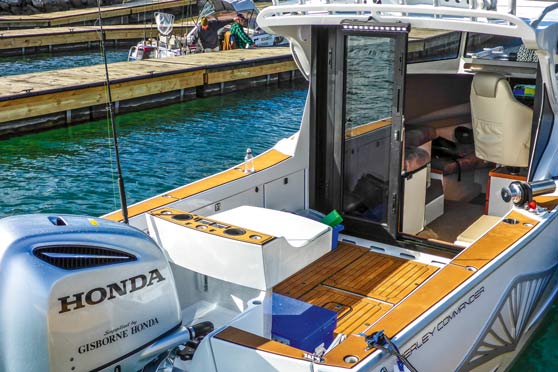
The hull is rated for 200-250hp and the test boat was pushed by a 250hp Honda VTEC outboard fitted with intelligent Shift and Throttle (iST) and hydraulic steering, including an attractive polished-wood wheel. Fuel capacity in the underdeck tank is 210 litres, giving a range, at cruising speed, of about 147nm (272km) on a full tank.
The outboard was fitted with a 17-inch pitch prop and at wide open throttle (WOT) the revs were 5600. Book revs for this engine at WOT are listed as 5300 to 6300rpm, so there is room to drop the pitch an inch or two if a bit more torque is required, but for general purposes, the existing prop is fine. Inboard versions of this boat can be built if required.
See the performance figures below
Performance:
(Honda 250 VTEC, 17 -inch pitch prop, four adults on board)
Revs Speed Fuel
(RPM) (knots) (l/hr total)
1000 4.1 3.8
2000 6.9 8.8
3000 21.1 19.4
4000 23.1 33.0
5000 33.0 60.0
5600 36.5 85.0
Stem to stern
The ground tackle is handled by a Lonestar Marine Elite3 variable speed drum winch, controlled from the bow. Beside this is a fold-down boarding ladder, useful for loading and discharging passengers off the bow on steep to beaches.
The wheelhouse roof has been designed to carry an inflatable tender (or other cargo, such as water toys) with tie-down bars/ hand rails along the sides and a non-skid foredeck making loading and unloading this equipment easier and safer.
The internal space unlocked by the plumb bow design allows the fitting of a separate enclosed cubicle for an electric flush toilet in the fore-cabin, along with a forward berth. A variety of berth layouts are available, sleeping up to three adults.
Two small hatches in the fore-cabin roof provide light and ventilation for the toilet and fore-cabin. As well as cubby-hole and side-shelf stowage in the fore-cabin, there is under-berth stowage space in both fore-cabin and wheelhouse.
Adopting principles of avoiding drilling holes into the hull, and avoiding dis-similar metal contact (with the potential for corrosive reaction), Herley has machined grab-rails out of heavy aluminium and welded them directly to the superstructure where required.
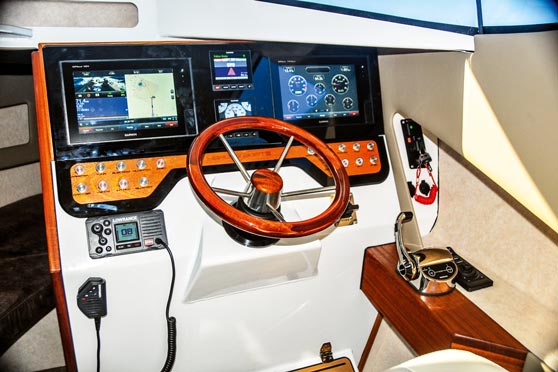
The wheelhouse electronics feature two Garmin GPSmap XSV 10-inch multifunction displays (including cockpit camera and instrumentation displays) Lowrance VHF, and Fusion sound system.
The helm seat is a comfortable roll-back bolster model with three layers of stowage beneath and more in the foot rest. Passengers have a variety of bench seats to choose from, with more stowage and an Isotherm fridge/freezer beneath. The wheelhouse and fore-cabin are fully lined, carpeted or painted. Two ventilation ports are fitted to the roof and a sliding, lockable, glass wheelhouse door allows both security and comfort.
Outside, Venta lighting is fitted extensively – cockpit floods and low-level lighting under the kick space, side floods and forward spots. The large cockpit is kept tidy with two fold-down side seats that fit flush into the gunwales, as do two large fold-down storage lockers. Extensive use is made of the attractive and practical synthetic SeaDek products, covering the cockpit deck and gunwale tops and giving secure footing that is also attractive and comfortable.
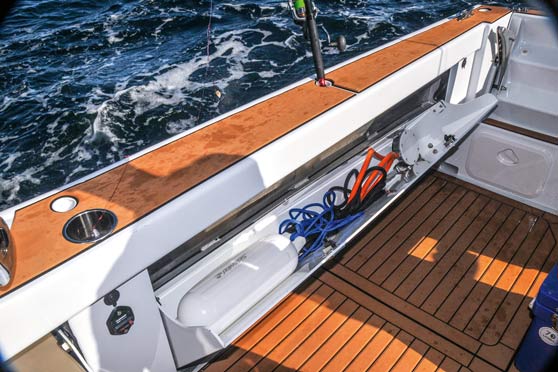
The two-battery system is protected at deck-level in the transom wall. There is no boarding platform, but the reversed counter is better for backing and has a stair section which folds down into the water for boarding and floods when in the water, so it sits down for easy use. Fold-down X-cleats are fitted around the gunwales.
Extensive fishing fit-out
The fishing fit-out is extensive, encompassing a wide range of disciplines. The boat’s owners, Dave and Brigitte Scammell, are from Gisborne where there are many fishing options available.
There are power outlets for four electric reels; a fold-out davit arm and a James Nilsson electric winch for cray pots (with side protection that doubles as a hull logo); a mount for a longline; mounts for a bolt-in game chair; a set of classy-looking Bonze Kraken outriggers; a pair of tuna tubes fitted down by the engine well; six through-gunwale rod holders along the sides, plus two across the transom which can also be used to mount a comprehensive bait station. This space is returned with interest by the three holders fitted to the station, which also boasts a tackle drawer and tool holders.
Other features are a livebait tank in the transom with washdown hose beneath; a hand washing water outlet with a foot switch fed by a 60-litre freshwater tank beside one tuna tube; and an eight-position rocket launcher on the hardtop. A big under-deck kill tank is fitted with two-hatch access and heavy-duty hinges as well as a smaller ‘tarakihi gate’ for easy depositing of smaller fish into the hold.
On the day BJ took us to one of his honey holes, where we quickly knocked over a feed of delicious tarakihi (but used an after-market ice bin to preserve the catch).
The trailer
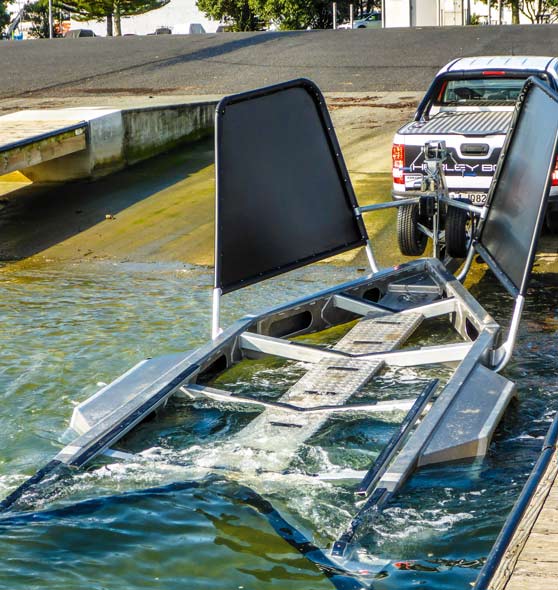
With a rig towing weight of around 2750kg (with full tanks), the test boat is carried on an aluminium A-frame, tandem-axle trailer built by Herley Boats. It features a double stainless-steel electric braking system, wind-down jockey wheels, alloy wheels (plus spares) dual-ratio manual winch, drive-on boat catch, submersible LED lights, removable guide poles with rollers, and stone chip protection screens for the bow.
The trailer is fitted with skid plates and benches, a series of keel rollers and a tread-plate walkway to help keep your feet dry. All this makes for an easy drive-on, drive operation (where this is permitted) with the rollered guide poles helping keep the boat square on to the trailer in a side wind or current.
All-in-all
Although Herley’s Commander echoes the style of a classic displacement hull, with speed to burn and excellent sea-keeping it is anything but. This boat gives the impression it is much bigger than it really is (seven metres LOA, with a two-and-a-half-metre beam).
Because of the space advantages bestowed by the plumb bow and the pilot-house design of the superstructure, a variety of layouts are possible, and this hull can be set up as a day cruiser or an overnighter.
The room harvested by the design is invested in a spacious cockpit, well kitted-out for nearly all types of recreational fishing. And finally, the level of finish is exceptional, with many, many hours of hand-finishing invested by the builders. You get what you pay for in this world, and this is quite a boat.
|
|
This article is reproduced with permission of |

Fishing Reports Visit Reports
Outer Hauraki Gulf Fishing Report 17/09/26
Spring wind the handbrake. Spring is starting to make its presence felt in the outer... Read More >
Top of the South Fishing Report - 17/09/26
Early snapper in Tasman Bay. Well, spring is finally here, and the days are getting... Read More >
Bream Bay Fishing Report - 17/09/26
Good snapper catches reported. After Tangaroa turned off the fish tap for a month or... Read More >
Bay of Islands Fishing Report - 17/09/26
Pacific bluefin tuna for the lucky few. The last fortnight has seen more fishable days... Read More >


Friday 25 September 2026
Major Bites
 - -
- - Minor Bites
 - -
- - Saturday 26 September 2026
Major Bites
- - Minor Bites
- - Popular Articles

Softbait Fishing - Part 1 - gear selection
John Eichlesheim writes an article about selecting the right equipment for softbait fishing... Read More >
Softbait fishing Pt 2 - tips and tricks
Techniques, tips and tricks of softbait fishing – getting the most from your soft baits.... Read More >

Surfcasting - setting yourself up
Gary Kemsley helps sort out the necessary gear for intending surf fishers.... Read More >

Squid - How to catch them
Squid fishing is a rapidly growing aspect of fishing - Paul Senior shares some hints and tips to get started.... Read More >
Comments
Latest Articles
Spearfishing Tips & Tricks
September 2026The South Seas Spearo team provide some salient advice for spearfishers about how to get the most out of their time in the salt this season... Read More >
New Fishing Tackle - Spring 2026
September 2026Check out these hot new products, fresh out this spring... Read More >
NZ Saltwater Fly Fishing Seasons
September 2026Sandflats and mudflats are beautiful fish-rich habitats that are particularly suited to fly fishing... Read More >
How to Catch Sea-run Trout
September 2026One area Greg Morton returns to time again to hunt sea-run and estuary brown trout is the coastal stretch from Christchurch to Southland... Read More >
Garmin Force Kraken + LiveScope Review
September 2026Garmin’s Force Kraken trolling motor and LiveScope sonar system enable positioning, tracking, and targeting fish with a high level of precision... Read More >