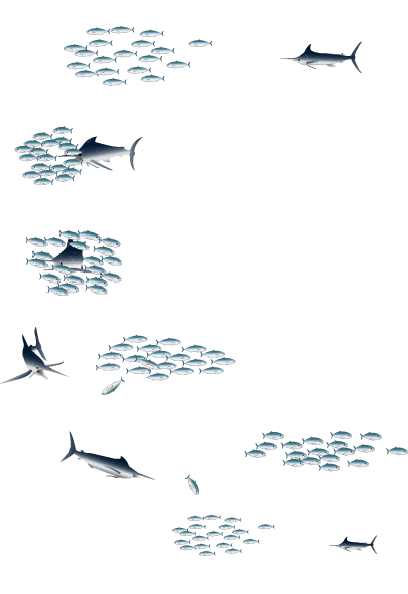
Why do blues die?

Page  123 4>
Post Options Post Options   Likes (0) Likes(0)   Quote obald Quote  Post ReplyReply Direct Link To This Post Topic: Why do blues die?
    Posted: 13 Feb 2012 at 8:44am
obald View Drop Down
Topic Moderator
Topic Moderator
Avatar

Joined: 17 Jul 2002
Location: Burkina Faso
Status: Offline
Points: 5214
I have for many years publicly expressed angst over the plight of any blue marlin coming within a hundred metres of a game boat in New Zealand waters. They all get acute transomitis and stainless steel poisoning and die. We should stop stringing up all these (in global terms) middleweight blues and release them all.
 
My stance is changing a little. I still would like to see most blue marlin that are hooked swim away from the boat but having had a little more up close and personal contact with these beasts I am now very sure that my black and white stance was wrong. I have been closely involved in the death of three blues in the last calendar year and now know that some (and I hope not all) of those poor buggers aimed at the centre of the earth from gantries up and down the land are not there because the angler wanted to kill them.
 
So why do blue marlin die? In other parts of the world much larger blues than the 170-220 kg models we speacialise in here routinely swim away from boats (or do they?) but in our waters the non evidence based impression I get is that a much higher proprtion of these don't get to swim away. Are our blues different? Unlikely I would think. Are we crap anglers and don't have the necessary skills to catch these very large fish quickly enough to allow them to swim off before they are totally stuffed? An uncomfortable truth I suspect. For most of us an encounter with a blue is a rare-ish event even if we are catching a fair number of their striped cousins. And they are very different animals in regard behaviour and sheer bulk.
 
The actual mode of death? Dunno and I haven't the time for a bit of proper internet research. I've heard tell of acute pericarditis which if you are a humanoid is definitely very bad for you. The bronzing is lactate in the skin and is a symptom and not a cause.
 
So, no finger pointing from me but a genuine interested enquiry from those who know more than I.
Random musings on all sorts of things http://obaldnz.blogspot.com/


Back to Top
Post Options Post Options   Likes (0) Likes(0)   Quote Bushpig Quote  Post ReplyReply Direct Link To This Post Posted: 13 Feb 2012 at 8:50am
Bushpig View Drop Down
Titanium
Titanium
Avatar

Joined: 17 Jul 2002
Location: Uzbekistan
Status: Offline
Points: 12651
Out of interest, what was th fight time on hat blue? Given the reports we were under the impression is was short.
I would rather laugh with the Sinners, than cry with the Saints
Back to Top
Post Options Post Options   Likes (0) Likes(0)   Quote A C Quote  Post ReplyReply Direct Link To This Post Posted: 13 Feb 2012 at 8:59am
A C View Drop Down
Titanium
Titanium
Avatar

Joined: 19 Jul 2002
Location: Drunken Haze
Status: Offline
Points: 10065
They don't seen to die up in the tropics, I always thought that when they went deep our water was too cold for them and they just expire from extreme fatigue and cold ?
Aye-Aye cloth eyes.
Back to Top
Post Options Post Options   Likes (0) Likes(0)   Quote krow Quote  Post ReplyReply Direct Link To This Post Posted: 13 Feb 2012 at 9:11am
krow View Drop Down
Titanium
Titanium
Avatar

Joined: 02 Aug 2007
Location: Whangarei
Status: Offline
Points: 6662
I doubt it's crap anglers as it looks like a lot die fairly quickly.
I'm failry sure that if I am graced with the option another one will die.
Back to Top
Post Options Post Options   Likes (0) Likes(0)   Quote lance@driveline.co.nz Quote  Post ReplyReply Direct Link To This Post Posted: 13 Feb 2012 at 9:41am
[email protected] View Drop Down
Forum Sponsor
Forum Sponsor
Avatar

Joined: 07 Mar 2006
Location: Waipuna AKLD
Status: Offline
Points: 10384
Stress assoeciated with 27kg and 60 Kg Gear. I think we should all go down to 15KG...lol
Back to Top
Post Options Post Options   Likes (0) Likes(0)   Quote Wind Up Quote  Post ReplyReply Direct Link To This Post Posted: 13 Feb 2012 at 10:10am
Wind Up View Drop Down
Gold
Gold


Joined: 19 Jan 2005
Location: Auckland
Status: Offline
Points: 568
I have always assumed they built up lactic acid as oxygen in their blood stream is depleted during the fight and ultimately this killed them...However I am sure some guru out there can either confirm or rubbish this and if so provide the real reason.
Back to Top
Post Options Post Options   Likes (0) Likes(0)   Quote Barrie Quote  Post ReplyReply Direct Link To This Post Posted: 13 Feb 2012 at 10:19am
Barrie View Drop Down
Titanium
Titanium


Joined: 17 Jul 2002
Location: Auckland
Status: Offline
Points: 10449
Originally posted by A C A C wrote:

They don't seen to die up in the tropics, I always thought that when they went deep our water was too cold for them and they just expire from extreme fatigue and cold ?


sounds like a very good explanation to me.
Colder temp may well cause the energy levels to be exhausted a lot quicker causing drowning
Back to Top
Post Options Post Options   Likes (0) Likes(0)   Quote Bushpig Quote  Post ReplyReply Direct Link To This Post Posted: 13 Feb 2012 at 10:36am
Bushpig View Drop Down
Titanium
Titanium
Avatar

Joined: 17 Jul 2002
Location: Uzbekistan
Status: Offline
Points: 12651
Aren't the blues in the islands typically smaller than here?
I would rather laugh with the Sinners, than cry with the Saints
Back to Top
Post Options Post Options   Likes (0) Likes(0)   Quote Lethal Quote  Post ReplyReply Direct Link To This Post Posted: 13 Feb 2012 at 10:39am
Lethal View Drop Down
Rest In Peace
Rest In Peace
Avatar

Joined: 28 Oct 2002
Location: In our thoughts
Status: Offline
Points: 23636
that is what most old fishermen "Charter Boat Operators" say as well AC,

some say let em run on a light drag, when they settle down up the drag and they just come straight in.

i tried it in the Islands on a estimated 150kg Blue, it worked a treat less than 30mins, but in saying that, the one before this was similar size and took 1hr30mins, and still swum away no problem....

so maybe the it is the cold which is there down fall...


Thanks for everything you did for us Eric. may you rest in peace, You were one of the real legends of NZ recreational fishing
Back to Top
Post Options Post Options   Likes (0) Likes(0)   Quote A C Quote  Post ReplyReply Direct Link To This Post Posted: 13 Feb 2012 at 11:18am
A C View Drop Down
Titanium
Titanium
Avatar

Joined: 19 Jul 2002
Location: Drunken Haze
Status: Offline
Points: 10065
Once they go through the thermocline in to the cold stuff with low oxygen levels possibly Eric ?
Aye-Aye cloth eyes.
Back to Top
Post Options Post Options   Likes (0) Likes(0)   Quote Jaapie Quote  Post ReplyReply Direct Link To This Post Posted: 13 Feb 2012 at 11:28am
Jaapie View Drop Down
Platinum
Platinum
Avatar

Joined: 14 Apr 2003
Location: Guinea Bassau
Status: Offline
Points: 2803
Reading into this article, I believe a few factors have been touched on.
 
The lactic acid build up is one of the key factors.
 
Another thing to remember is the type of swimming muscles used and the conditions they are being used in. - fighting for it's life against a heavy drag setting.
When one looks at the physiology of muscles and muscle contraction it is a complex procedure. Secondly, mammals are warm blooded whereas fish are cold blooded (exceptions I know, but bear with me). Simplifying things down, we would effectively look at red muscles (tuna) versus white muscles (marlin) and warm blooded versus cold blooded to get a very big insight into the anatomy and physiology of what we are targeting.
 
Looking at red muscles they contract relatively slowly but require a lot of oxygen - why are tuna so tough fighting!!! Bulk and stamina play an important role.
 
On the other hand, white muscles are contracting faster, do not require the same amount of oxygen but the stamina is not quite there.
 
Blues (as with most fish) use white muscles as swimming muscles.
Yes, when you cut them up there are flanks or bands of red muscles along the caudal region and interspersed throughout the white meat, and this supplements those white muscles I'm on about.
Great for bursts of speed when feeding or trying to get away quickly, but not so good when stressed out over long periods.
 
Blues are super fast and use great amounts of energy and stamina in a short period of time and quite often the exertion is too much for the body and in particular the heart.
The cardio vascular system simply cannot cope and the heart literally explodes.
 
Someone touched on the subject of water temperature and this is indeed a pivotal factor to consider. In warmer temperatures (tropics - Fiji, Tonga) muscle contraction is stronger and dare I say it, faster for our cold blooded predators. However, stamina becomes a problem.
Conversely, warm blooded mammals are slower but have a better stamina ability.
 
Fighting something for hours on end and the build up of lactic acid in those tired muscles isn't going to do anyone any favours. Trying to release something close to the verge of death isn't going to be easy either.
 
So what is the key -
 
Personally, aggressive boat driving and good angles.
Using the gear properly and cutting down on fight times where possible.
 
Tag rather than gaffs LOL
 
Simplistic explanation, but hopefully helpful.
"Only when the last tree has died, the last river has been poisoned and the last fish has been caught,will we realize that we cannot eat money" - 19th Century Indian Creed
Back to Top
Post Options Post Options   Likes (0) Likes(0)   Quote biggear Quote  Post ReplyReply Direct Link To This Post Posted: 13 Feb 2012 at 11:31am
biggear View Drop Down
Titanium
Titanium
Avatar

Joined: 07 Feb 2008
Location: Tauranga
Status: Offline
Points: 3614
Id say it was because we killed it dead??? Or was it the sight of Boulder bent over the rod huffing and puffing?
Dont let the grey hair fool you!
Back to Top
Post Options Post Options   Likes (0) Likes(0)   Quote Martini Max Quote  Post ReplyReply Direct Link To This Post Posted: 13 Feb 2012 at 11:35am
Martini Max View Drop Down
Platinum
Platinum
Avatar

Joined: 12 Oct 2002
Location: Whitianga
Status: Offline
Points: 1073

 A few years ago, I saw a clip of a researcher (well known, but I can't remember his name) dissecting a Blue Marlin caught during the HIBT. I remember one of his comments being that these Blues can accelerate to 50mph  in one and a half times their body length. This was in explanation of the "shape" of the tail muscles, being that they surround the tail section radially, rather than longitudinally, and so giving this acceleration capability. Same for many fish I imagine -tunas etc. That this is sustainable for  (for these fish)  only short periods (how long is short?).  

Without any research, I suspect maybe they internally 'overheat' when sustaining long runs/jumps. Possibly as AC says, when they go deep, the temp. change of only a few degrees may be the reason - too rapid a change . Maybe "over exertion"  results in the same as an overweight unfit fat bugger may suffer, when trying to sprint 200m.Dead

 Or maybe they are just buggered and think 'to heck with it and kick off'.

 This was written much earlier this am, and finished just now. I think Jaapie has very well summed it up. Cheers.


"I do nothing..I do it well.. I then move on to doing more of nothing"
Back to Top
Post Options Post Options   Likes (0) Likes(0)   Quote TOSF Quote  Post ReplyReply Direct Link To This Post Posted: 13 Feb 2012 at 1:12pm
TOSF View Drop Down
Forum Sponsor
Forum Sponsor
Avatar

Joined: 22 Jun 2011
Location: Mangawhai Heads
Status: Offline
Points: 1087
Jaapie, some good info there, cheers.

This is a good thread for sure and already a few good points have been made. 
I am a kiwi and have fished central america now for the last 6 years, I have brought only one marlin on board in that time but sadly I have released a few fish that might not have made it and the thought of those fish is sad but it is the game we play, it is a blood sport. 
One thing I have noticed in the areas I fish now that a catch or a release is when the mate touches the leader only, this changes the whole game and gives the fish a better chance at surviving, it also promotes more aggressive driving , shorter fights and lighter leaders for higher hook up rates. 
Putting a tag in a fish or subduing a fish boat side for a photo is limiting the fishes chances of recovery for sure.
This is not a dig at us kiwis but it seems that in NZ that a fish is only caught when it has a tag in it? or brought on board? this way of thinking is only doing the fish more damage, interesting reading this forum with the way people analyze what is caught and what is not, this is not a dig at the way we class a caught fish but our way of thinking is surly killing a few fish each year that could have lived just because a captain or angler was not sure if he "Caught the Fish" so to make sure drag it beside the boat just so his mate can not say he did not catch it and over analyze it at the bar that night.
A lot of the touch the leader thing has come from tournaments with circle hooks and simplifying the rules.
Colder water may have something to do with it? using a lot more energy? be good to learn more about this more.
Interesting though I know one boat that has put satellite tags hundreds of Marlins, they say the worst survival rate came from Blacks? I personally have had more issues with blacks but that may be due to live baiting.
It is interesting how the "common" tournament rules of each country then reflect back to each countries way of interrupting a catch or release.
Please do not take this the wrong way, I do not mind killing the odd fish and even more so for prize money, but this does make you think for day to day fishing how we can release fish quicker.

Be good to learn more about the Blue and how we can look after an amazing fish and release them healthy. I sure there will be some great info coming out of this thread for sure with the amount of experienced people that post here.

Just my 5 cents worth.
http://www.facebook.com/TonyOrtonSportFishingOffshoreAdventures
www.offshoreadventures.net
Back to Top
Post Options Post Options   Likes (0) Likes(0)   Quote alan syme Quote  Post ReplyReply Direct Link To This Post Posted: 13 Feb 2012 at 1:16pm
alan syme View Drop Down
Gold
Gold
Avatar

Joined: 02 Jan 2009
Location: tauranga
Status: Offline
Points: 854
really interesting thread, good discussions.


They don't seen to die up in the tropics, I always thought that when they went deep our water was too cold for them and they just expire from extreme fatigue and cold ?
they do also die in the tropics, same style as nz, fight then go deep then dead weight. not sure it is as common as nz or not but it does happen on a fairly regular basis from what i have seen.

Aren't the blues in the islands typically smaller than here?


not sure about other places in the tropics, but in the cook islands the blues are way smaller than nz on average. biggest landed in raro this summer has only weighed 125kg, most caught are sub 100kg with lots way under that.
Back to Top
Post Options Post Options   Likes (0) Likes(0)   Quote Peter Pakula Quote  Post ReplyReply Direct Link To This Post Posted: 13 Feb 2012 at 1:23pm
Peter Pakula View Drop Down
Platinum
Platinum


Joined: 28 Jul 2002
Status: Offline
Points: 1434
Blues don't die in the fight, they are killed by the tactics used to fight them. Hard to take eh! The ingrained traditional 'fear fight' will pretty much kill just about every blue you hook regardless of where in the world you are.
Back to Top
Post Options Post Options   Likes (0) Likes(0)   Quote SumDumBum Quote  Post ReplyReply Direct Link To This Post Posted: 13 Feb 2012 at 1:48pm
SumDumBum View Drop Down
Bronze
Bronze
Avatar

Joined: 31 Dec 2010
Status: Offline
Points: 61
Jaapie  offers good information and experience , I agree with it all . But added to jaapies information I would also factor in the the  NZ Thermocline , which would be a lot harsher that in warmer tropical areas.
How does that work..... ??? The  Colder the water , the less Oxygen it Holds...... add that to a desperate fight for life with a sounding fish.....and maybe they just suffocate down there....
 
It is always a sounding fish that dies.... I havent heard tell of one flaking out on the surface...
 
Thats My theory anyway.... and of course I could be hopelessly off the mark.
Si Vis Pacem para Bellum
Back to Top
Post Options Post Options   Likes (0) Likes(0)   Quote Barrie Quote  Post ReplyReply Direct Link To This Post Posted: 13 Feb 2012 at 1:51pm
Barrie View Drop Down
Titanium
Titanium


Joined: 17 Jul 2002
Location: Auckland
Status: Offline
Points: 10449
Originally posted by Peter Pakula Peter Pakula wrote:

Blues don't die in the fight, they are killed by the tactics used to fight them. Hard to take eh! The ingrained traditional 'fear fight' will pretty much kill just about every blue you hook regardless of where in the world you are.


could you take this further please Peter.
why is it the fight and what do you suggest to improve things?

Not that I have cought a Blue but I would have thought that the fight would be the same?
Is it a lighter drag or heavier line?
Back to Top
Post Options Post Options   Likes (0) Likes(0)   Quote herby Quote  Post ReplyReply Direct Link To This Post Posted: 13 Feb 2012 at 2:04pm
herby View Drop Down
Titanium
Titanium
Avatar

Joined: 26 Jul 2005
Status: Offline
Points: 6356
Colder water holds more oxygen SumDumBum
Back to Top
Post Options Post Options   Likes (0) Likes(0)   Quote Jaapie Quote  Post ReplyReply Direct Link To This Post Posted: 13 Feb 2012 at 2:36pm
Jaapie View Drop Down
Platinum
Platinum
Avatar

Joined: 14 Apr 2003
Location: Guinea Bassau
Status: Offline
Points: 2803
Originally posted by SumDumBum SumDumBum wrote:

..... I would also factor in the the  NZ Thermocline , which would be a lot harsher that in warmer tropical areas.
How does that work..... ??? The  Colder the water , the less Oxygen it Holds
 

That is a very good point you make there.


The thermoclines are quite variable depth wise depending on where you are in the world.

Evidence suggests that in the tropics there is a semi-permanent thermocline and variable thermocline in temperate regions. NZ falls nicely within this sector (sub 23 degrees latitude)


Below the thermocline the water is quite cold (it can vary upwards of 12 degrees from surface temperatures if I remember correctly) and evidence suggests it becomes anaerobic and more so the deeper one goes.


Applying that to the metabolism of the cells in the fishes body, they are struggling in an environment without oxygen (more accurately decreased oxygen).


For the boffs, anaerobic glycolysis (sorry guys) leading to the lactic acid buildup argument all over again.

"Only when the last tree has died, the last river has been poisoned and the last fish has been caught,will we realize that we cannot eat money" - 19th Century Indian Creed
Back to Top
Page  123 4>
Forum Jump
Forum Permissions View Drop Down


This page was generated in 0.563 seconds.

Fishing Reports Visit Reports

Freshwater Fishing Reports
Canterbury Fishing Report - 26/06/26

Canals still the place for a monster trout I am sitting at my desk and... Read More >

26 Jun 2026
Saltwater Fishing Reports
Raglan Fishing Report - 25/06/26

Trophy snapper in close The snapper fishing out deeper continues to be the most consistent... Read More >

25 Jun 2026
Saltwater Fishing Reports
Northland Fishing Report - 25/06/26

Swords aboard! With some of the smoothest seas and lowest winds we have seen in... Read More >

25 Jun 2026
Saltwater Fishing Reports
Bay of Islands Fishing Report - 25/06/26

Kingfish and snapper in the bay Having spent the week weighing kingfish, I decided that... Read More >

25 Jun 2026
Fishing bite times Fishing bite times

Major Bites

Minor Bites

Major Bites

Minor Bites