Ok guys, here is my somewhat shoddy attempt at a step by step on building “Overstrength Assists” using JigStar Kevlar Assist cord.
In a lot of areas, guys are having problems with toothy critters cutting them off on the Assist, or fishing in areas with high concentrations of fish with super tough toothy mouths, and want to beef up their assists without having to go to Wire assist hooks.
I took a leaf outta the Shout guys books, and had a look at how they did their ready made assists, and I think I’ve come up with a great solution, and using our Kevlar, you pretty much end up with a bullet proof connection.
1 word of warning, you will obviously use more Kevlar than normal using this method! But on the flip side, you end up with a vastly heavier Assist cord set up.
Here is what you need:
200lb or 240lb JigStar Kevlar
Jigging Hooks ( I’ve used a Jigging Master Monster 13/0 for this demo )
Solid Ring
Pair of strong scissors/pliers for cutting the Kevlar:
Ingredients:

What you want to do is cut two equal length pieces of assist cord. These pieces need to be approx 1.5 to 2 x the length you would regularly use for tying assists ( like I said, it uses a fair amount )

Thread both sections of the Kevlar through the spilt ring to equal length:

Now comes the slightly tricky part… it was tough for me to shoot using only one hand….
Basically what you want to do is start to plait the 4 sections together… what I do is take the two tag ends from one side of the ring, and use those as “one” piece and the other two tag ends as the other 2 legs for the plait.
Its easiest if you hook the solid ring over something and then start your plait.
You should end up with something like this:

Next step, once you have plaited a section long enough, is to thread all 4 tag ends in through the hooks eye. Make sure to use proper jigging hooks with the kinked eye, and thread the tag end into the eye from the hook point side:

Pull the cord through the eye till the eye traps up against the end of the plait.
Now is where having the extra length assist cord comes in handy, and is infact essential.
To finish off the Assist, you need to tie a simple overhand knot, in the 4 strands of Kevlar, around the hooks shank.
If you don’t have enough length to the Kevlar, this is nearly impossible…. Its important to keep the threads neat and lying next to each other, not bunches and twisted as this will give you a bulky finish:


Once you have threaded the Kevlar round into the knot, make sure all the strands are lying neatly and then start snugging them down one by one:

You should end up with something looking like this before you really tighten it down:

Once you’ve given it a good tightening down by pulling on all the tag ends individually, making sure they all lie neatly, you should end up with something like this:

You then can trim the tag ends of the 4 strands of Kevlar, and finish it off with a small section of Heat shrink over the tag ends to neaten it up if you wish, or leave them as is.
Below is an example of two finished Assists.
The Top one is using 240lb JigStar Kevlar and the bottom is using 200lb Jigstar Kevlar:

A close up of the 240lb rig:

And a shot of the two showing the plait:

Its pretty simple really, certainly not rocket science, but takes some testing to get lengths and neatness right.
Hope it helps if you having issues with any tougher or rough mouther critters.
My next experiment is going to be something similar, but employing steel cable as the “second” length of assist cord.
Any comments and thoughts appreciated.
Cheers
Nepps


 looks good bro


Thats choice bro cheers, hopefully slow them couta up a bit
 Nepptune wrote: Nepptune wrote:Hi Chris. I actually had another look at my Kudako rigs ( with the white cord as you mentioned ) and it looks like they actually use a different plait, quite possibly the 4 strand plait, rather than my version entailing the 3 strand plait, with one strand being a double....
I'll see if I can figure it out, as I'm sure your neice did, and try a few.
|

| Kezza wrote: Chris - .MOV files should play natively in QuickTime or just drag and drop the file on an open web browser window. |

 .
. .
. | hookerpuka wrote: Gueaa the up side to that rig torcea is if the jig falls off youd never be none the wiser, |
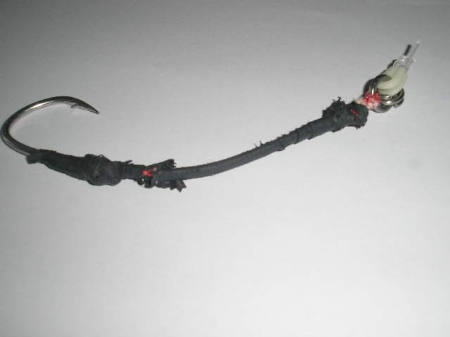

| Torcea wrote: I am not trying to high jack your post Andre... Just another idea
AHole showed me this and I find it is bullet proof
Heat shrink with glue holds the Chain link at 90 degrees to the hook
so when the split ring is added the hook always faces out and never
becomes snagged on the jig there for makes for better hookup rates
.Having the heat shrink up the chain link preserves the quality of the braid
connection against the cheap split rings . |

| Mr Plastic wrote: Mustard do a 49 strand wire that is very flexable due to the number of strands and wont retain memory if bent around on itself. The secret is to have a swivel on the wire at the top end, this gives it great movement. Bulletproof.. cuda have no show. Check this vid----- http://www.youtube.com/watch?v=SQpmRtV4K9Q. Here is one i made up with 4 strands of 50kg kevlar cord, owner sj-41 and size 8 owner solid ring.
.
|


Whitebait season underway Spring is here, and along with it, the good old Canterbury nor-Wester!... Read More >
Fishing hard, weather conditions trying. Cold winds and lots of rain have made for testing... Read More >
Workups building as spring approaches. Spring is starting to show its hand in the outer... Read More >
Pacific bluefin tuna return. The day after I submitted the last report, we were out... Read More >


Major Bites
Minor Bites
Major Bites
Minor Bites

 Forum Topics
 New Posts
 Search
 FAQ
FAQ Register
 Login
Login


 Topic Options
 Post Options
 Likes(0)


