Life jackets when wading ????????????

Post Options Post Options   Likes (0) Likes(0)   Quote bazza Quote  Post ReplyReply Direct Link To This Post Topic: Life jackets when wading ????????????
    Posted: 15 Dec 2014 at 8:11am
bazza View Drop Down
Titanium
Titanium
Avatar
OBE - Over Bloody Eighty

Joined: 12 Dec 2006
Location: Mostlyinthepoo
Status: Offline
Points: 17915
A couple of days ago I was asked if I wore a life jacket wading rivers when fly fishing.

Must confess altho I always carry them on the boat, the thought has never crossed my mind of wearing one whilst wading rivers. Neither can I re call ever seeing one being worn, however given my record of having experienced several unscheduled short trips downriver began to wonder if doing so might be appropriate. Sure it would be an unwelcome extra
item to be worn on top of a vest or whatever but surely an inflatable would not add that much bulk.

They are as far as I am aware almost mandatory for white water rafting or kayaking rivers so why not when wading?

What are other members thought on this ?

When you cry, feel pain or sadness, no one notices your sorrow .... BUT
fart just ONE time !!!!!!!!!!!
Back to Top
Post Options Post Options   Likes (0) Likes(0)   Quote Rainbow Quote  Post ReplyReply Direct Link To This Post Posted: 15 Dec 2014 at 9:18am
Rainbow View Drop Down
Topic Moderator
Topic Moderator


Joined: 27 Jul 2005
Status: Offline
Points: 3315
I Don't think I would wear a life jacket but here is a cautionary tale about breathable waders.     

A Timely Wake-Up Call   
Herb Spannagl
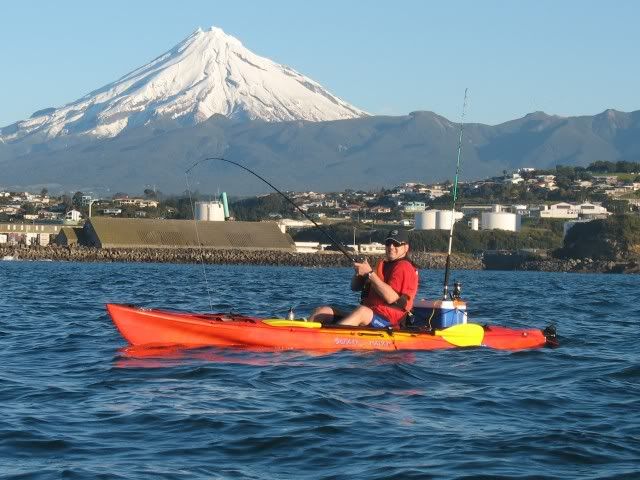
An unusually windy January offered few opportunities for us West Coasters to venture out wide looking for tuna.    Halfway through the month the wind eased for a day but the sea was still heaving with a 3- 4m swell.   After checking out the various Oracles my friends and I decided the conditions were manageable to head out into blue water.   We cleared the New Plymouth harbour and for the next three hours covered a lot of sea without finding fish.   The westerly kicked in just in time to inflate the sails for the homeward run.   When we approached the harbour the tide was in and big waves crashed right over the main breakwater and part of the port entrance, forcing us to circle wide before entering the port.    Confident that I was clear of the breakers I had kept the sail up and had left my trolling line out.   Suddenly the kayaker on my left yelled: ”Here is a good one”. I quickly looked over my shoulder but it was already too late.   Only metres behind me roared a monster wave with a menacing breaking top.   Before I could brace its steep face picked up my kayak’s stern at such a steep angle that the bow dug in and the kayak flipped.   Luckily I was still hanging onto the paddle when I came up.    The kayak was upside down and as I pulled it towards me on the paddle leash I could feel other lines trailing from the kayak.   The sail had collapsed, I could feel my rods hanging from their tethers and try as I might I could not flip the kayak the right way up.    Worse of all a strong outgoing current was dragging me back towards the breakers.    My two mates who had been slightly ahead realised my predicament and came back to assist.    Before we could do anything we had to get further into the port to get clear of the outward current.    I hung onto one kayak, while my other mate towed my kayak.    In calmer water and with a lot of combined effort we eventually righted my kayak.   As we were to discover later it was the amount of water trapped inside the insulated icebox that made the job so difficult.    

I normally have no trouble getting back onto the kayak but on that occasion I just could not launch myself far enough over the deck.    As I repeatedly slipped back I could feel the energy draining from my body.   Eventually I made it and as I did I realised why I had had so much trouble.   Each leg of my breathable waders contained a lot of water making it very difficult to pull myself up.   I still don’t know how I ended up kneeling in the foot wells and with my kayak tightly wedged between my mates’s kayaks I could not hang my legs over the side to roll back into my seat.   When I finally managed to plant my butt the water in my waders spread horizontally making me feel as if I were sitting in a shallow bathtub.   It was only after we got to the ramp that I realised just how much water was inside.    Before I could stand up I had to lie head down on the ramp to drain my waders.    I had worn these waders for a number of years and with a tight wading belt around my waist I had re-entered during several practice sessions without much water getting past the belt.   This and some Youtube clips had convinced me that stocking foot waders were safe.

I don’t mind admitting that the whole episode left me a bit rattled.   Eventually I calmed down enough to check over the damage.    One of the mast bases had broken, there was water in my “waterproof” radio bag yet the “Voyager” was still transmitting messages from the Coast Guard, my Lowrance sounder was still alive, my Olympus camera was wet but still working and both my rods were there too. Amazingly I had only lost the lure and a fair chunk of my pride.    As they say it could have been worse, far worse, actually.

It took me a day or two to debrief this event.    I made a list of thirteen contributing factors, some of which I shall detail below.
1.     My first decision was to ditch the waders and buy a pair of buoyant neoprene kayak pants.   Another aid to re-entering is wearing buoyant Crocs type footwear, which with the neoprene pants keep the legs near the surface.   I had worn them without using the heel straps and they had simply floated off.    
2.     A few days later Martin Rook, who was one of my rescuers did a re-enter exercise in the shallows and to his great surprise found that the submerged sail was no great hindrance when flipping the kayak over.   Neither did he have any trouble folding it up beneath the kayak by first releasing the forward bungie.   The only problem he identified was that his personal tether was too short to reach the bow.   
3.     However, his biggest surprise was his difficulty to flip the kayak over with a half flooded icebox.   Following that revelation I resolved that in future I would not secure the icebox, making it easier to dump it in an emergency.
4.     With all the cords and fishing lines hanging from the kayak I exchanged my folding knife I carry inside my PFD for a more accessible divers knife that can be strapped to my leg.
5.     Maybe it is my middle age spread but during my swim my tight fitting PFD floated up leaving me somewhat suspended.    I have now built in a crotch strap, which I can tighten keeping the PFD where it should be.    The strap does not pinch when I am sitting down.   
6.     Learning how water in the icebox impeded righting I had a good look at my hatches making sure they are waterproof.    I am happy with the seals on both my forward hatch cover and the centre well lid, which I now keep closed and strapped down at all times.
7.     For a long time one of my pet hates has been the thoughtless protrusions on the gunnels near the seat, such as saddles, brass clips, hooks and buttons as well as some handles, which are perfectly located to catch on a wet suit or PFD during re-entry.   Some PFDs have chest straps and pockets that also catch on the above fixtures as the kayaker pulls him or herself over the gunnels.   I noticed one of my pocket zip closures was missing and must have got ripped off during my attempts to get back on board.   Lets face it re-entry is hard enough without having to try slithering over ill placed obstacles.   PFD chest pockets are very handy for all manner of cargo but the downside is that this added bulk also hampers re-entry.
8.     With a sail, paddle and rod leashes there are numerous cords floating around or hanging down in a capsize.    What item is attached to which cord can be quite confusing, especially when some cords are tangled with others.   One idea is to use different coloured cords for quick identification.   

My mishap made me realise how easy it is to become complacent.    In a somewhat perverse way I am glad this incident happened because it has forced me to look hard and to look close.    When I consider the above list this has been a timely safety wake-up call.    I wonder how many others have confronted an honest personal safety check?

While I had a hard look at the use of breathable waders for kayak fishing I also remembered that I had only last year “upgraded” from buoyant neoprenes to non-buoyant breathables for winter fly fishing on the Tongariro.   Years ago we tested neoprenes by jumping into a local river and even when we filled them with water they remained buoyant.   This has been born out by a number of unfortunate anglers who have survived floating down several Tongariro rapids.    Much has been made of the need to wear a wading belt with breathables to stop water entering.    However, my experience has shown that this is an illusion.   The wading belt is around one’s waist, which leaves a loose bib that extends right under the armpits.    This bib acts like a funnel if the floater tries to stand up, hang onto a rock or even tries to swim against or across the current.   Once water is trapped in the bib current or gravity can force it past the belt into the lower part of the waders.   I am sure my repeated attempts to get up onto the kayak funnelled much of the water down my waders.

The realisation that breathables can so easily turn into a death trap has made me doubly cautious when wading over the boulder-strewn bed of the Tongariro.    No more crossings where the wading stick starts to vibrate, the knees begin to shake like an old fashioned sewing machine and the inevitable question: “Is this going to be it?” forces itself on one’s mind.   Much as I love the outdoors this little “What if” reflection has been good for me.    It is also time well spent for all with a passion for the Wild.     
Back to Top
Post Options Post Options   Likes (0) Likes(0)   Quote o Neill Quote  Post ReplyReply Direct Link To This Post Posted: 15 Dec 2014 at 10:30am
o Neill View Drop Down
Platinum
Platinum


Joined: 22 Apr 2011
Status: Offline
Points: 1405
Learn a lesson from WW2 paratroops and carry a flick type knife on a lanyard. The US paras carried these so even with a broken arm they could cut themselves free of their parachute cords.
Ok spring loaded knives are illegal but my Leatherman blades I can open with one hand and would soon make short work of wader pockets/legs filling with water, ok waders buggered but beats drowning
Back to Top
Post Options Post Options   Likes (0) Likes(0)   Quote flyfisher Quote  Post ReplyReply Direct Link To This Post Posted: 15 Dec 2014 at 10:43am
flyfisher View Drop Down
Titanium
Titanium
Avatar

Joined: 06 Apr 2006
Location: Wellington
Status: Offline
Points: 5978
Just about killed myself wading at Otamangakau a few times sinking into that quick-mud! Been thinking about using my inflatable pfd there next time for this very reason!... As a side, if you ever find yourself sinking in mud.. kneel and shuffle along on your knees, spreads the surface area and makes a huge difference.

Agree with Rainbow on neoprene vs breathables, neoprene waders are great for floating feet up! Taken far too many swims over the years to know this!
https://www.youtube.com/user/troutboynz
Back to Top
Post Options Post Options   Likes (0) Likes(0)   Quote bazza Quote  Post ReplyReply Direct Link To This Post Posted: 15 Dec 2014 at 11:31am
bazza View Drop Down
Titanium
Titanium
Avatar
OBE - Over Bloody Eighty

Joined: 12 Dec 2006
Location: Mostlyinthepoo
Status: Offline
Points: 17915
Re wearing a belt :-

Quite a few years ago when a member of AFAC the club organised a water safety morning at the Mt Wellington pool, run by a nice lady from the Water Safety Council & tailored specifically towards freshwater ie rivers / lakes.

It was interesting that the WSC did not advocate using a waist belt as there were certain inherent risks such as air trapped below the waist tends to tip your body backwards & be carried down river backwards which as well as obscuring your vision of where you are heading which runs the risk of hitting your head on a rock whereas without a belt there is more chance of both seeing the rock then using your legs to bounce off it.

She did not advocate NOT wearing a belt either but advised trying both methods so as to make a personal choice then to illustrate the point promptly jumped in the pool in an old fashioned pair of heavy rubber steel studded waders sans a belt then proceeded to rather effortlessly complete several lengths of the pool. Those of us that had brought along belts tried jumping in then doing likewise both with & without wearing a belt resulting in everyone without exception agreeing they felt more confident without a belt.

She made the point that apart from being rendered unconscious from hitting your head on a rock that most fresh water drownings happen once the person has their feet back on the ground then tries to stand up to reach the bank as the weight of the water in the waders makes it impossible & causes complete exhaustion. They advise dog paddling or kicking the bottom to reach the shore then roll out like a walrus so the water drains before trying to stand or crawl.

Another unwelcome aspect is that white water is comprised of a large % of air bubbles therefore does not provide adequate buoyancy but conversely mixed with enough water that does not allow you to breathe the air when semi submerged therefore if about to hit white water try to take a deep breathe & hold it as long as possible.   
When you cry, feel pain or sadness, no one notices your sorrow .... BUT
fart just ONE time !!!!!!!!!!!
Back to Top
Post Options Post Options   Likes (0) Likes(0)   Quote corokid Quote  Post ReplyReply Direct Link To This Post Posted: 15 Dec 2014 at 12:02pm
corokid View Drop Down
Platinum
Platinum


Joined: 05 Jun 2006
Location: Auck-Coromandel
Status: Offline
Points: 2051
I am fairly conservative when wading alone , unwritten rule of not going over knee deep . Allow a little more in slow waters with firm bottom. But even shallow water knee deep or less is hazardous when fast flowing and slippery rocky bottom. My best insurance for this is a folding wading staff attached to a lanyard in holster on belt. Using in upstream hand . Having this always at hand rather than relying on a stick you may not have when commited halfway through a crossing that gets dodgy.
I do have an inflating vest if required. Like wading at night at stream mouths.
Back to Top
Post Options Post Options   Likes (0) Likes(0)   Quote bazza Quote  Post ReplyReply Direct Link To This Post Posted: 15 Dec 2014 at 3:46pm
bazza View Drop Down
Titanium
Titanium
Avatar
OBE - Over Bloody Eighty

Joined: 12 Dec 2006
Location: Mostlyinthepoo
Status: Offline
Points: 17915
Yep Dave I am getting one of those fold up wading poles as a chrissy pres but was granted permission to use it when away last week as thought it would be rather ironic if I drowned & it was still sitting under the xmas tree.

I found it fantastic to use apart from the fact it is a bit long which is probably due to being a bit vertically challenged.

They rely on a rubber cord to fold up or to deploy so was wondering if anyone knows if they can be shortened by cutting off say approx. 15 cm from one of the sections & the cord?
When you cry, feel pain or sadness, no one notices your sorrow .... BUT
fart just ONE time !!!!!!!!!!!
Back to Top
Post Options Post Options   Likes (0) Likes(0)   Quote corokid Quote  Post ReplyReply Direct Link To This Post Posted: 15 Dec 2014 at 6:34pm
corokid View Drop Down
Platinum
Platinum


Joined: 05 Jun 2006
Location: Auck-Coromandel
Status: Offline
Points: 2051
I imagine you could cut one end off Bazza , should be fairly long but.

Was going to say you should not have any trouble in the local coro streams we talked about. But saying that a mate of mine got into a bit of bother sorting out his whitebait stand in what could be descibed as a creek. Had to slip out of waders as he was alone stuck in the mud. 
Back to Top
Post Options Post Options   Likes (0) Likes(0)   Quote bazza Quote  Post ReplyReply Direct Link To This Post Posted: 15 Dec 2014 at 7:43pm
bazza View Drop Down
Titanium
Titanium
Avatar
OBE - Over Bloody Eighty

Joined: 12 Dec 2006
Location: Mostlyinthepoo
Status: Offline
Points: 17915
Originally posted by corokid corokid wrote:

I imagine you could cut one end off Bazza , should be fairly long but.

Was going to say you should not have any trouble in the local coro streams we talked about. But saying that a mate of mine got into a bit of bother sorting out his whitebait stand in what could be descibed as a creek. Had to slip out of waders as he was alone stuck in the mud. 


Yep ...... we tend to under estimate the possible risk factor associated with that which we consider to be rather docile water.

Without going into details a couple of the biggest scares or sobering experiences I have had were on the Waihou which up until then I had considered to be rather benign safety wise.

As yourself & FlyFisher have said wearing waders in mud can be potentially lethal ( sorry Eric ) as I discovered when attempting to foolishly night flyfish in the upper harbour & once in trouble had serious doubts with a rapidly rising tide as to if I would be alive see the sun rise in the morning.
When you cry, feel pain or sadness, no one notices your sorrow .... BUT
fart just ONE time !!!!!!!!!!!
Back to Top
Post Options Post Options   Likes (0) Likes(0)   Quote skunk'd_again Quote  Post ReplyReply Direct Link To This Post Posted: 15 Dec 2014 at 7:48pm
skunk'd_again View Drop Down
Silver
Silver


Joined: 30 Jun 2012
Status: Offline
Points: 414
I've done more than my share of silly bugger antics wearing waders. The most unnerving is when you're standing in the middle of a swift run and when you pause the freestone river bed starts moving under your feet. It definitely scares me straight, for a while. Never considered a lifejacket before either. You know if Simms bought out a stylish camo gortex one most people would go buy it, especially if it had the word "Guide" written on it, although that would automatically make it three times the price. Big smile    
Back to Top
Post Options Post Options   Likes (0) Likes(0)   Quote Essexkiwi Quote  Post ReplyReply Direct Link To This Post Posted: 15 Dec 2014 at 9:23pm
Essexkiwi View Drop Down
Bronze
Bronze


Joined: 27 Aug 2012
Location: Tauranga
Status: Offline
Points: 84
I think whether or not to wear a PFD comes down to knowing your own personal abilities and limitations.

I've used both neoprenes and breathables, and done wader safety training in both.  I definitely feel more comfortable in neoprenes because of the inherent bouyancy even if they get water inside, and also prefer wearing a belt with both. 

Knowing proper technique if you end up going downstream unexpectedly, especially what not to do, is in my opinion more important than what you're wearing.  Reliance on equipment to get you out of the crap is never a great Plan B to rely on either.  Equipment can fail.

If you're fit, a good swimmer, and consciously competent in wader safety then you probably don't need a PFD river fishing (river mouths of course are a different story). 

If however you can tick a few boxes in the list of being old, in poor physical shape, a weak swimmer, and have never done a wader safety course, then investing in a PFD or integrated inflatable vest is probably a good idea. 

Back to Top
Post Options Post Options   Likes (0) Likes(0)   Quote JB Quote  Post ReplyReply Direct Link To This Post Posted: 15 Dec 2014 at 9:37pm
JB View Drop Down
Platinum
Platinum
Avatar

Joined: 16 Sep 2002
Location: Christchurch
Status: Offline
Points: 1629
When I fish in the Waitaki i always throw on a manual blow up life jacket. After 10 minutes wearing don't even know it's on. Never had to use it but if I ever do need it,it's not sitting in the boat . It is reasonably common for the Waitaki due to its fast flow. I'm now in the habit so generally through it on. Can't see why you wouldn't now. Too many good memories to make for me not to wear one.
Back to Top
Post Options Post Options   Likes (0) Likes(0)   Quote Rainbow Quote  Post ReplyReply Direct Link To This Post Posted: 15 Dec 2014 at 10:43pm
Rainbow View Drop Down
Topic Moderator
Topic Moderator


Joined: 27 Jul 2005
Status: Offline
Points: 3315
Getting stuck in the mud is no fun at all.     I got stuck on the top end mud flats of Lake Aniwhenua stalking cruising browns.     I was wading wet and made one step too many and before I knew it started to sink in.    The more I tried to get one leg out the deeper the other one sank.    I had no option but to throw myself forward and slither through the mire before I could safely stand up.    What a mess.      

Re Waders.    the trapped air is largely a Myth because when you are standing up the water pressure pushes all the air out.     You would have to dive in head first to trap inside the waders.      On the other hand a bit of air would help to keep you feet up as you are screaming down the rapids hopefully feet first.     Years ago we were monitoring Blue Ducks on the Manganuioteau From the National Park to Ohakune HW bridge down.     We always floated on an inner tube wearing wet suits, helmets and boots to kick ourselves off the cliffs or those large boulders.      Not a good idea to go down head first.


Back to Top
Post Options Post Options   Likes (0) Likes(0)   Quote Kenshin Quote  Post ReplyReply Direct Link To This Post Posted: 15 Dec 2014 at 10:44pm
Kenshin View Drop Down
Platinum
Platinum
Avatar

Joined: 01 Feb 2008
Location: JAFA Land
Status: Offline
Points: 2972
http://www.torpedo7.co.nz/products/2RLJINNCA/title/rfd-catalyst-inflatable-lifejacket---adult
Be patient and calm – for no one can catch fish in anger. –Herbert Hoover
Back to Top
Post Options Post Options   Likes (0) Likes(0)   Quote JB Quote  Post ReplyReply Direct Link To This Post Posted: 18 Dec 2014 at 9:54pm
JB View Drop Down
Platinum
Platinum
Avatar

Joined: 16 Sep 2002
Location: Christchurch
Status: Offline
Points: 1629
Hi guys,
Just read this article and though I'd post link.
http://m.nzherald.co.nz/nz/news/article.cfm?c_id=1&objectid=11376365
Back to Top
Post Options Post Options   Likes (0) Likes(0)   Quote letsgetem Quote  Post ReplyReply Direct Link To This Post Posted: 19 Dec 2014 at 7:40pm
letsgetem View Drop Down
Titanium
Titanium
Avatar

Joined: 09 Oct 2008
Location: Whangaparaoa
Status: Offline
Points: 3318
Reminds me, of about 5 years ago - arrived from upstream at the pool below where Pouto stream comes into the Tongariro. After fruitless fishing of the wrong side of Pouto run, I eyed Waddells run. Wanted to get over the other side, so I found a strong and long stick, and walked into the bottom of the pool. It got deeper and deeper - when I was at the point of no-return (if I had tried to turn I would have arsed over), the water was about 15cm below the top of the waders (neoprene). I got so buoyant, it felt like I imagine walking on the moon. Just a fluke I didn't go over, and fish Waddells run a lot faster than I planned!
Back to Top
Post Options Post Options   Likes (0) Likes(0)   Quote flyfisher Quote  Post ReplyReply Direct Link To This Post Posted: 22 Dec 2014 at 10:24pm
flyfisher View Drop Down
Titanium
Titanium
Avatar

Joined: 06 Apr 2006
Location: Wellington
Status: Offline
Points: 5978
Wow... what a coincidence... today, I went completely under in a soft spot wading Otamangakau... so did Jack 10m away from me at the same time!!! I panicked as he was asking me to help him before I went under.... but I found I could kinda doggy-paddle quite fine wearing some Simms G3's completely filled!

Only needed to go 1-2m to get solid ground again, what DID help was my pack again... roll-top waterproof packs are a lifesaver!!! Could feel it help me with lift... I really though I was in trouble for a second, not pleasant. Caught it all on video which I'll post, you can see Jack also up to his neck almost! We both got out, wet...
https://www.youtube.com/user/troutboynz
Back to Top
Forum Jump
Forum Permissions View Drop Down


This page was generated in 0.367 seconds.

Fishing Reports Visit Reports

Saltwater Fishing Reports
Raglan Fishing Report - 11/06/26

Solid snapper hook-ups out deep With the continuation of more settled weather there’s been some... Read More >

11 Jun 2026
Freshwater Fishing Reports
Canterbury Fishing Report - 11/06/26

Brave the cold, reap the rewards With a big southerly blow through here yesterday, it’s... Read More >

11 Jun 2026
Saltwater Fishing Reports
Bay of Islands Fishing Report - 11/06/26

Junior anglers celebrate potential world records The McDonald’s Northland 56th International Yellowtail Tournament kicked off... Read More >

11 Jun 2026
Saltwater Fishing Reports
Tauranga Fishing Report - 28/05/26

Tarakihi on the bite Trips are few and far between at this time of year,... Read More >

28 May 2026
Fishing bite times Fishing bite times

Major Bites

Minor Bites

Major Bites

Minor Bites