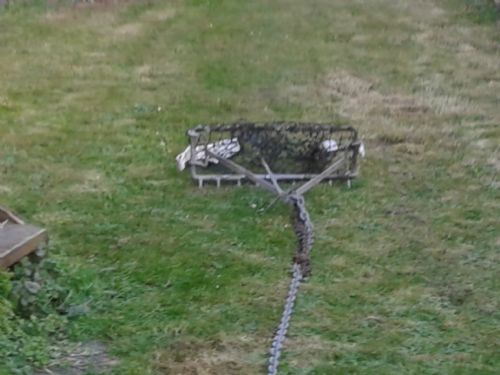
Best rope for towing scallop dredge

Page  12>
Post Options Post Options   Likes (0) Likes(0)   Quote Surf_fisher Quote  Post ReplyReply Direct Link To This Post Topic: Best rope for towing scallop dredge
    Posted: 05 Aug 2017 at 5:23pm
Surf_fisher View Drop Down
Gold
Gold
Avatar

Joined: 28 Jul 2013
Location: Hamiltron
Status: Offline
Points: 644
I am going to put my tinfoil hat on here as I know dredging is a touchy subject and before anyone has a go at me about dredging for scallops I can not dive or use a snorkel.

All I am wanting to know is what is the best rope and diameter to use to make a bridle and towline as september will be my first time I have ever been able to go and get a feed of fresh scallops instead of being ripped off by fish and chip shops or paying through my nose at the supermarket.

Callsign: ZMU 4809
Back to Top
Post Options Post Options   Likes (1) Likes(1)   Quote smudge Quote  Post ReplyReply Direct Link To This Post Posted: 05 Aug 2017 at 7:13pm
smudge View Drop Down
Moderator - Ninja
Moderator - Ninja
Avatar

Joined: 17 Jul 2002
Location: Te Toro
Status: Offline
Points: 33744
Hi Hunter, don't worry about those who cry about dredging. Some people are just a little too precious. How deep will you be fishing? My scalloping is all in the Manukau harbour around 4 to 5m deep. I have a length of chain maybe 5m long and a 12mm polypropylene rope. Prior to that I had a 10mm rope (the sinking type) and it was better. I just use a 'standard' dredge and they work very well in the shallow water. the critical thing (apart form being where the scallops are) is to get the speed right. My first dredge allowed me to drag quite quickly - 4 knots but the one i have now needs to go a little slower at 2 knots. It's not unusual on a good bed to get 40 or more scallops in one 5 minute drag.
Best gurnard fisherman in my street
Back to Top
Post Options Post Options   Likes (0) Likes(0)   Quote veitnamcam Quote  Post ReplyReply Direct Link To This Post Posted: 05 Aug 2017 at 8:19pm
veitnamcam View Drop Down
Silver
Silver


Joined: 12 May 2016
Status: Offline
Points: 180
Rig a small float on your dredge line at the point you tie onto the bridal incase of breakage.
What type of dredge?
Most dredges will work well in less than 10m
15-20m foil types generally work well and start to struggle deeper than that.
You can get them to work in 30m plus but that generally requires 110m  or more of thin 8-10mm rope and maybe a couple of weights on the line.

rule of thumb 3x depth =amount of line out.
Back to Top
Post Options Post Options   Likes (0) Likes(0)   Quote MB Quote  Post ReplyReply Direct Link To This Post Posted: 05 Aug 2017 at 8:33pm
MB View Drop Down
Titanium
Titanium
Avatar

Joined: 08 Jan 2016
Location: Northland
Status: Offline
Points: 6020
How about offering to take a diver out and splitting the bounty. Everybody happy? Smile
Back to Top
Post Options Post Options   Likes (0) Likes(0)   Quote Surf_fisher Quote  Post ReplyReply Direct Link To This Post Posted: 05 Aug 2017 at 8:37pm
Surf_fisher View Drop Down
Gold
Gold
Avatar

Joined: 28 Jul 2013
Location: Hamiltron
Status: Offline
Points: 644

Most of my dredging will be in no more than 20 meters, most of the time will be around the 3 - 15 meter range if dredging in Kawhia harbour which is where I usually take the boat which is a fish city FC 390 with 30 HP mercury I may give the east coast a whirl every now and then if I am going on a mission to waiheke like I did last sunday. I got my dredge secondhand off trademe for $25 and it came with around 4-5 meters of what looks like close link chain


Callsign: ZMU 4809
Back to Top
Post Options Post Options   Likes (0) Likes(0)   Quote Surf_fisher Quote  Post ReplyReply Direct Link To This Post Posted: 05 Aug 2017 at 8:42pm
Surf_fisher View Drop Down
Gold
Gold
Avatar

Joined: 28 Jul 2013
Location: Hamiltron
Status: Offline
Points: 644
Originally posted by MightyBoosh MightyBoosh wrote:

How about offering to take a diver out and splitting the bounty. Everybody happy? Smile

Maybe because I don't have the room on my boat for tanks etc and it is not set up to cater for divers and why should I have to wait to find a diver to come out with me. This is the last time I want to see divers mentioned in this thread please.

Callsign: ZMU 4809
Back to Top
Post Options Post Options   Likes (0) Likes(0)   Quote MB Quote  Post ReplyReply Direct Link To This Post Posted: 05 Aug 2017 at 8:45pm
MB View Drop Down
Titanium
Titanium
Avatar

Joined: 08 Jan 2016
Location: Northland
Status: Offline
Points: 6020
Fair enough, just a thought.
Back to Top
Post Options Post Options   Likes (0) Likes(0)   Quote Surf_fisher Quote  Post ReplyReply Direct Link To This Post Posted: 05 Aug 2017 at 10:23pm
Surf_fisher View Drop Down
Gold
Gold
Avatar

Joined: 28 Jul 2013
Location: Hamiltron
Status: Offline
Points: 644
Originally posted by MightyBoosh MightyBoosh wrote:

Fair enough, just a thought.

All good mate Smile

Callsign: ZMU 4809
Back to Top
Post Options Post Options   Likes (0) Likes(0)   Quote Steps Quote  Post ReplyReply Direct Link To This Post Posted: 06 Aug 2017 at 10:39am
Steps View Drop Down
Titanium
Titanium


Joined: 14 Oct 2013
Location: Franklin
Status: Offline
Points: 12854
The best description, ANYWHERE and shame Smudge hasnt provided a link, is his  thread in the forums and a article in the how tos
 WQe started messiong around last yr.. set up bridle etc as Smudges instructions..Discissing this later, he had a bridle cause keeps a little boat less power, straight.
Dropping the bridle wa the 1st thing to go.

Rope, well lost an anchor while back, and use the old  spare 10mm warp.
Just how much 'strain' does it put out the back.. to be honest..its disappointingly little. Pulling up from 18/20m is far greater. Even so put on the stern cleat, and take the weight holding on...keeping 'feel' one knows its on the bottom working, and if full.
 How far can you get down? With around 50/55m of warp, and mete or so if 10mm short link anchor chain we can drag 18m but getting to around 20/ 21m it becomes suspect on the bottom.
We also hook one of the long line bouys with 3mm braid onto the frame.. just incase someone forgets to keep the warp on the cleat...

Do search of the sier for Smudges instructional.
Back to Top
Post Options Post Options   Likes (1) Likes(1)   Quote MATTOO Quote  Post ReplyReply Direct Link To This Post Posted: 09 Aug 2017 at 7:43pm
MATTOO View Drop Down
Titanium
Titanium


Joined: 10 Sep 2010
Location: The Dawn
Status: Offline
Points: 7951
The secret is as follow.
Lower dredge down slowly and clean so the mesh lays without engaging in hook ups.
Doing this while moving ahead.
Use a heavy chain 10 or 15 mm it needs to be heavy.
Or use length on a lighter chain.
Small diameter rope, and strong rope is a key.
Length is another, use plenty of length, say 20 m for 5-6 m and greater for deeper.
Pull as slow as you can that makes headway.
On a good bed, full cage in less than five minutes.
Job done.
Then go fishing.
Still cruising in my now sweetas pimped out Southern 755 HT0!
Back to Top
Post Options Post Options   Likes (1) Likes(1)   Quote MacSkipper Quote  Post ReplyReply Direct Link To This Post Posted: 10 Aug 2017 at 6:28am
MacSkipper View Drop Down
Titanium
Titanium
Avatar

Joined: 04 Jul 2014
Location: Manukau Harbour
Status: Offline
Points: 4478
Originally posted by MATTOO MATTOO wrote:

The secret is as follow.
Lower dredge down slowly and clean so the mesh lays without engaging in hook ups.
Doing this while moving ahead.
Use a heavy chain 10 or 15 mm it needs to be heavy.
Or use length on a lighter chain.
Small diameter rope, and strong rope is a key.
Length is another, use plenty of length, say 20 m for 5-6 m and greater for deeper.
Pull as slow as you can that makes headway.
On a good bed, full cage in less than five minutes.
Job done.
Then go fishing.
I found GPS very useful as can monitor speed through water and track - an experienced mate said main mistake is towing to fast and bouncing dredge along bottom - walking pace is aim.  You can use a land feature and a marker to check if moving as well, its tricky in tidal currents - hence why I like using GPS.
Good fishing trip nothing breaks, great trip catch fish.
Back to Top
Post Options Post Options   Likes (0) Likes(0)   Quote smudge Quote  Post ReplyReply Direct Link To This Post Posted: 10 Aug 2017 at 3:46pm
smudge View Drop Down
Moderator - Ninja
Moderator - Ninja
Avatar

Joined: 17 Jul 2002
Location: Te Toro
Status: Offline
Points: 33744
Thanks Steps, I should have posted that link I'll try and find it.
I agree 100% with Mattoo, that's exactly what I do. A GPS is great and I map out an area so I know where there is mud and where there are scallops. I just hold the rope and can tell by the feel of it if I am moving too fast, not at all or if it is in mud.
Best gurnard fisherman in my street
Back to Top
Post Options Post Options   Likes (0) Likes(0)   Quote Surf_fisher Quote  Post ReplyReply Direct Link To This Post Posted: 10 Aug 2017 at 6:37pm
Surf_fisher View Drop Down
Gold
Gold
Avatar

Joined: 28 Jul 2013
Location: Hamiltron
Status: Offline
Points: 644
Thanks for the comments so far guys and when you find your link smudge I will definitely read it as I have used the search function to try and find it but alas I could not. plotter will definitely be used while dragging the dredge as I will be marking spots where I find scallops for future reference.

Callsign: ZMU 4809
Back to Top
Post Options Post Options   Likes (0) Likes(0)   Quote smudge Quote  Post ReplyReply Direct Link To This Post Posted: 10 Aug 2017 at 7:46pm
smudge View Drop Down
Moderator - Ninja
Moderator - Ninja
Avatar

Joined: 17 Jul 2002
Location: Te Toro
Status: Offline
Points: 33744
If you ever make it up to Waiuku I'd be happy to show you what we doHunter
Best gurnard fisherman in my street
Back to Top
Post Options Post Options   Likes (0) Likes(0)   Quote smudge Quote  Post ReplyReply Direct Link To This Post Posted: 10 Aug 2017 at 8:18pm
smudge View Drop Down
Moderator - Ninja
Moderator - Ninja
Avatar

Joined: 17 Jul 2002
Location: Te Toro
Status: Offline
Points: 33744
Here's a link to an article I wrote. It was heavily edited but 90% of it was my work:

http://www.nzfishingworld.co.nz/latest/2015/12/scallop-days-are-here-again
Best gurnard fisherman in my street
Back to Top
Post Options Post Options   Likes (1) Likes(1)   Quote smudge Quote  Post ReplyReply Direct Link To This Post Posted: 10 Aug 2017 at 9:18pm
smudge View Drop Down
Moderator - Ninja
Moderator - Ninja
Avatar

Joined: 17 Jul 2002
Location: Te Toro
Status: Offline
Points: 33744
And here's something else I wrote, I think this is the article Steps was referring to:

Dredging for scallops

Scallops are one of many real delicacies to come from the sea but many people consider gathering them for themselves is just too hard to bother with. Instead they will settle for some bought from the local supermarket, where they will be clean, hassle free and if you’re lucky several days old.

While diving is an environmentally friendly option for gathering scallops it is beyond the means of many of us. I‘ve never dived and probably never will as I’m much happier sitting in a boat or on the shore breathing in air as nature intended, with nothing likely to sneak up behind me and bite me in half. An irrational fear for sure but that’s how it is. Needless to say I can’t teach you about diving for scallops but I certainly respect those who do and I leave those scallop beds alone. I do all of my dredging on the Manukau Harbour in areas where people don’t dive. Other west coast harbours have similar scallop beds so together with a little local knowledge the same techniques will apply.

The areas I target are generally around 4 to 5 metres deep at high tide, meaning that they are in very shallow water at low tide. That’s an important piece of advice right there because the easiest way to collect scallops is to stop at an exposed sand bar at low tide. If you choose a very big tide then harbours such as the Manukau and Kaipara will have large exposed mud flats at low tide.  It’s then a simple matter of wading the shallows and picking them up. It couldn’t be easier and it also shows you exactly where they are or alternatively, where they aren’t. Either way, you learn! You do need a keen eye to spot them but it is very easy to select the bigger ones. Of course you need to ensure that your boat is well anchored or you have a boat man onboard because if for any reason you can’t get back to your boat things will get very serious very quickly, especially as the tidal movement on the big tides will be severe.

I’ve heard many different theories about how you must drag against the tide and just as many that say you must go with the tide. My theory is that it doesn’t really matter! Recently after a bit of a fishing session with my youngest son Scott, we decided to dredge for scallops. I set us on a course, telling him to aim for something in the distance. At 16 he’s old enough to operate the boat and I went through the controls with him, giving him instructions not to touch the throttle and to let me know if any boats approached. As I busied myself setting the dredge, a process that took maybe a couple of minutes and not a word from Scott I looked up and saw we were heading back to where we came from. Having just completed a half circle there was nothing for it but to stop the boat and reset the drag. When it came in we had near our limit of 30 legal scallops.

That experience emphasises two important points: direction is not critical and you don’t need to tow the dredge for more than a few minutes – especially while you’re prospecting for them. Once the net is full you are simply disturbing the sea floor for no reason and several short drags will soon tell you if you are in the right spot.

The set up I use is just one of those budget models available from most of the bigger stores, I have 5 metres of 6mm chain attached to it and 20 metres of 10mm rope with the end tied to a stainless steel ring I had made up. Off that ring I have two ropes of around 3 metres long with a loop tied in the end of each one. I put each loop on the rear cleats of my boat. Alternatively you can just attach the rope directly to one cleat but that will cause the boat to slew to the side that the dredge is attached to. I don’t recommend that for small boats, especially if the sea is anything but calm. A ski pole makes the best attachment point but my bridle set up works just as well. Remember to attach the dredge to the cleat or pole before you do anything else, I’ve heard of many of them disappearing over the stern!

Before you set out make sure that the rope is coiled so it won’t tangle and there is nothing in the way that will prevent its smooth progress out the back end of your boat.

When I start to deploy the dredge I do so smoothly keeping tension on the rope at all times. That keeps it from tumbling or getting tangled up in the chain or rope. Once it is on the bottom, I feel for it ‘bumping’ along the sea floor which is similar to when you are drift fishing with a heavy sinker bouncing along a stony sea bed. If the rope goes tight and there is just a smooth heavy pull on the rope you will be scooping up mud and you don’t want that! You also don’t want to put the dredge out at speed, I get my boat chugging along just off idle and once the whole thing is out I increase speed to 3 knots which is around 1200rpm on my boat. A lot of people want to help you with this task but it really is best if you put the dredge out yourself. When you do, be careful not to wrap the rope around your hand. I’ve seen a few do that, luckily not when the dredge has struck heavy mud. If people are keen to help have one steer the ship and the others can keep a look out for other vessels.  Of course if there is a dive flag in the area, either come back later or find another scallop bed.

Although I said earlier that I don’t believe it makes a difference whether you drag with, against or across the current flow, retrieval is much easier if you drag against it. The boat tends to come to the dredge that way leaving the only muscle work required to lift it up to the boat. My boat has a duck board on the back which the dredge sits on nicely so no mess comes on board. Alternatively a good heavy tarp or towel draped over the gunnel will prevent scratching you shiny boat. A nylon tarp on the deck to place the dredge on keeps the mess to a minimum.

If you have a lot of empty shells or other debris with only one or two scallops, you are probably right on the edge of a bed so move 50m either side of where you did your first drag and try again before giving up on an area. A GPS is a fantastic aid to help build a picture of where the beds are clean and bountiful. Once you’re onto the tasty buggers, mark the spots so you cover an area rather than just a straight line from A to B.

Make yourself aware of the regulations for your area before you go and keep a couple of measures on board. You can easily make a measure yourself but there are some inexpensive multi species measures that do the job well. I make sure none pass through the gauge and if someone else is measuring I check the small looking ones they have already measured as a spot check. Counting your catch can be surprisingly tricky. I lay them out in pairs and arrange them into rows of ten scallops. It’s then a simple matter of counting the rows. That’s how fisheries officers count shellfish catches and it works for me too.

Sometimes you will find things other than scallops in your catch especially if you stray off into areas of sea grass or weed. On a couple of occasions where I’ve done this we’ve had sea horses in the dredge. It’s not uncommon to get starfish, crabs and little sucker fish. Unfortunately it isn’t uncommon to find beer cans and bottles, bait bags, berley nets and other rubbish. Take your crap home! I have heard of people scooping up fishing rods and long lost dredges too.

Strictly as research for this article of course, I was forced to go and harvest some scallops on the same week as I wrote this article. Three of us left the boat ramp at 5.00pm and we were back high and dry with our boat cleaned and a limit catch of 60 scallops an hour and a half later. That was even allowing for a photo session and a slow trip out in sloppy conditions. It took us two attempts with our first effort netting twenty six legal sized scallops. One more drag and we had sixty four if the things! That meant we had to throw 30 back. One answer I can’t give you is why you always get the big catches when you only need a few more. When that’s all we have to complain about though life’s pretty good isn’t it? Give it a go, it’s a rewarding way to spend an hour or so!


Best gurnard fisherman in my street
Back to Top
Post Options Post Options   Likes (0) Likes(0)   Quote Steps Quote  Post ReplyReply Direct Link To This Post Posted: 11 Aug 2017 at 9:54am
Steps View Drop Down
Titanium
Titanium


Joined: 14 Oct 2013
Location: Franklin
Status: Offline
Points: 12854
Yep those are them...
If you do a BIG google those 2 stand out way above anything else....espec once you start having a play it falls into place.

 PS I dont spend ages trying to find links and stuff.. my view is if someone is real serious on their question, they can do so with a little point in the right direction.

Back to Top
Post Options Post Options   Likes (0) Likes(0)   Quote Surf_fisher Quote  Post ReplyReply Direct Link To This Post Posted: 11 Aug 2017 at 7:18pm
Surf_fisher View Drop Down
Gold
Gold
Avatar

Joined: 28 Jul 2013
Location: Hamiltron
Status: Offline
Points: 644
Originally posted by smudge smudge wrote:

If you ever make it up to Waiuku I'd be happy to show you what we doHunter

No worries Smudge thanks for that will keep that in mind 

Callsign: ZMU 4809
Back to Top
Post Options Post Options   Likes (0) Likes(0)   Quote dontpanic Quote  Post ReplyReply Direct Link To This Post Posted: 12 Aug 2017 at 9:18am
dontpanic View Drop Down
Silver
Silver


Joined: 20 Nov 2015
Status: Offline
Points: 137
I think we may give this a try in spring
Can anyone suggest a productive spot to try scollop dredgeing around the Hauraki Gulf islands
I have noticed a commercial boat dredgeing outside of Man O War bay in the waiheke channel would this be a resonable place to start?
Back to Top
Post Options Post Options   Likes (0) Likes(0)   Quote Steps Quote  Post ReplyReply Direct Link To This Post Posted: 12 Aug 2017 at 11:26am
Steps View Drop Down
Titanium
Titanium


Joined: 14 Oct 2013
Location: Franklin
Status: Offline
Points: 12854
Can anyone suggest a productive spot to try scollop dredgeing around the Hauraki Gulf islands
I have noticed a commercial boat dredgeing outside of Man O War bay in the waiheke channel would this be a resonable place to start?

 dredging rather than diving around the gulf is rather frowned on...understandable as very different conditions and environment the west coast harbours.
Be very careful, 9 times out of 10 there will be divers around... divers present, leave the bed alone move to the next...Stay WELL clear, take what you think ok then double it.

 As to of Man o war.. thats well inside the the top of the Waiheke channel,  I stand to be corrected here..way inside any commercial limits..and a lot of the bottom there is flat rock.

The only really constructive scallop catches are the divers, dredging is very hit in miss and if hit, small stuff.
Back to Top
Page  12>
Forum Jump
Forum Permissions View Drop Down


This page was generated in 0.262 seconds.

Fishing Reports Visit Reports

Freshwater Fishing Reports
Canterbury Fishing Report - 26/06/26

Canals still the place for a monster trout I am sitting at my desk and... Read More >

26 Jun 2026
Saltwater Fishing Reports
Raglan Fishing Report - 25/06/26

Trophy snapper in close The snapper fishing out deeper continues to be the most consistent... Read More >

25 Jun 2026
Saltwater Fishing Reports
Northland Fishing Report - 25/06/26

Swords aboard! With some of the smoothest seas and lowest winds we have seen in... Read More >

25 Jun 2026
Saltwater Fishing Reports
Bay of Islands Fishing Report - 25/06/26

Kingfish and snapper in the bay Having spent the week weighing kingfish, I decided that... Read More >

25 Jun 2026
Fishing bite times Fishing bite times

Major Bites

Minor Bites

Major Bites

Minor Bites