
WASSP's Key Pulse and Interference Management System Release
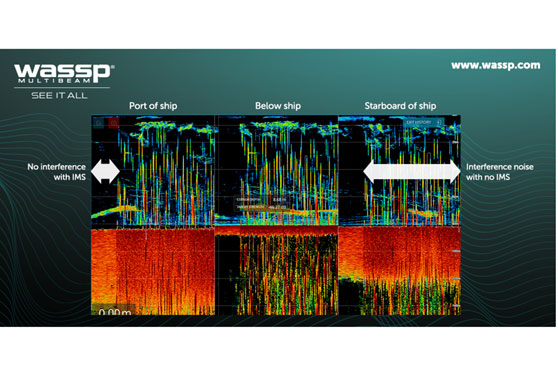
WASSP, the professional multibeam sounder that delivers water column and seabed profiling with 224 beams offering significant improvements in speed and accuracy over conventional single-beam echo-sounders, is delighted to announce the launch of its innovative new Key Pulse and patent pending Interference Management System including automated frequency and bandwidth algorithm.
One major problem faced by manufacturers of sonar systems is that underwater environments are often noisy due to other acoustic devices operating in the same local body of water. Noise levels or interference caused by interoperating acoustic equipment vary widely depending on the operating parameters of the equipment and the water column. This noise interferes with accurate underwater detection and makes it difficult, both for the sonar device and for the user, to interpret an underwater environment.
When multiple sonars and sounders are transmitting in close proximity, there is competition for a clear reception and with no authority like the International Telecommunication Union (ITU) to control the frequencies used, the result can be significant acoustic interference between systems. Rather than the common solution of simply increasing the power output, which exacerbates the problem overall, WASSP has taken an innovative approach. By changing the frequency and bandwidth to a location in the frequency domain that is not in use by any other system at that moment in time. This does not only prevent acoustic interference in the WASSP equipment but also in the other acoustic equipment on board.
It is an object of at least some embodiments of the invention to provide a sonar system with an improved interference management system that allows for the automatic and dynamic adjustment of the operating settings of a sonar system to optimally avoid interference from interoperating acoustic equipment.
By taking the standard KP and adding to it, WASSP’s new software enables all sounder and sonar systems, regardless of manufacturer, to operate significantly more efficiently.
Rufus Whiteford, WASSP’s Global Marketing Manager, commented: “Our Key Pulse and Interference Management System is set to transform the operating environment for fishing and workboats using any sonar system. It’s an excellent example of the WASSP tradition of finding innovative solutions to marine industry problems.”
Stefan Richardson, WASSP’s CTO, added: “The WASSP R&D department is very proud to be able to release this latest WASSP system that will make a difference to the full Acoustic Equipment Suite performance for many fishing vessels all over the world.”
WASSP systems are used extensively for fishing, surveying and mapping, and a range of other activities, its multibeam sounder technology highlights individual and schools of fish in the water columns and reefs, wrecks, foreign objects and seafloor hardness changes on the seafloor. This development allows these multibeam sounders considered by mathematicians as fulfilling the perfect sounder equation to work on vessels with an array of other sounders and sonar. WASSP’s international loyal customers can benefit from this development by contacting their local authorised WASSP dealer and requesting a remote acoustic survey where a WASSP expert will advise on the best solution for individual vessels.
Included in this software release:
- Interference Management system license
- Depth information is now exported via NMEA from the DRX
- Mapping beam angles can be set in the DRX webpages allowing you to control the width of your scan
- Should the transducer be installed facing backwards we can now accommodate for this in the software
- DRX webpages settings can be saved and exported making similar setups easier on sister ships
- Korean, Norwegian, Spanish and Portuguese languages have now been added and are supported in the user GUI
- License page has been improved making it easier to use
- DRX processor will automatically use the PASHR timestamp when PPS is initialised
Example from a trial vessel
Vessel had FSV-84 80kHz Sonar, CH37 162kHz Sector Sonar, CI68 244kHz Current indicator, FCV-1500 15/200kHz Sounder and WASSP 160kHz. This means with the 2nd Harmonic of the FSV-84, the CH37 and WASSP all transmitting at about 160kHz the subsea acoustic is very busy and difficult for any to operate at optimum.


Sunday 27 September 2026
Major Bites
 -
- Minor Bites
 -
-  -
- Monday 28 September 2026
Major Bites
- - Minor Bites
- - 
Fishing Reports Visit Reports
Outer Hauraki Gulf Fishing Report 17/09/26
Spring wind the handbrake. Spring is starting to make its presence felt in the outer... Read More >
Top of the South Fishing Report - 17/09/26
Early snapper in Tasman Bay. Well, spring is finally here, and the days are getting... Read More >
Bream Bay Fishing Report - 17/09/26
Good snapper catches reported. After Tangaroa turned off the fish tap for a month or... Read More >
Bay of Islands Fishing Report - 17/09/26
Pacific bluefin tuna for the lucky few. The last fortnight has seen more fishable days... Read More >
Comments