
Select Committee Supports Hauraki Gulf Marine Protection Bill
As one of its final actions, the outgoing Labour Government introduced to Parliament the Hauraki Gulf / Tīkapa Moana Marine Protection Bill. In collaboration with iwi groups, the government initiated this legislation to create two new forms of marine protection for the Hauraki Gulf: High Protection Areas and Seafloor Protection Areas. These two designations offer less protection than marine reserves, which are no-take zones under the Marine Reserves Act. High Protection Areas ban all fishing except for customary take exclusive to iwi. Seafloor Protection Areas prohibit specific fishing methods, including bottom trawling.
The purpose of the legislation is to contribute to the restoration of the health and mauri of the Hauraki Gulf / Tīkapa Moana by establishing new marine protection while acknowledging customary rights within and the High Protection and Seafloor Protection Areas.
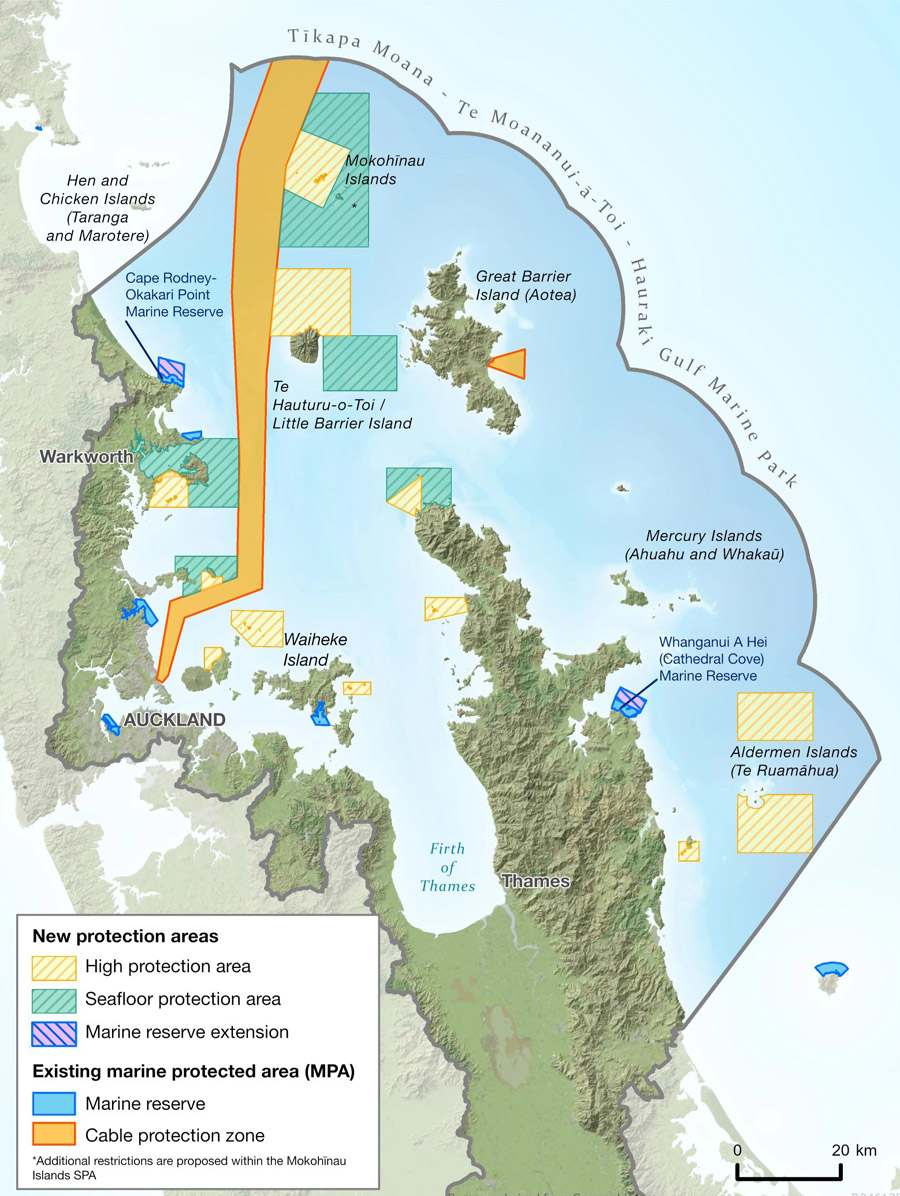
The bill proposes to increase marine protection by prohibiting or limiting certain activities in nineteen new areas, to be made up of:
· 12 high protection areas;
· 5 seafloor protection areas, and
· 2 marine reserves
The two new marine reserves are being established as extensions to the existing Cape Rodney–Okakari Point Marine Reserve and the Whanganui A Hei (Cathedral Cove) Marine Reserve. Marine Reserves are strictly “no take” zones, including all marine life, shells, rocks, and driftwood. They are recognised as best practice in both safeguarding marine biodiversity and ecosystem functioning.
High Protection Areas
High Protection Areas are the major instrument proposed in this initiative. The purpose of the High Protection Areas, (HPAs) is to protect, restore, and enhance biodiversity while still allowing non-commercial food gathering (customary fishing) by tangata whenua, (Māori people of a particular locality). Commercial and recreational fishing will be off-limits for everyone else.
A range of activities will also be prohibited. This includes the large-scale removal of non-living materials such as sand, stone, and driftwood, and the dumping or discharge of waste, sewage, or litter that will have a more than minor adverse impact on aquatic life.
Several of the 12 HPAs cover large areas, including some of the most favoured recreational fishing spots in the Gulf and off the Coromandel coast. These consist of:
· The Ōtata / Noises Islands
· An area west and south of Tiritiri Matangi
· Parts of the Mokohīnau Islands
· North-western side of Motutapu
· An area surrounding Pakatoa and Shag Island
· A substantial area on the northern side of Little Barrier Island
· Areas in west and north Coromandel
· Alderman Islands
· Areas around Kawau Island
Seafloor Protection Areas
Activities prohibited in Seafloor Protection Areas (SPAs) include trawling that contacts the seabed, dredging, and Danish seining fishing methods. Dumping, depositing, or discharging waste or other matter that is likely to have an adverse effect on aquatic life is prohibited. Sand extraction, mining, and aquaculture are also prohibited. There will be additional prohibitions on set netting, potting, and bottom longlining in the SPA around the Mokohīnau Islands. Fishing methods and activities that are not harmful to seafloor habitats, such as spear fishing and line fishing, are permitted in the SPAs. The Department of Conservation (DOC) warns there may be additional restrictions in some of these areas.
Biodiversity objectives will be agreed with iwi
The biodiversity objectives for both the High Protection and Seafloor Protection Areas will be agreed with iwi. DOC intends to work in partnership with local whānau, hapū, and iwi to identify their biodiversity objectives for each HPA and SPA site. The objectives will be refined over time based on the best available information, including Mātauranga Māori. There is no provision for local government to be party to the establishment of these objectives. This arrangement will mean that other citizens, through their local body representatives, will not be involved in the process.
Additionally, DOC proposes that iwi have the option to design their own Customary Practice Management Plans (CPMPs). These plans will allow iwi to exercise authority over their own customary practices.
Parliamentary select committee supports the legislation
In June, the parliamentary select committee considering the Bill submitted its report to the House of Representatives. The committee was largely supportive of the legislation, recommending only a few minor amendments. While they recognised the substantial number of public submissions expressing concerns over the fairness of permitting customary fishing in HPAs, the committee did not consider it necessary to change any provisions in the legislation regarding non-commercial customary fishing.
The Bill is currently before Parliament awaiting its second reading.
If you support equal fishing rights for all New Zealanders in the Hauraki Gulf, you can add your voice to the cause by going to https://www.fairfishinghaurakigulf.nz/
- Gulf Users Group


Major Bites
Minor Bites
Major Bites
Minor Bites
Fishing Reports Visit Reports
Tauranga Fishing Report - 28/05/26
Tarakihi on the bite Trips are few and far between at this time of year,... Read More >
Canterbury Fishing Report - 28/05/26
Fresh and salt turning it on! It is not very often I get to say... Read More >
Bay of Islands Fishing Report - 28/05/26
Lures paying dividends We finally had a break in the SE winds that have been... Read More >
Manukau/West Coast Fishing Report - 28/05/26
Snapper and gurnard in the harbour The weather has finally taken a turn for the... Read More >
Comments