
See Weed - Chuck it Straight Back

This is our second summer living with Caulerpa seaweeds in the waters off Aotea Great Barrier Island and Ahuahu Great Mercury Island...
These invasive seaweeds can spread rapidly in favourable conditions, forming vast, dense beds or meadows and potentially smothering native species and important habitats, such as seagrasses.
The exotic Caulerpa species can spread by breaking into little pieces. This can happen naturally by wave action, but the biggest risk of spread is when it gets tangled in equipment, like an anchor or fishing gear, and is moved to new locations. The pieces can survive for a week or more in moist conditions, such as an anchor locker or a bunched-up fishing net.
So, what can you do to help stop the spread? This is really important: if you pull up your anchor and notice any seaweed on the anchor or chain, remove it and put it back in the same location. By throwing all seaweed back, you don’t have to be an expert in identifying exotic Caulerpa.
If you use an electric winch, take a moment to walk forward and check the anchor well before you move on. And if you find something on your gear later when you’re in a new location, do not put it in the sea. Instead, put it somewhere safe and dispose of it back on land.
Working together as a community, we can stop these pest seaweeds from spreading to new locations.
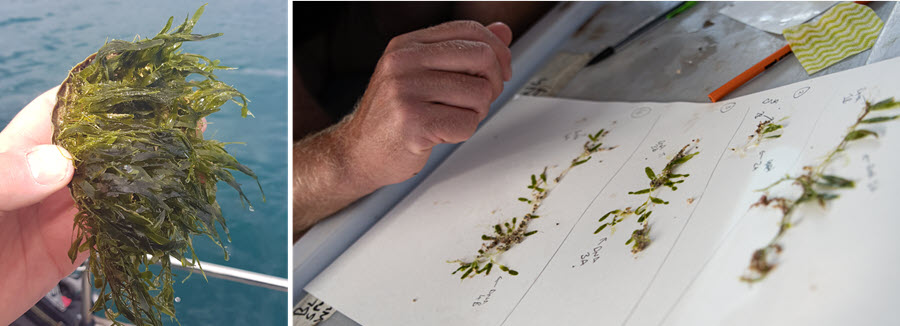
Caulerpa weed has been described as the ‘gorse of the sea’ and has the potential to smother native species and important habitats such as seagrass beds.
Work underway to manage the situation
Since exotic Caulerpa was first found in New Zealand in mid-2021, Biosecurity New Zealand has been working closely with Aotea and Ahuahu Mana Whenua and the local communities, along with Auckland Council, the Waikato Regional Council, and the Department of Conservation to collectively decide the most appropriate course of action.
Martin Cleave, of Ngāti Wai Trust Board and a Mana Whenua representative on Biosecurity NZ's Caulerpa governance group, says:
"It is incredibly important for us all to join together in a spirit of kotahitanga/unity and help stop the spread. This means complying with the rules in place: no anchoring, and no fishing in these restricted areas. The Mana Whenua on Aotea continue to support the rāhui and the Controlled Area Notice and have not taken any seafood from the restricted areas for a little under two years now. We are happy to continue with this while we work together with Biosecurity New Zealand to determine the next course of action. This invasive weed has unified the Aotea community and strengthened relationships across the ministries. May it continue."
Joe Davis, Ngati Hei representative on Biosecurity NZ’s Caulerpa governance group, says:
“We would like to voice our appreciation to the local community, including the recreational and commercial fishing sectors, the boating community, the tourism industry, and the general public for their support to the governance group who, along with Biosecurity NZ, are trying hard to find some workable solutions to what has become a very complex problem”.
“Invasive exotic Caulerpa is yet another threat to the bountiful and beautiful waters of Te Whanganui o Hei – the Great Bay of Hei or Mercury Bay – its offshore islands, and the adjacent marine environs. Like rust, Caulerpa never sleeps. It is the ‘gorse’ of the sea – potentially smothering habitat, threatening natural substrate, and diminishing opportunities for bi-valves like mussels and scallops to take root and lead normal life cycles. Human intervention is what is required to research and find a way of dealing with this dreadful threat as a starting point. Vigilant anchor hygiene and containment in known hot spots is the very least boaties and fishers can do in our fight to deter environmental catastrophe.”
The governance groups of the response for Aotea and Ahuahu have agreed to a programme of reducing the risk of spread through legal movement controls and rāhui, scientific research and extensive public education.
Currently, there are legal controls (Controlled Area Notices) in place around these waters to help stop the spread. These will be in place until the end of April 2023 at this stage and will be reviewed at that time. Mana Whenua for the islands have also imposed a rāhui on the same areas.
Under the CAN, certain activities, including fishing, are restricted. At Aotea Great Barrier Island, the only fishing allowed in the controlled areas (Okupu Blind Bay, Whangaparapara Harbour, and Tryphena Harbour) is hand line or rod and line from the beach or wharf/jetty. All other forms of fishing are prohibited. At Ahuahu Great Mercury Island, no fishing of any form is allowed in the defined controlled area. Check the maps below. The rules are at: www.biosecurity.govt.nz/caulerpa
.jpg)
There will be an on-water compliance team in the affected waters over the summer, checking that people are doing the right thing. Biosecurity ambassadors will be active on Aotea and in Whitianga and the wider Hauraki Gulf areas. They will speak with people about exotic Caulerpa, how to reduce spreading them through human activities and about the CAN and rāhui that are in place. You may meet them around the docks, wharves, beaches and community spaces.
The impacts of exotic Caulerpa infestation have already been felt by many groups, including fishers. A Fisher Working Group is being established for both affected islands to advise on how best to engage with fishers and get the message out on how to manage the risk of Caulerpa. The groups will also be a sounding board for future response decisions.
MPI Director Response and Readiness John Walsh says:
”There is a lot of fishing activity that goes on around Aotea and Ahuahu – we really need the support of fishers to manage this threat to our marine environment. None of us wants to see this invasive seaweed widespread in the Hauraki Gulf.”
If you have any questions about exotic Caulerpa, email [email protected]
www.biosecurity.govt.nz/caulerpa


Friday 25 September 2026
Major Bites
 - -
- - Minor Bites
 - -
- - Saturday 26 September 2026
Major Bites
- - Minor Bites
- - 
Fishing Reports Visit Reports
Outer Hauraki Gulf Fishing Report 17/09/26
Spring wind the handbrake. Spring is starting to make its presence felt in the outer... Read More >
Top of the South Fishing Report - 17/09/26
Early snapper in Tasman Bay. Well, spring is finally here, and the days are getting... Read More >
Bream Bay Fishing Report - 17/09/26
Good snapper catches reported. After Tangaroa turned off the fish tap for a month or... Read More >
Bay of Islands Fishing Report - 17/09/26
Pacific bluefin tuna for the lucky few. The last fortnight has seen more fishable days... Read More >
Comments