
Milky Flesh Snapper Report Released

An in-depth scientific report has found a mix of complex climate factors are likely causing Milky White Flesh Syndrome, says Fisheries New Zealand.
Fisheries New Zealand’s Director Science & Information, Simon Lawrence, says snapper with the condition appear to be skinny and have mushy, white flesh rather than their usual translucent, firm flesh, and are malnourished.
"Early and ongoing tests ruled out exotic disease and food safety issues, meaning that fish with the syndrome are still safe for people to eat if they choose to," says Simon Lawrence.
"The evidence suggests a complex interplay between factors, including extended La Niña weather patterns and warmer waters causing lower production of the phytoplankton and zooplankton that provide important food sources at the bottom of the food chain.
"This is a complex issue, and is more likely to be due to the effect of recent weather patterns and natural changes in fish biology throughout the seasons. Prevalence of the syndrome appears to be declining which supports these theories.
"Warmer ocean temperatures may also be affecting snapper metabolism, meaning they need to use more energy and require more food."
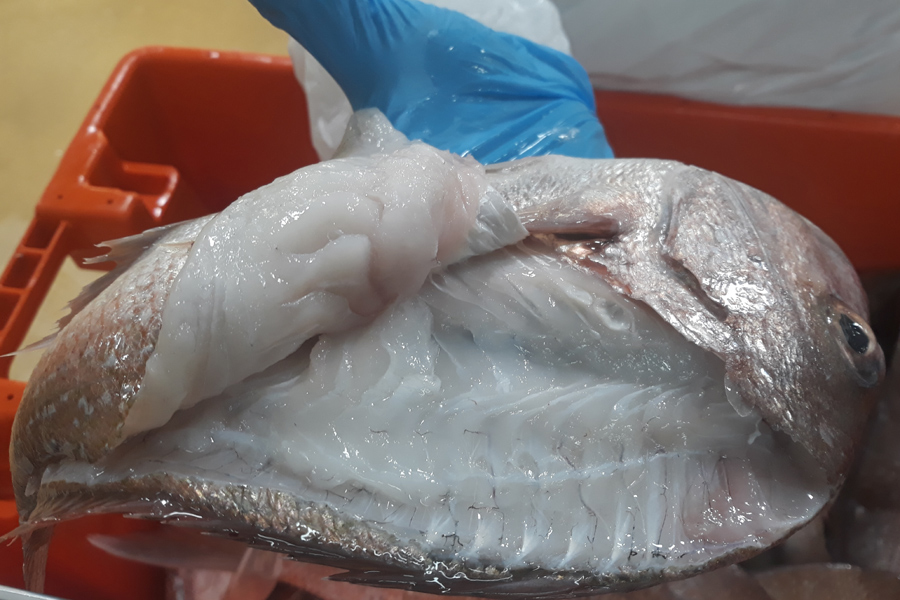 Fisheries New Zealand says that a lack of food is the likely cause of the milky flesh snapper syndrome, but there was no evidence to suggest that fishing was the cause of that. Image: Rikki Taylor (NIWA).
Mr Lawrence says the report found that a lack of food was the likely cause of the syndrome, but there was no evidence to suggest that fishing was the cause of that.
"Overall, we’ve been seeing more snapper in the Hauraki Gulf for some time. The fishery is abundant, with plenty of younger fish entering the stock, all competing for food.
"Commercial fishing does not affect the main food sources of snapper.
"They are opportunistic feeders and are unfussy about what they will eat."
Mr Lawrence says the areas in the Gulf where bottom trawling was permitted did not correlate with the areas where the syndrome was most prevalent.
The National Institute of Water and Atmospheric Research (NIWA) undertook research on behalf of Fisheries New Zealand and collected a range of data, including information from commercial and recreational fishers about affected snapper and where it had been caught.
The syndrome has been most prevalent throughout the inner Hauraki Gulf, near Auckland, and around Doubtless Bay near Northland.
Researchers considered data gathered from fishers together with environmental information, such as sea surface temperature, to determine if any changes had occurred in the period before fish with the syndrome were seen.
"We know that individual growth rates of all snapper around New Zealand have declined over the last 15 years as snapper abundance has increased, which could be explained by the mix of factors at play."
Fisheries New Zealand has received recent reports about snapper with a few similar symptoms on the North Island’s west coast. Some initial tests have been undertaken and Fisheries New Zealand continues to investigate, but there are no biosecurity concerns.
"The report underlines this complexity and its insights will be used in future fisheries assessments," Mr Lawrence said.
For more information and the full report, click here.
- Fisheries New Zealand


Monday 28 September 2026
Major Bites
 - -
- - Minor Bites
 - -
- - Tuesday 29 September 2026
Major Bites
- - Minor Bites
- - 
Fishing Reports Visit Reports
Outer Hauraki Gulf Fishing Report 17/09/26
Spring wind the handbrake. Spring is starting to make its presence felt in the outer... Read More >
Top of the South Fishing Report - 17/09/26
Early snapper in Tasman Bay. Well, spring is finally here, and the days are getting... Read More >
Bream Bay Fishing Report - 17/09/26
Good snapper catches reported. After Tangaroa turned off the fish tap for a month or... Read More >
Bay of Islands Fishing Report - 17/09/26
Pacific bluefin tuna for the lucky few. The last fortnight has seen more fishable days... Read More >
Comments