
Guide to safe loading and towing for light vehicles
This is reproduced from
http://www.nzta.govt.nz/resources/glovebox-guide-safe-loading-towing/guide-safe-loading-towing.html
On average, seven people a year are killed and 45 seriously injured in crashes involving a light vehicle towing a trailer (the word trailer includes caravans, as well as boat, horse and garden trailers).
Incorrect loading is a factor in around 27 light vehicle crashes a year including one death and five serious injuries.
This guide contains detailed advice on loading and towing practices to keep you within the law and protect you, your goods and others on the road.
 How much can your vehicle tow safely?
Most vehicles have tow ratings given to them by the manufacturer specifying the gross trailer weight braked, unbraked, or both, that the vehicle can safely tow. Although the law does not require these tow ratings to be followed, the NZ Transport Agency (NZTA) recommends that they be taken into account.
In addition to the requirements above, the law requires that every light vehicle and trailer combination must be capable of stopping within a distance of seven metres from a speed of 30km/h. In effect, this means that the maximum allowable weight of an unbraked trailer is limited by the weight and braking ability of the vehicle being used to tow it.
The NZTA recommends, as a guide, that the laden weight of an unbraked trailer should not exceed three quarters of the unladen weight of the towing vehicle and then only if the towing vehicle's brakes and tyres are in excellent condition. A trailer heavier than this may prevent the vehicle combination from meeting the seven metre from 30km/h brake performance requirement. To illustrate the increase in stopping distance when towing an unbraked trailer, consider a trailer with a laden weight equal to the weight of the towing vehicle.
This combination can be expected to have double the stopping distance of the towing vehicle alone, and even a towing vehicle with good brakes is likely to fail the legal brake performance requirement of seven metres from 30km/h. If the trailer is equipped with brakes, it may be possible to safely tow a trailer heavier than three quarters of the unladen weight of the towing vehicle, but the seven metres from 30km/h brake performance requirement still applies.
Note:Remember that a car, utility vehicle or light van is not permitted to tow more than one trailer or vehicle.

What your trailer must have
Your trailer must display:
- a current warrant of fitness
- a current vehicle registration label.
Lights
Front position lamps (‘side lights’)
A trailer that is more than two metres wide, or extends more than one metre from the centre of the vehicle on either side must have one pair of front position lamps.
Any other trailer may have one or two front position lamps, but if only one is fitted it must be fitted on the side of the vehicle closest to the middle of the road.
Rear position lamps (‘tail lights’)
A trailer must have at least one red rear-facing position lamp.
If the trailer was first registered after 1 January 1978 and is more than 1.5 metres wide, it must have two rear-facing position lamps fitted.
A trailer may have a maximum of two pairs of rear-facing position lamps.
Stop lamps
A trailer first registered in New Zealand on or after 1 April 2012 must be fitted with one or two pairs of stop lamps.
A trailer first registered in New Zealand before 1 April 2012 must be fitted with one or two pairs of stop lamps if its construction, equipment or loading prevents following drivers from seeing an arm signal given by the driver of the towing vehicle.
Reflectors
The trailer must have at least two rear red reflectors fitted, one on each side.
Registration plate lamp
The letters and numbers on the trailer registration plate must be lit by a white light. It is important that the white light doesn't dazzle following drivers or confuse them about which way the trailer is facing.
Direction indicators
A trailer first registered in New Zealand on or after 1 April 2012 must be fitted with one or two pairs of rear direction indicator lamps.
A trailer first registered in New Zealand before 1 April 2012 must be fitted with one or two pairs of rear direction indicator lamps if its construction, equipment or loading prevents following drivers from seeing an arm signal given by the driver of the towing vehicle.
A trailer may be fitted with one or two pairs of front direction indicators.
Note:If your load covers up essential lights on your vehicle or trailer, you must fit temporary lights to your load to make sure you comply with the legal requirements set out above. For example, bicycles carried on a towbar-mounted cycle rack on the back of your vehicle can often cover up your tail lights.
A vehicle lighting retailer or garage can advise you on purchasing and fitting temporary lights to your load.
Tow bars and tow couplings
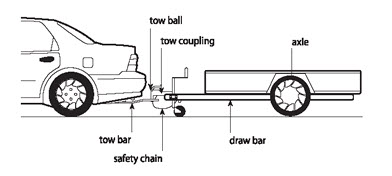
Although tow bars are not required to be rated and certifi ed on light vehicles, there are safety requirements. Your tow coupling and tow bar must be strong enough to safely tow your fully laden trailer. The tow bar must also be correctly fitted so that it transfers the towing forces to the structure of the towing vehicle without any distortions of the tow bar or the towing vehicle's bodywork/structure.
In addition, when you are loading the trailer, make sure that there will be a downwards force on the vehicle towbar at the point of attachment equal to about 10% of the weight of the trailer plus load. Do not put too much weight at the back of the trailer. Ensure there is a downwards force at the point of attachment, to improve the handling characteristics when you are towing.
The coupling on the trailer must have a manufacturer's rating appropriate for the gross laden weight of the trailer and be compatible with the tow ball size.
There are two sizes of tow balls in use:
- The older 1 7/8 inch diameter ball.
- The newer 50mm diameter tow ball.
The tow ball and coupling must be in good condition and securely attached to the tow bar and trailer draw bar respectively. When connecting the trailer to the towing vehicle, you must make sure that the tow coupling, electrical connection and safety chain/s are all connected correctly so that they work properly. Remember that the gap between the vehicle and the trailer must be no more than four metres.
Trailer brakes
There are three types of brakes:
1. Service brakes
- Direct- this service brake system allows the driver of the towing vehicle to directly control the trailer brakes from the driving position. This includes vacuum-operated brakes and pneumatic over hydraulic systems, controlled directly by the driver of the towing vehicle.
- Indirect- with this service brake system the action of the driver applying the towing vehicle's brakes causes the trailer to push against the towing vehicle and this force indirectly controls the trailer brakes. This includes override brakes.
2. Breakaway brakes
- These brakes will apply themselves automatically if the trailer is accidentally disconnected from the vehicle.
3. Parking brakes
- These brakes are applied by hand and are useful for holding the trailer when it has been disconnected from the towing vehicle.
Light trailers may be required to have service brakes, parking brakes, breakaway brakes or safety chains depending on the gross laden weight of the trailer. The table below outlines the requirements for the types of brake that must be fi tted to light trailers.
Requirements for service brakes, parking brakes, breakaway brakes and safety chains on light trailers:
|
Type of brake |
Gross laden weight of trailer of 2,000 kg or less |
Gross laden weight of trailer of more than 2,000 kg but less than 2,500 kg |
Gross laden weight of trailer 2,500 kg and up to 3,500 kg |
|
Service brake |
Not required, but if fitted see Performance requirements for brakes on light trailers |
Required: May be either direct or indirect (see definitions on Trailer brakes) |
Required: Must be direct (see definitions on Trailer brakes) |
|
Parking brake |
Not required |
Not required |
Required |
|
Breakaway brake |
Not required |
Not required |
Required |
|
Safety chains* |
Required: Unless fitted with a breakaway brake |
Required: Unless fitted with a breakaway brake. |
Not required |
* The safety chains must meet the applicable warrant of fitness requirements.
Performance requirements for brakes on light trailers
- Brakes fitted to a trailer, whether or not they are legally required, must be in good working order.
- The service brake, if fitted, must act on both wheels on at least one axle. The service brakes on the towing and towed vehicles must together be capable of stopping both vehicles within seven metres from a speed of 30 km/h.
- The parking brake, if fitted, must be capable of holding the trailer at rest on a slope of one in five.

- Some trailers under 2500 kg are fitted with a hand brake. The hand brake operates by activating the hydraulic brake system and should not be used as a parking brake as it is not guaranteed to remain engaged indefinitely. However, this type of hand brake is useful for controlling and braking trailers under 2500 kg when not connected to the vehicle. It is also useful as a temporary brake when positioning chocks under the trailer's wheels to permanently secure the trailer.


Saturday 26 September 2026
Major Bites
 - -
- - Minor Bites
 - -
- - Sunday 27 September 2026
Major Bites
- Minor Bites
 - -
- - 
Fishing Reports Visit Reports
Outer Hauraki Gulf Fishing Report 17/09/26
Spring wind the handbrake. Spring is starting to make its presence felt in the outer... Read More >
Top of the South Fishing Report - 17/09/26
Early snapper in Tasman Bay. Well, spring is finally here, and the days are getting... Read More >
Bream Bay Fishing Report - 17/09/26
Good snapper catches reported. After Tangaroa turned off the fish tap for a month or... Read More >
Bay of Islands Fishing Report - 17/09/26
Pacific bluefin tuna for the lucky few. The last fortnight has seen more fishable days... Read More >
Comments