
The Phoenix hornet kayak review
With cheap Asian fishing kayaks being imported by the container load, it takes a brave company to start making kayaks in New Zealand.
The Phoenix Kayaks brand, ARMoulding in Auckland, is such a company, taking on not only this challenge, but also the even more difficult road of competing with the Asians on price.
The driving force behind this diversification are Jason Walker and Regan Ashton, two keen kayak fishers who worked at the now-defunct Ocean Kayak factory in Silverdale, north of Auckland.
Regan’s contribution to fishing-kayak design in this country has been remarkable: he created the Prowler 4.7 and the Prowler 4.3, as well as a number of trail-breaking accessories.
I have collaborated with Regan for a number of years, mainly offering new ideas and improvement suggestions for the current designs. Besides this personal involvement, I truly welcome this new venture because we need good competition among local manufacturers to keep the innovations coming.
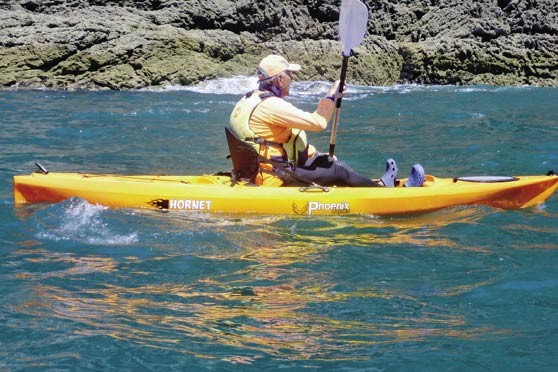
After getting their eye in with two or three play ‘yaks, the Hornet is the first Phoenix kayak with a strong fishing orientation. The 23kg Hornet is a mid-sized (3.6m long and 0.78m wide), entry-level kayak. Possessing a 125kg load capacity, it comes with: a paddle; seat; tackle basket; Railblaza StarPort and rod holder; two flush-mounted rod holders; and a sounder plate – all for only $999.
After the usual ‘mystery tease’, it was finally launched at the September Auckland On Water Boat Show, where it received a good reception from the kayak-fishing fraternity.
CAD drawings and even photos can only tell you so much. The real test for a fishing kayak must be on the water. Luckily, by the time my test kayak arrived I had recovered sufficiently from major knee surgery to contemplate giving the Hornet and my new knees a fair test.
A windy October offered few opportunities to go to sea, giving me plenty of time to cast a critical eye over the Hornet. Before examining its individual features, I ran my hands over the hull and found no soft spots, a sign of good Kiwi quality control and a great reassurance for users.
This kayak has a straight hull with a bow that neatly cuts rather than slaps into oncoming waves. The bow lines flow elegantly into hard chines that gently diminish and exit at the blunt stern. For such a short kayak, the Hornet has an optimal waterline. The hard chines and 780mm width provide maximum water contact, ensuring this kayak is very stable. While a wider kayak is slower than one with a leaner waist, it is also safer; Regan knows this and his generous beam choice no doubt reflects the market at which the Hornet is aimed.
Beneath the hull is a sizeable transducer indent that can accommodate all popular transducer models – including the Raymarine Dragonfly, whose factory brackets can be bolted to either the top or the front wall of the transducer scupper. After this simple installation, the remaining cavity can be filled with foam or silicon. The hull’s somewhat flattish underside terminates in a square-cut tail fin that enhances straight tracking.
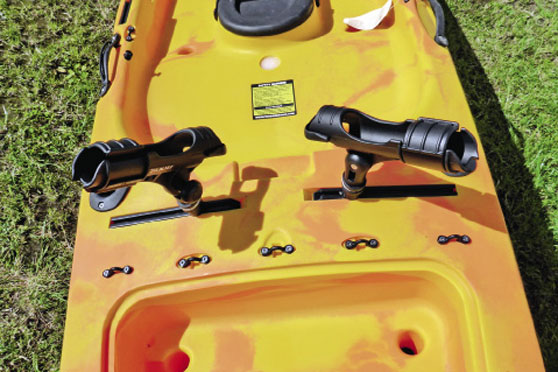
Topside the Hornet has all the features one expects from a fishing kayak. Going back from the toggle-carrying handle at the bow, the flat foredeck contains an oval hatch that gives access to the interior for storage of a trolley, battery, or a drybag with emergency gear. The rubber-framed lid is held down by friction when the its small rubber lip is pressed into a shallow groove on the outside of the hatch opening’s surrounding plastic frame. The moat around the hatch is drained by a rounded channel at the base of a water-deflecting upstand.
The boat’s wide beam allows for a spacious footwell with a decent lidded centre well in the middle. Inside the well is a nicely fitted drop-in plastic bin that can be preloaded with lunch and tackle. The hinged lid is made of plastic and held down by two bungie loops.
The flat seat platform is wide enough to accommodate the bum of a hippo, so careful adjustments of the four seat anchors were needed to stay centred on the seat (I would have appreciated small depressions for my two ‘prunes’ to find a natural parking space).
On the upside, the extra beam allows the seat platform to be above the waterline, ensuring a relatively dry behind without compromising stability.
Surprisingly, the foot well is rather short. I am just under 1.8m tall and could not stretch my legs, despite having moved the footrests hard forward. Taller people can remove the foot track and gain another 85mm leg room. (The foot well could have easily been made longer by borrowing some of the largely underutilised area behind the seat.) A future rudder control will involve a New Zealand-made toe-pedal system.
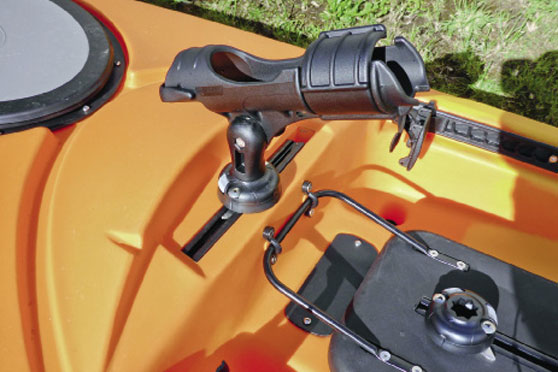
Although the rear well is large enough to hold a drop-in insulated fish bag, I would have liked to have seen a separate compartment for an anchor and other hardware that is able to get wet. Again, the overly-wide bulkhead behind the seat could have provided some room.
There are two flush rod holders behind the seat, and additional fixtures can be mounted on in-built rails spread right around the periphery of the hull. The rails fit three types of Railblaza bases, to which one can clip the numerous attachments that this innovative company provides. Fittings other than Railblaza can be mounted via an available track nut that slides into the rails.
I must admit to not being overly fond of wide kayaks, but realise that the Hornet is aimed at new paddlers who value stability over speed. However, the protruding side handles add to its width, and despite extra caution I did hit my fingers sometimes during the first test paddle.
On the water the Hornet was stable and handled small oncoming waves well, but when the wind built to a decent chop, I got a few good drenchings over the bow despite the deflection upstand on the foredeck. With its straight hull I would not consider the Hornet a rough water vessel. From the few trips I have done with the Hornet, I believe it’s well suited to calmer inshore or fresh water lake conditions.
It is an attractive, well priced addition to our growing fishing kayak fleet and a good start for this new homegrown kayak maker.


Major Bites
Minor Bites
Major Bites
Minor Bites
Fishing Reports Visit Reports
Tauranga Fishing Report - 28/05/26
Tarakihi on the bite Trips are few and far between at this time of year,... Read More >
Canterbury Fishing Report - 28/05/26
Fresh and salt turning it on! It is not very often I get to say... Read More >
Bay of Islands Fishing Report - 28/05/26
Lures paying dividends We finally had a break in the SE winds that have been... Read More >
Manukau/West Coast Fishing Report - 28/05/26
Snapper and gurnard in the harbour The weather has finally taken a turn for the... Read More >
Comments