
Kilwell Xantu SP review
New-tech rod-building
Rotorua’s Kilwell Sports are New Zealand’s last remaining fishing rod manufacturer. As well as producing composite rod blanks for its own Kilwell-branded range of fishing rods, it makes fibre-tube products for a wide range of industrial and non-fishing sporting applications. In addition, Kilwell Rod Craft supplies rod blanks to numerous independent and custom rod-builders in New Zealand, Australia and around the world.
As part of Kilwell’s ongoing commitment to quality, its Xantu range uses the latest ‘nano’ technology to construct rods that are strong and incredibly light. The process bonds nano-resins with nanofibre in a multi-layered, non-woven web that dramatically increases flexural lifting power without increasing weight.
 While Kilwell is not the first to use nano technology in fishing rods, the N. E. T. (nano-enhanced technology) process they have developed sandwiching bundles of unidirectional fibres between radial hoops and bi-axial fibre layers separated by a layer of Xantu nanofibre webbing is a world’s first. Every Xantu rod has a unique serial number as part of Kilwells quality control, and that’s also useful as if it's stolen it can be traced. All Kilwell products now come with a lifetime warranty.
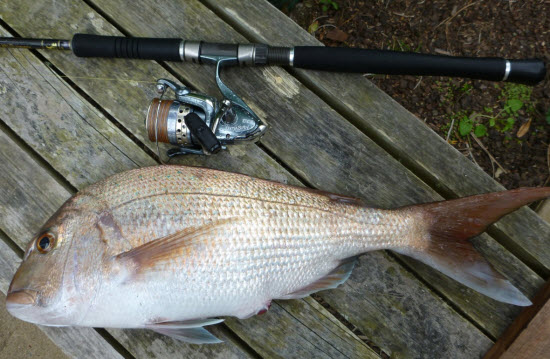
The rod I got to trial is an attractive grey-black Xantu 6-8kg SP with nicely understated blue-grey and gold bindings. It’s a two-piece rod, 7-foot (2.14m) long and rated for lines of between 6 and 8kg breaking strain. The graphite-to-graphite ferrule system joins the shorter butt section to the rest of the rod just above the stripping guide.
Guides are high-quality Fuji components designed specifically for use with superbraid lines, their upwardly angled eyes and super-smooth frames contributing to tangle-free casting. Guides are both under- and over-bound for durability and strength. Grips are good-quality high-density EVA and the Fuji reel seat is a screw up type. The rubber butt cap is grooved for use with a gimbal belt.
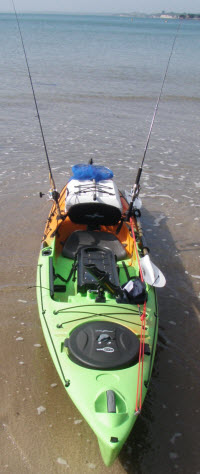
I had received no specific instructions for using the rod, so I took it fishing and used it as I would any other rod in my collection. Primarily I cast and retrieved soft plastics with it, though it also served duty working inchiku jigs in deeper water and throwing a few small jigs about. I used it from my Stabicraft and also from my Prowler 4.3m kayak.
The immediate impression I got on picking up the rod was its lightness. Unfortunately, the TiCA Dynaspin SH3000R reel it was supplied with is quite sizable and I felt its weight affected the balance of the outfit. If it were my rod, I’d match it with a smaller reel, perhaps the TiCA Dynaspin SH2000R.
The TiCA is a handsome reel that appears well engineered. An all-metal, multiple ball-bearing design (8 rust-resistant ball bearings), it’s very smooth, although the drag became rather sticky after a couple of outings. Ater disassembling it was clear it had suffered some water ingress at some point. Drying it out should cure the problem, but unlike some reels, the drag knob does not have a rubber seal to keep water out.
The reel was spooled with plenty of fine diameter Sunline IGFA rated 8.8kg superbraid that proved nice to handle, virtually tangle-free and showed good knot strength. Unlike most braids it breaks at or under its nominal breaking strain which in this case is 8.8kg.
Catching fish on this rod quickly confirmed that it’s a lot more powerful than it looks. The action is quite fast, the tip folding away and the butt section bending progressively. It’s a great lifting tool, though I felt the relatively light tip was not ideal for soft plastics fishing – I prefer a bit more stiffness to impart action to the lures. It was pretty good as an inchiku rod though and also cast small lures long distances. In the hands of my nine-year-old daughter, it was a weapon.
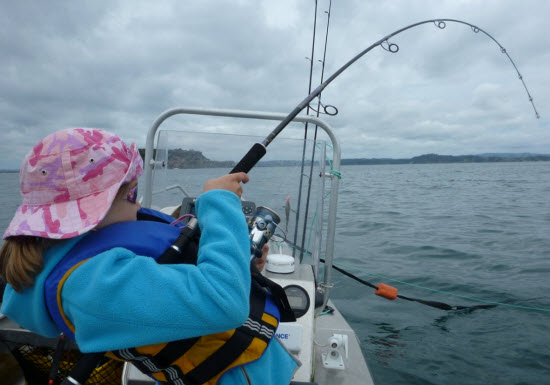
She appreciated its lightness and the way the rod shortens up when playing a fish, which is so much easier on the angler. She pinched the Xantu off me at every opportunity.
The slight stickiness of the drag aside, the reel impressed too. It’s certainly an attractive piece of kit that feels reassuringly solid. TiCA don’t appear to have taken any shortcuts in its manufacture and as such, it represents good value.
Things we really liked about the outfit
The rod and reel is an attractive combination that stands apart from many other branded combos. I especially liked the rod’s low-key livery and Kilwell’s use of high-quality fittings.
The Xantu is a great rod to play fish on. It’s powerful, but very communicative, transmitting every bump, tail beat and headshake to the angler. It easily fishes 8kg line.
I also like the foregrip design and soft gimbal nock.
The reel feels solid and well able to fish 10kg line. Before the drag began slipping/got wet it was powerful and nicely progressive.
What we think could be improved
If it’s a soft-baiting outfit you are after, this weight Xantu wouldn’t be my first choice because of it’s relatively fast, tippy action. You can fish soft baits with it of course, and I did very successfully, but the slightly heavier Xantu 8-10kg SP is likely better suited to this style of fishing.
It was a great rod from the kayak because of the way it shortens up under load. It’s a good choice for a kayak fisher who intend to fish baits, throw lures, jig, troll a bit and soft bait as well. In shallow water fishing where kayaks are so deadly, the soft-ish tip is not really a disadvantage.
This is such a wonderfully lightweight rod, and the smaller TiCA Dynaspin would be a fine match.
The reel would benefit from a rubber gasket to keep rain and spray from finding its way into the drag, but otherwise seems sold and well built.
Available from selected fishing tackle outlets. For details, visit www.kilwell.co.nz
Rod specifications Kilwell Xantu 0469 rod
Length: 7’ (2.14m)
Line weight: 6-8kg
Construction: N.E. T. process bonding graphite composite layers and a layer of Xantu nanofibre webbing
Guides: 7 Fuji braid-secific guides, plus tip
Reel seat: Fuji graphite with stainless steel hoods and graphite-plastic locking ring
Gimbal nock: soft-touch rubber
Nanotechnology and rodbuilding at Kilwell
(The following is an extract from BayFisher Magazine - thanks to kevin Power)
At the Hutchwilco NZ Boat Show in May this year, Kilwell released their new nano fibre range of Xantu blanks, claiming a world first for fishing rods.
Nano composite rods are themselves nothing new of course, with many manufacturers using nano resins in their blanks, so what is so different and new with the Kilwell blanks?
General Manager Neville Podmore from the Kilwell fibre tube factory in Rotorua explains:
First of all, what is nanotechnology? Very briefly, nanotechnology involves the creation and manipulation of particles that range in size from 1 to 1,000 nanometres (nm), where 1 nanometre equals 1 billionth of a metre. To put that into perspective: depending on the type of nano particle a human hair will be as much as 100,000 times thicker than that nano particle.
The key benefit of nano particles is their high ratio of surface area to total volume - creating more bonding sites and thus enhanced properties, including strength. “We have combined nano resin with nanofibre in a fishing rod blank. The polymer hybrid of continuous nanofibres forms a non-woven web that bonds with nano resin and carbon fibre to create a rod blank, giving a dramatic increase in flexural lifting power without increasing weight” says Neville.
In essence, rolled carbon blanks are manufactured from a variety of pre-impregnated carbon fibre cloths. Typically carbon fibre fabric is shipped as a dry, loosely-woven cloth. To use it, you apply wet epoxy resin to the cloth and then let it set and cure at room temperature. Pre-impregnated refers to carbon fibre fabric that is pre-impregnated with epoxy resin from the manufacturer. This epoxy typically has hardener already mixed in, and heat is then used to bond and cure the composite cloth.
Most current carbon composite rod blanks are manufactured from epoxy resin-impregnated carbon cloth, with no nano technology used at all. Nano carbon composite rods employ nano particle technology in the pre-impregnated resin only, but this process offers advantages over standard resins.
Compared to the standard epoxy resin, a nano/epoxy composite delivers improved in-plane shear strength and greater interlaminar shear strength. So, for any given rod size a nano rod will take more load or bend further before the layers of carbon cloth delaminate; this allows rod manufacturers to make lighter rods with no loss in strength.
What’s new with Kilwells' blanks?
In addition to nano carbon cloths the new Xantu rod blanks include an ultra-thin nano fibre cloth called Xantu.Layer, which is rolled as a layer between two of the multiple layers of carbon cloth. (This is done when the various layers of carbon cloth are being rolled to form a rod blank.) The key advantage here is that the nano cloth is made up of a continuous nano fibre, rather than a collection of nano particles or tubes, and this continuous fibre is able to tolerate a higher flexing load than individual nano tubes/particles, when teamed with the nano resins in the manufacture of the rod blanks.
What this new nano fibre has allowed Kilwell to achieve is a stronger rod blank without any increase in weight. Kilwell has extensively tested the Xantu cloth and have observed considerable increases in rod blank strength - up to 70% higher than standard rod blanks.
Xantu also opens up new manufacturing and rod action possibilities for rod blanks in the future – although the blanks are still subject to the same laws of physics as other composite blanks and need to be treated in the correct manner; they’ll still break like any other when abused. What is interesting is that rod manufacturers can now put that rod “which broke while I was winding in a 27cm snapper” under the electron microscope and detect with 100% certainty whether the failure was due to a manufacturing defect. Kilwell now confidently provide a lifetime warranty against faulty materials, components and workmanship on all Kilwell branded products.
Xantu.Layer is made in New Zealand by a company specialising in the development of creating nano fibres from natural products such as fish collagen and are at the forefront of producing electro-spun natural nano fibres. Xantu.Layer feels and looks like plumbers’ tape except that it’s super thin and light by comparison. Currently Kilwell are producing soft-plastic, jigging, game rod and surfcasting blanks using the new technology, with more to come. From this cutting-edge NZ-designed and manufactured product.
 |
An original article written for The Fishing Website - Fishing.net.nz Ltd By John Eichelsheim 2012 Copyright Fishing.net.nz Ltd. All rights reserved. ----- Advertisement -----
|


Major Bites
Minor Bites
Major Bites
Minor Bites
Fishing Reports Visit Reports
Tauranga Fishing Report - 28/05/26
Tarakihi on the bite Trips are few and far between at this time of year,... Read More >
Canterbury Fishing Report - 28/05/26
Fresh and salt turning it on! It is not very often I get to say... Read More >
Bay of Islands Fishing Report - 28/05/26
Lures paying dividends We finally had a break in the SE winds that have been... Read More >
Manukau/West Coast Fishing Report - 28/05/26
Snapper and gurnard in the harbour The weather has finally taken a turn for the... Read More >
Comments