
Setting reel drag

New materials and techniques continue to see reels evolving, but whatever style of fishing you enjoy, experienced angler Chris Firkin says the reel’s drag system is the most important aspect to consider…
Today there is a massive range of reels available, some of which are specific to particular species of fish and specialised techniques.
As reels have advanced, the drag systems have, too. The biggest advance has been the move towards smaller reels with ultra-smooth, powerful and, in some cases, overbuilt drag systems. The most important thing you should expect from any quality reel is a smooth, consistent drag that doesn’t get sticky or lumpy.

Many smaller reels now offer gruntier drag capabilities than before to better handle certain styles of fishing. Softbaiting, top-water and jigging reels are good examples.
The drag is your safety valve. It’s not designed to be locked up or wound down as tightly as possible; rather, it allows your spool to release line when a specific amount of resistance set on the reel’s drag system is exceeded. So, provided the drag level has been set correctly (traditionally around one third the weight of the line), you won’t bust off when a decent fish is hooked.
Understanding, utilising and working your drag in relation to the reel being used – in combination with the fish you are chasing – will see many more fish caught than lost. Experience is the best teacher.
Personal experience
In my late teens (a ‘couple of weeks ago’, in the late 1980s…), I was crazy about land-based game fishing. This is where I learnt my first harsh lesson about the importance of using drag pressure correctly, and it’s one I will never ever forget.
A couple of mates and I did a land-based trip to the Coromandel, fishing a favourite spot at the upper western corner named ‘Blairs Point’. Our ultimate goal at the time was a 30kg-plus king, but to that point we’d only landed a reasonable king and a bunch of nice snapper.
A couple of hours had gone by, with not much action, when a cracker kingie suddenly materialised into the berley trail. It was easily in the 30kg-plus size range we were targeting, and soon made a beeline for my live bait. Seconds later, the balloon popped off and I’d hooked the beast. In response, it headed away strongly against what now seemed like an insignificant 5kg of drag on the 15kg mainline. Instinctively, I started to increase my drag.
Now, this particular fish did everything right for me, running straight out, not sideways along the ledge or towards the nearest structure, as so many kings tend to do. But, after increasing the drag pressure, the fish ran faster, so I reacted by increasing my drag pressure further in an attempt to at least slow the monster down.
After what seemed an eternity, but in fact was three to five minutes, there was a loud crack as the line broke, and I flew backwards, ass over tit, landing in a heap on the rocks behind me. Once my ego – and my body – had recovered, I re-rigged my livebait setup. Then, when I tried to pull some line off my reel, I found the drag was set so tightly it was nearly impossible to do so, and realised my big mistake. Obviously, had I not increased the drag, I still may not have landed the fish, but at least I would have had it on for longer and tired it out more, which would have given me a better chance.
So, what did I learn that day? Firstly, patience: let the fish run, let the drag do its job, and don’t panic. Secondly, the disadvantages of star-drag reels compared to lever-drag reels: with lever-drags you can pre-set the drag accurately, and even if you have to alter it for some reason during the fight, you can always return to that optimal level afterwards. Knowing you have the right drag pressure at all times is a big positive. Thirdly, it’s hard to resist increasing the drag pressure when lots of line is being lost, whether we are inexperienced or not!
Game fishing
Lever-drag system reels are preferred when game fishing as it’s simply the most very effective system.
Most anglers set their (strike) drag at one-third of the mainline’s breaking strain (i.e. 5kg of drag for 15kg line; 8kg for 24kg; and 12kg for 37kg). Then, once you have set your drag correctly at the strike position, leave it, especially if the fish is charging off and/ or jumping about on the surface. In fact, the only thing you should even be considering is backing the drag off a little, especially if it’s a big, angry blue marlin with a bad attitude coming at you and heading back over your line!
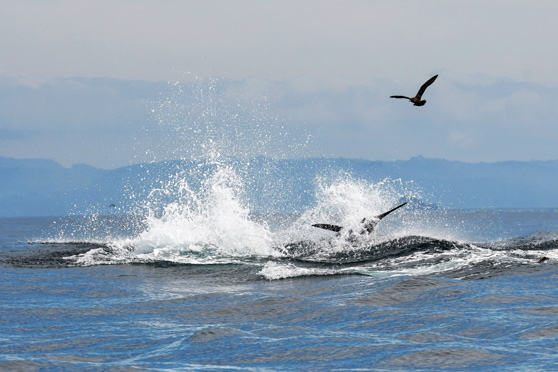
A big blue ‘girl’ can easily empty half a spool of line or more on its first run. This regularly means several hundred metres of line is pulled through the water at speed, effectively creating a huge increase in extra pressure at the hook end. A change in tactics is required: despite your brain screaming for the pressure to be increased at the sight of the rapidly emptying spool, you should do the opposite and start backing off. After all, in addition to the extra pressure created by the line in the water, a half-empty spool is harder to turn, significantly adding to the problem.
Later, when the fish isn’t pulling line off the reel, it’s time to increase your drag and gain line. It pays to stay alert though; as soon as the fish starts getting agitated and pulling string, back off to a third again. Having said all this, I learned that if your knots are up to speed and your line is of good quality, you can push things much further than the ‘one-third’ rule – but there is a time and a place for doing this. For example, you can push the drag lever up past the ‘strike’ position if the fish has settled down and you are locked in a stalemate, perhaps with a trophy tuna or broadbill holding stubbornly beneath you.

I personally had an experience with one of New Zealand’s top charter skippers in the 2001 NZSFC Nationals, where I hooked an ‘average’ 180-200kg blue marlin. I had 37kg line on my ‘lucky’ Shimano Tiagra 80W and this fish was determined to head in the opposite direction to us.
Unfortunately, the sea conditions were so atrocious we couldn’t turn the 16.8m (55ft) boat to follow it.
After just three or four minutes I had lost half a spool of line, and by 10 minutes I was looking at less than 50m left, yelling, “Houston, I think we have a problem!”
On the plus side, I had been preparing: four minutes into the fight I’d started backing off the drag; at 10 minutes I was almost in freespool.
Short story, it ended well: we finally got an opportunity to turn the boat and eventually tag this majestic beast, then releasing it to fight another day.
Through failures in the past I understood what needed to be done when ‘working the drag’ correctly, and it made the difference between catching or losing the fish. Of course, having legendary skipper Rick Pollock at the helm certainly helped!
The increasing use of light-gauge hooks is changing the face of the sport-fishing scene; now, even 15kg line or less can prove effective. But remember to fight the fish as smoothly as possible, never applying any more than 5kg of drag, regardless of the line class – and be particularly careful when tracing the fish.
If you like to put some pressure on fish so they are brought in quickly for a healthy release, light-gauge hooks are not for you.
Horses for courses
Using the right gear for the size and species of fish you are targeting will increase your chances of success, especially if the time is put in, too. The key is not to give up, just keep trying.
For example, in some circumstances you must try and stop the fish before it gets into the reef and busts you off. If you don’t succeed, it’s all over Rover – wave bye-bye to your $200 stick-bait or $50 jig! That’s why deep-water jigging for kingfish requires a stiffer, shorter, purpose-built jigging rod and a compact reel with a powerful drag system.
On the opposite side of the coin, spinning for monster trout or salmon in the South Island in gin-clear water can mean the only way to get a bite is by dropping down to 6lb (2.7kg) or even 4lb (1.8) trace. This leaves very little margin for error.
It can be done, though. Landing a trophy trout requires plenty of patience. First, let the fish run; this may mean having to chase after it for a kilometre or more downstream, but it will tire out slowly, despite the lighter-than-usual drag. Then, with a little bit of Lady Luck on your side, you may land the fish of your dreams.
|
|
This article is reproduced with permission of |

Recent Forum Posts Visit Forum


Inox or tackle guard
in The Briny Bar13 hours ago
Schecter
I've been using Inox to clean all my reels and rods. I simply spray it on a cloth and rub. There are no issues as far...

Rod building gear for sale
in Rod Building26 hours ago
Buggar-me
Is anyone interested in buying rod building equipment?I rebuilt rods for a few years so accumalted a lot of "stuff".Eyes, threads, handles, winding machines etc Approx 2k...

Out with the "Twelves"
in Fishing Reports47 hours ago
Telecaster
Can confirm the method still works - they were keen on yellow this afternoon - despite the poor bite times we managed 11 snapper and 3...

SNA1 Recc fishing cops the blame.
in Fisheries Management56 hours ago
MB
Down-sizing is also a big issue in my opinion SaltyC. Snapper are just not a species of fish that do well with catch and release, especially...

here is one for you Tonto
in The Work-Up216 hours ago
Tonto2
Just seen this Alan, well done. I thought i had retired and was going to be a full time fisherman but no , been dragged back...

Hey Smudge...come over to where the Carrots are!
in Fishing Reports394 hours ago
Keith C
Nothing better than a calm winter's day freespooling small baits in the Gulf. Home to the 'Naki and 7m wave warnings from Opunake to Mokau....
Manukau Harbour & West Coast fishing
in Fishing Reports470 hours ago
Schecter
Very tough fishing for myself at the end of the harbour yesterday morning. The fog was dense, and to make matters worse, I was fishing and...

Allblacks score predictions
in General Sports Chat495 hours ago
smudge
Warriors and AB's games overlapped here too...
FC 595 For Sale
in Buy Sell Trade or Exchange698 hours ago
Kandrew
Very good boats can’t come up for sale often....
Popular Articles

Softbait Fishing - Part 1 - gear selection
John Eichlesheim writes an article about selecting the right equipment for softbait fishing... Read More >
Softbait fishing Pt 2 - tips and tricks
Techniques, tips and tricks of softbait fishing – getting the most from your soft baits.... Read More >

Surfcasting - setting yourself up
Gary Kemsley helps sort out the necessary gear for intending surf fishers.... Read More >

Squid - How to catch them
Squid fishing is a rapidly growing aspect of fishing - Paul Senior shares some hints and tips to get started.... Read More >
Fishing Reports Visit Reports
Outer Hauraki Gulf Fishing Report 06/08/26
Mixed fortunes The coming week of weather looks like a tale of two halves for... Read More >
Canterbury Fishing Report - 06/08/26
Canals hit and miss It’s cold, damn cold! Truly feels like winter has finally arrived... Read More >
Bay of Islands Fishing Report - 06/08/26
Snapper and kingfish firing First, my apologies for missing reports during July – it’s been... Read More >
Bream Bay Fishing Report - 06/08/26
Winter snapper bite slow Nothing much has changed since the last report a fortnight ago.... Read More >
Comments