
Yellowfin Tuna Techniques
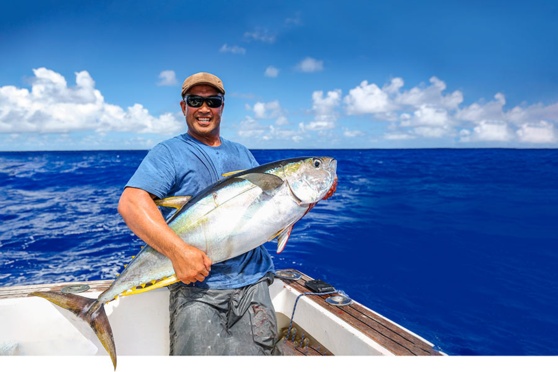
The speed at which our yellowfin tuna disappeared around twenty years ago still has me in shock: present in reasonable numbers in 1999, they had virtually gone from our waters three years later.
My suspicions lie with the Pacific commercial tuna fleet, which I believe identified the migratory route of our visiting yellowfin population very accurately, allowing them to annihilate the tuna.
So complete was the slaughter, I'm guessing this group of fish was no longer worth pursuing commercially, allowing them to slowly rebuild over the last two decades since. Global warming may actually have helped in this instance, too.
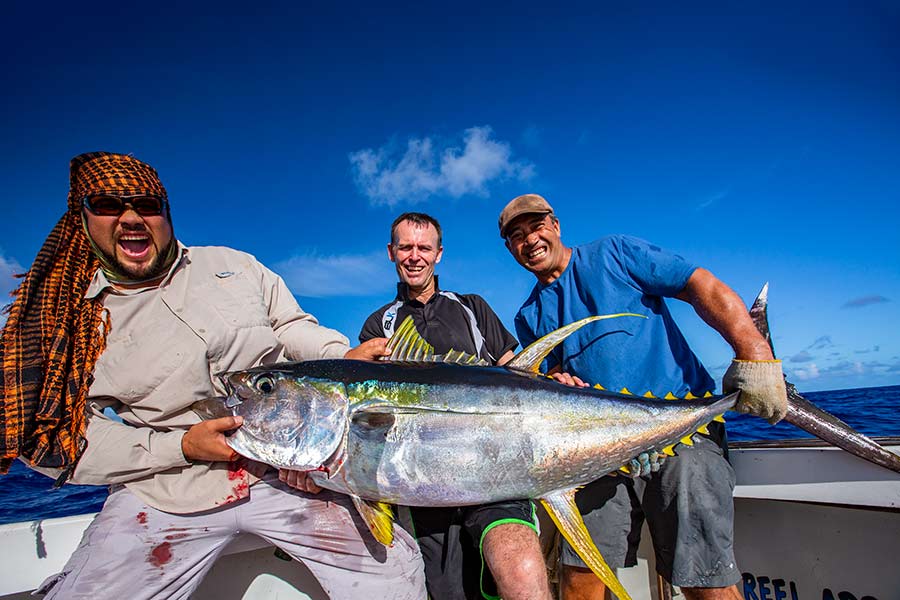
The strikes can be explosive, the runs blindingly fast, and the fights exhausting; no wonder this yellowfin tuna catch is being celebrated!
On the move
Trolling is still the most widely used technique, mostly because it's the easiest to master and allows other worthwhile fish, such as marlin and mahimahi, to be caught, too. Yellowfin are fast swimmers and I find trolling speeds around 8-10 knots give the most success.
Suitable tackle
As yellowfin rarely exceed 60kg in our waters, 15kg tackle is ideal for the job, but the possibility of marlin literally crashing the party means most anglers prefer to use 24kg or even 37kg stand-up outfits instead. All reels should hold at least 500m of line, but 800-1000m is even better. Typically, the first 200m consists of nylon (the `top shot') spliced or knotted to several hundred metres of braid or hollow-core dacron underneath.
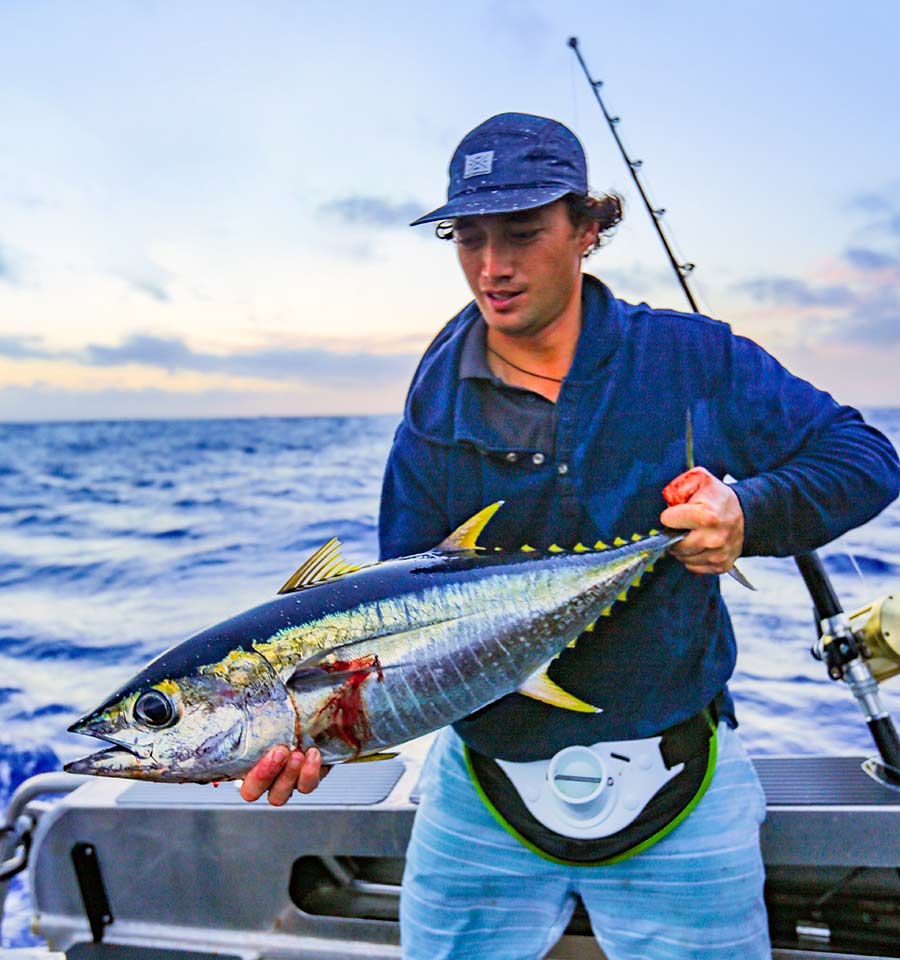
Trolling skirted lures
Yellowfin tuna can be very unpredictable in their lure preference (even juveniles can crash big marlin lures at times), but small- to medium-sized lures are usually the most consistent producers.
Skirted lure types include: tiny to modest-sized pusher-faced models; relatively small metal jet heads; streamlined bullet heads/straight-runners; and small to medium-sized angle-faced lures.
Well-proven colour combinations include: green and yellow; green, yellow and orange (`fruit salad'); black and purple; blue, pearl/silver, green and strands of pink/red (`evil'); orange, chartreuse, yellow and white (`zucchini'); and luminous, green with touches of blue (`lumo').
The various lure types have very different trolling strengths and weaknesses, with the boat speed, exact lure positioning, line elevation, and the distance they're set from the boat suiting some types much better than others - as we will discuss shortly.
In all cases the lures tend to be placed amongst the roiling area of white water produced by the propellers and in positions that mean they won't tangle one another in rough seas or when the boat is turned too sharply.
The way you decide to position the various lures is called a `lure pattern'. Most patterns consist of staggered lures either side that form a V or W formation when looked down on from above. It's always worth having one lure positioned well back beyond the boat's white water and main lure pattern; this straggler is frequently the one that does the damage on yellowfin!
Just where you place the lures on the pressure waves is important too: if positioned too high on the wave face, they will pop out and tumble, whereas being set in between waves sees them wallow unattractively. I like mine to be in the bottom third/half of the various pressure waves' face.
Line elevation plays a big part as well. Basically, the further the lure is set from the boat, the greater the elevation required (although, as you will find out, there are exceptions). So those lures closest to the boat's stern (i.e. the second pressure wave) will often be flat-lined, with the line brought down from the rod tip and secured to the reel-handle stem, safety clamp or a corner bollard using a rubber band or AFTCO Roller Troller.
The third and fourth pressure waves suit lures run directly off the rod tips, while those further out require outriggers or an uprigger to get the elevation needed to perform at their best.
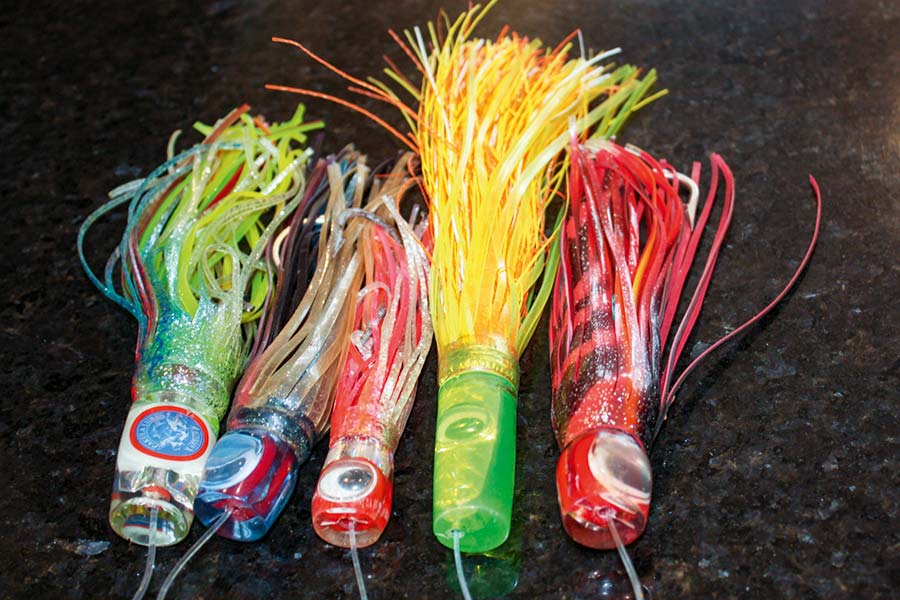 A selection of suitable pusher-type lures. Do not discount the smaller lures - the tiny Pink Pakula Roach in the middle has accounted for some huge fish (including blue marlin)
Pushers
Pushers are easy lures to run. The primary aim is to have them hitting the surface, sending up white water and then heading back downwards, shaking their booty and trailing bubbles. Ideally, just as the bubbles finish, the pusher should be bursting back to the surface again. A mixture of boat speed and line elevation helps to ensure this happens, as outlined earlier.
However, the size and weight of the hook/s fitted and the thickness of the trace also play a significant part: the bigger and thicker the hook and the stronger the trace, the more the lure's natural action is dampened. I suggest using just a single 7691 pattern (slightly incurving) or light gauge type hook, with the size determined by which hook size's gape the lure head slips just inside (or very nearly does).
Around six metres of 200-300lb trace suits most small- to medium-sized pusher lures, depending on the lure's head size.
Metal jet heads
Although much more widely used overseas, I have often witnessed how effective these lures can be!
Not only do they generate a thick bubble trail, thanks to the holes drilled through their face, the metal head's weight means they can be run pretty fast - we often used them at 12-15 knots chasing wahoo and yellowfin in various Pacific Islands - and they stay in the water in rough conditions too, even when run quite short with plenty of line elevation.
Typically fitted with a skirt consisting of white feathers and strands of shiny tinsel, jet heads work exceptionally well when placed close to the boat's stern, amongst the churning white water. However, they are also a prime candidate for running well back; even without generating a trail of bubbles they still get hit, thanks to the gleaming chrome-metal head and undulating tinsel skirt.

Jet heads are underrated in this country - when set correctly, their weight means they stay in the water at high trolling speeds and produce great bubble trails.
Bullet heads
Rather than offering an enticing action, these streamlined lures are simply pushed around by the water as they move through it, making them very easy for fish to line up and eat ± a big plus when dealing with speedsters like yellowfin!
This type of lure is often weighted, helping it stay in the water if it's rough and when run at high trolling speeds. Consequently, it's another excellent candidate for the `caboose' position well out the back of the lure pattern, perhaps with a small bird teaser attached ahead of it.
It's perfect for downrigging, too. Yellowfin are sometimes very reluctant to hit lures on the surface, whereas lures presented just a few metres down are repeatedly hammered. Using a downrigger is often a pain, but it can almost double your chances of catching yellowfin.
Similarly, attaching a trolling weight between your outfit's mainline clip and the leader gets the lure down a bit deeper and onto the tuna menu, as will some bibbed and bibless diving minnows (dealt with later on).
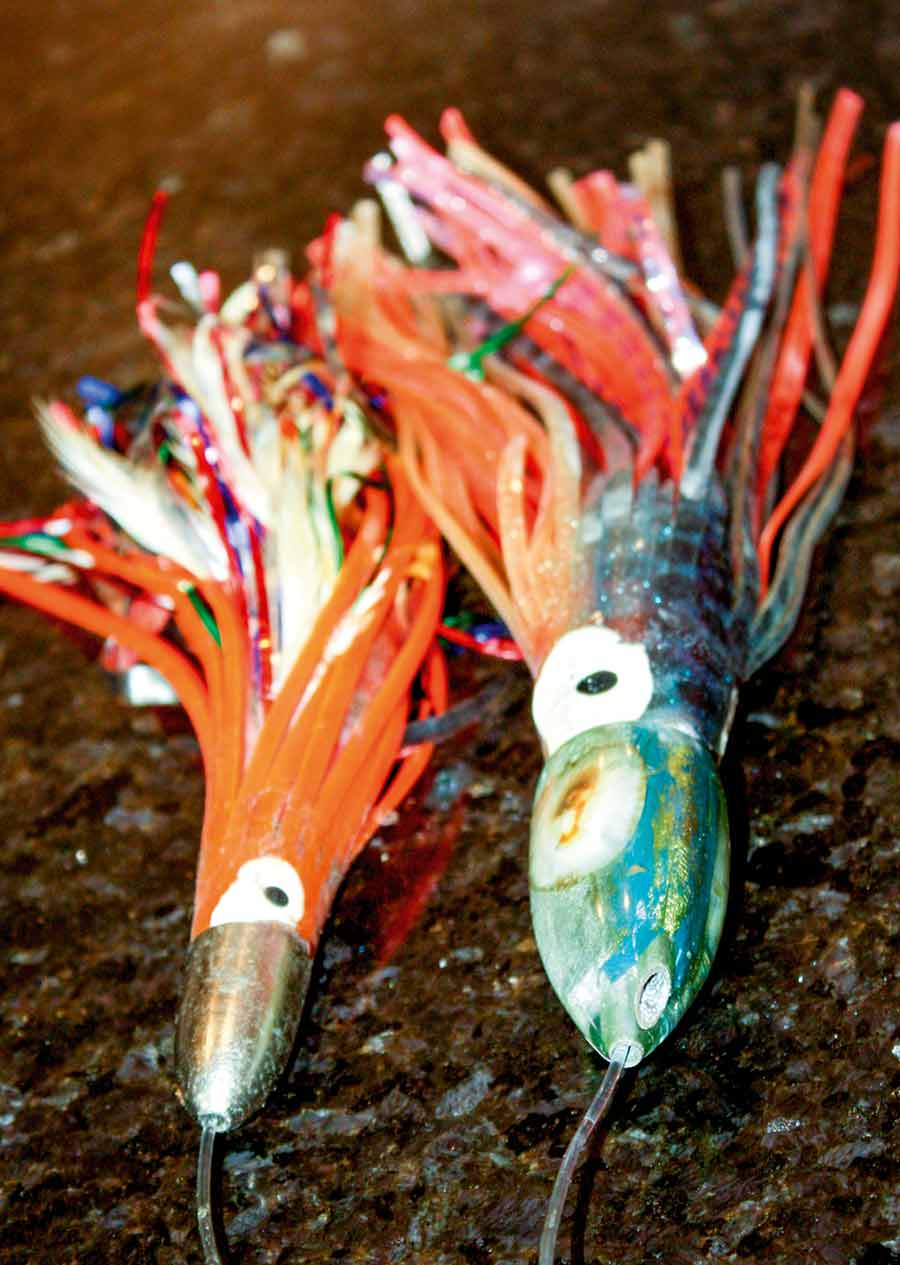 There is nothing fancy about bullet-head lures - they don’t move around much, enabling fast fish like tuna to smash them.
Angle/slant-faced lures
This type of lure is a bit harder to get running well, but when done correctly they can look spectacular in the water, splashing and ducking and diving and trailing thick plumes of bubbles.
Again, much depends on your hook and leader choices (basically the same criteria as for pushers), with one more important requirement: the single hook must be set in place so its point faces upwards. Some lures have slots in the head's base to accommodate this but jamming the head down onto a tightly-wound-on rubber band just above the hook also works well, as does inserting a toothpick into the lure head's rear, wedging the hook firmly in place.
The angle-face lure also offers another key advantage: By placing a bird teaser ahead of it, not only does the teaser create plenty of ruckus, helping to draw tuna in and get them excited, it keeps the lure near the surface and working properly, even if positioned a hundred metres behind the boat.
.jpg)
A tightly-wound rubberband shaped into a wedge is great for jamming angle-face lure heads on in the correct position’ so the hook sits upwards.
My pick:
The Zuker ZTWG
My favourite tuna lure is a cross between a bullet- and angle-face type. The Zuker ZTWG is streamlined with a very
small scooped angle face, so it slips to the surface, splashes briefly, then weaves smoothly away. Yellowfin love this type of action – and that’s why the old-style Cedar Plugs work so well – their action is surprisingly similar!
Many of the Zuker ZTWG colours work well, but my favourite colour is Zucchini (chartreuse, orange, yellow and white).
However, I like to improve this lure's performance further by adding a daisy-chain of small Moldcraft squid (starting 1.5 metres ahead of the lure), terminating at the small Boone bird-teaser attached to my mainline's clip. These items combine to create an impressive ruckus, and I'm certain they help attract many more strikes.
 The Zuker ZTWG in ‘Zucchini’, complete with a Moldcraft squid daisy-chain and small Boone bird teaser - absolutely lethal.
The essential minnow
Using a bibbed or bibless minnow can add around a third to a half more yellowfin bites.
The faithful old Rapala CD18 has caught me many lovely yellowfin over the years, but its light construction, unsuitable treble hooks, and temperamental metal bib posed problems.
I overcame most of them by replacing the VMC trebles with Owners (3/0 at the middle and a 1/0 at the back to balance the heavier treble hook weight) and learning how to `tweak the bib' to get it swimming straight again. When run at 8-10 knots, speeds they sometimes need to handle, they need to be perfectly tuned.
I also discovered 100lb leader is about as thick as you want to go and that it needs to be connected in the most streamlined way - either crimped via a tiny loop, or Uni knotted and tightened up against your thumbnail so a small loop is created.
Minnows designed to run with single hooks are recommended, as they hold on to the fish more securely and tend to be structurally stronger.

Fortunately, there are now excellent options from River2Sea, Halco and Nomad, and Rapala's latest models are much improved too.
Whatever your choice, run the minnow in the closest position, but as far out as possible without the following skirted lure catching on its line.
Next month: More exciting yellowfin techniques to try!

March 2022 - Mark Kitteridge
New Zealand Fishing News Magazine.
Copyright: NZ Fishing Media Ltd.
Re-publishing elsewhere is prohibited
Fishing Reports Visit Reports
Outer Hauraki Gulf Fishing Report 17/09/26
Spring wind the handbrake. Spring is starting to make its presence felt in the outer... Read More >
Top of the South Fishing Report - 17/09/26
Early snapper in Tasman Bay. Well, spring is finally here, and the days are getting... Read More >
Bream Bay Fishing Report - 17/09/26
Good snapper catches reported. After Tangaroa turned off the fish tap for a month or... Read More >
Bay of Islands Fishing Report - 17/09/26
Pacific bluefin tuna for the lucky few. The last fortnight has seen more fishable days... Read More >


Saturday 26 September 2026
Major Bites
 - -
- - Minor Bites
 - -
- - Sunday 27 September 2026
Major Bites
- Minor Bites
 - -
- -
Comments