
Yellowfin Tuna on Topwater Lures
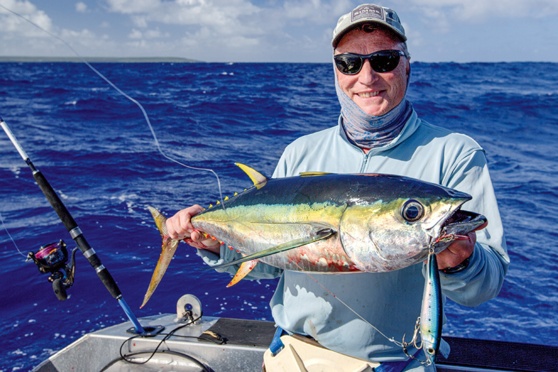
Nothing gets Mark Kitteridge more excited than the prospect of catching yellowfin tuna on topwater lures.
Can there be a more exciting way to catch yellowfin than on topwater lures? I very much doubt it!
Picture this: You’re out trolling and come across sporadic explosions of whitewater as roaming yellowfin burst onto schools of scattering baitfish all around the boat. Yahoo, time to get that pre-prepared topwater outfit into action – finally!
Your offering has been agonised over earlier in the morning, but in the end, the calm conditions screamed poppers rather than stickbaits. After finding sufficient casting space, the popper sails out (bugger, you think, maybe not far enough?). Stabbing the rod firmly backward sees the lure shifting a sheet of water, followed by that delicious multi-second wait as the slack line is wound up and the white water is allowed to dissipate.
Boof! You work the lure forward again, and then, just as you start winding the slack line in, a yellowfin almost clears the water to absolutely slam the popper, showing its huge size and long sickle fins in the process, leaving just roiling water and foam afterwards. A second later sees the rod wrenching down and your reel accelerating to a shrieking pitch you’ve never heard before – yellowfin on! Now it’s time to close your mouth and stop swearing!
Suitable topwater tackle
As yellowfin tuna rarely exceed 60kg here in New Zealand, with 15-40kg being typical, a 24-27kg (PE5-6) outfit provides a very practical option.
Rod choice is critical. It comes down to determining how important your casting and fish-fighting capabilities are in relation to each other. A long rod will help to cover plenty of water with a suitably weighted lure, increasing your chances of encountering fish and enticing a hook-up. However, as plenty of leverage is required when fighting these stubborn fish afterwards, a shorter rod is much more effective for this role. Long story short, a topwater rod will always be a compromise to various degrees.
My current popper rod is a Shimano 8’3” Ocean Plugger with PE6 (60lb) maximum capabilities. This rod can effortlessly cast lures up to 130g; then, upon hooking up, the tip section ‘folds away’ to leave a much shorter (and effective) fish-fighting length, cutting battle times and reducing some of the potential pain involved. And I am talking about real physical pain here! Make the wrong choice and even the keenest anglers can be brought to their exhausted knees and perhaps be forced to pass the outfit on. I, therefore, suggest avoiding using long, powerful and stiff topwater rods, as they can become a crowbar for the never-say-die tuna to use against the angler as it endlessly circles and circles and circles deep down!
Hook a decent yellowfin on the troll, and it’s possible to lose 400-500m of 24kg line, but do the same from a drifting boat and it’s rare to see more than 200-250m leave the reel’s spool. Even so, I recommend finding a reel with a 300-400m braid capacity as: the hook-up may occur at the start of your retrieval; the reel could have lost a little line; the fish may be especially big or energetic; and crazy things can happen!
Also, for obvious reasons, the reel should be as high quality as possible. Tuna don’t just take lots of line at a blinding pace after hooking up, they then go on to fight stubbornly for every inch of the line retrieved. If your drag or gearing system is found wanting, a lot of hard work may well end in heart-breaking failure.
Consider the reel’s retrieval ratio, too. Those with too-high ratios can make getting line back under tension challenging (that’s why bicycles have multiple gears so they can climb steep hills with less effort). Besides, a large spinning reel with a 5:1 ratio can still retrieve a lot of line with every handle turn due to the spool’s generous circumference. Having said that, improved technology is helping the latest gearing systems to be stronger and even more efficient than before, so opting for a very high-quality reel with a 6:1 ratio is not necessarily the end of the world. My new Daiwa Saltiga 14000 reel is a prime example, but I have yet to see how it will perform against a large, unyielding opponent!
The two most popular topwater lure types are poppers and stickbaits. Whatever type you decide to use, those rigged with single hooks tend to grab more flesh, making them less likely to rip out during long fights, but most are designed to perform better with high-quality trebles such as Owner and BKK. I usually have a mix of both, with most of my topwater lures sporting a treble mid-body and a single from the rear. As tuna have good eyesight, I suggest using around three to four metres of 100lb trace, either mono or fluoro, connected with a PR or FG knot.
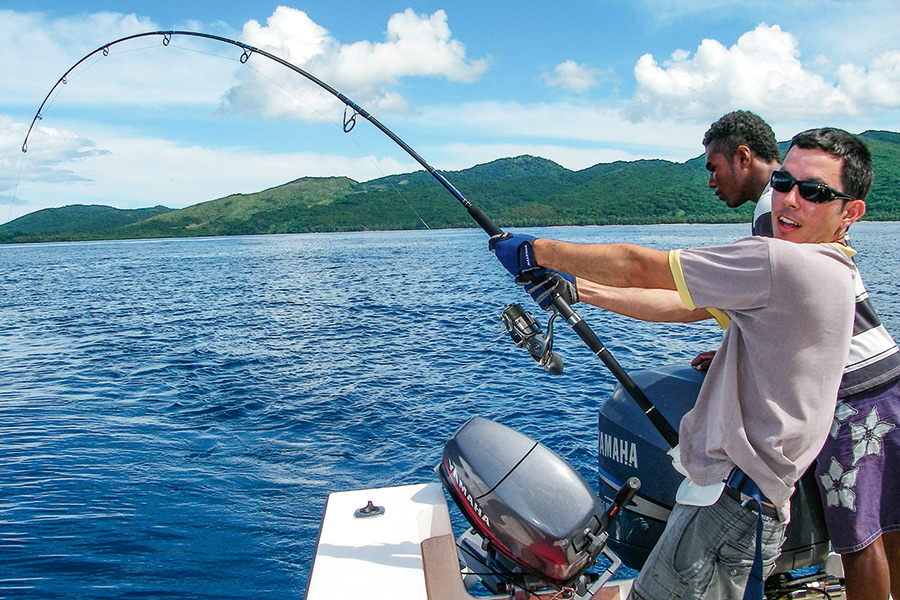
This Australian angler’s stiff, powerful topwater rod led to exhaustion and forced him to hand this modest yellowfin on to another angler (not shown) to fight.
Fishing techniques
An experienced popper exponent can make a popper sound just like a feeding fish when worked back to the boat, thanks to the cup-face noisily pushing up a sheet of water, making a sound and impression similar to predators feeding on baitfish. These disturbances act like a dinner gong to any nearby yellowfin, especially in calm conditions, drawing them in for a share of the feeding carnage, only to find the popper on the surface, apparently mortally injured and vulnerable.
Poppers are not perfect though. Most models are prone to bursting out of broken water and tumbling, also doing the same when anglers get too excited with their lure actions due to large fish swirling and crashing behind their offering. This can lead to the rear hook becoming caught around the trace, preventing the lure from working.
A few brands have innovative designs to reduce this problem. For example, the Halco Roosta’s cleverly shaped face and weighted rear combine to make this lure surprisingly tumble-proof in most conditions, while the Maria DuckDive’s slightly smaller face and the Williamson Jet’s jet holes serve to reduce water pressure, making them less likely to fly out.
It is up to the angler to decide which popper suits their capabilities and the circumstances. I find lures around 165-230mm lengths suit 24kg tackle, but some experimentation may need to be done at the time to find out exactly which size, lure type and action will press the right buttons. A strong, compact clip (I have found Mustad Fastaches to be excellent, especially those without the added swivel) can help with quick lure changes.
Sometimes poppers are easy to use: Just stab firmly backwards with the rod to suddenly bring the lure forwards, shifting lots of water in the process and ideally making the ‘BOOF!’ sound we topwater fishos love to see and hear. Next, the lure is left motionless amongst the receding whitewater for a while as the slack line created is wound in and the rod brought back into position in front of the angler. It is during this phase that most poppers get annihilated. However, the ideal pause length can vary a great deal, as can the length and strength of the lure sweeps, so again, it does pay to experiment.
Personally, I like my ‘bloops’ to be more erratic, so they mirror the sounds of feeding predators more accurately. This is achieved by stuttering the rod’s backward sweep to create two or three quick, successive splashes of different velocities. It’s harder on the arms, but the results are often worthwhile.
When conditions are rougher, the watery noise created by poppers becomes less discernible over the chaotic din of the mighty ocean, and they also don’t work as well, often failing to splash when ripped forward, or firing out of the broken water and tumbling. It is now time to use a stickbait – those around 160-190mm in length tend to get the job done.
However, trying stickbaits for the first time should not take place when the tuna are suddenly on the chew in front of you. For example, the chosen lure/s may not cast as well as hoped, and as the different stickbaits vary greatly in the way they behave when worked back with the rod and reel, it’s in your interests to familiarise yourself with any likely offering/s well before the potential opportunity arises.
Most importantly, experiment with the length and firmness of your rod sweeps, as well as with the pauses in between. Some stickbaits will fire right out of the water when ripped too violently with the rod, while others really come to life when treated this way. Some of the very best and most expensive are actually the hardest to master, yet the rewards for perseverance can, literally, be huge!
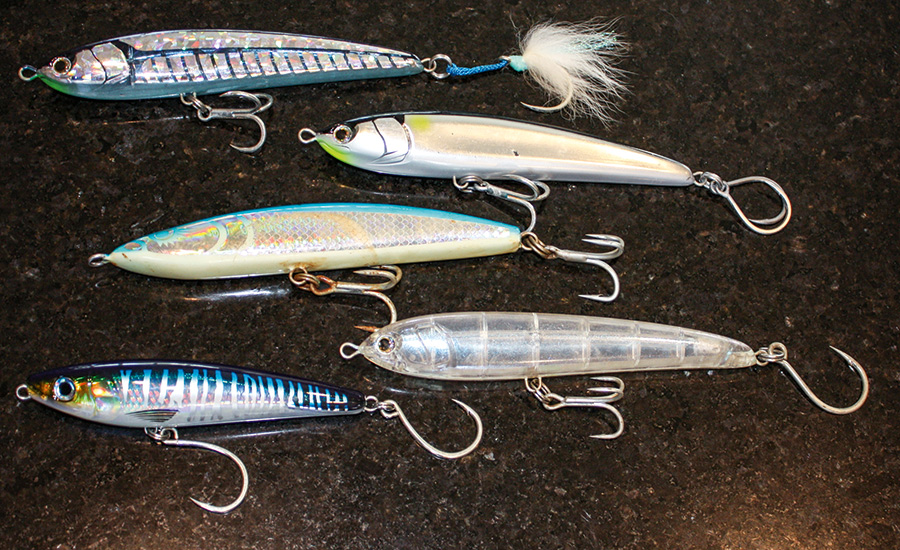
These medium-sized stickbaits – a mix of Rapala, BFP Swimbaits, and Maria Rapidos and Legatos – should help entice a bite.
Parting tips
Place yourself in the clearest part of the boat to cast if possible. Although some cockpits can be tidied away nicely to allow this, I find the bow is the best place by far on many vessels, especially if there’s a sturdy railing to brace against (especially tucked up in the bowsprit!). Yellowfin can be very big and are nearly always tough. Do your body a favour by wearing a compact and relatively open rod bucket to spread the pressure and allow effective rod control and leverage. And if you can find a light harness system to secure your spinning reel outfit too, so much the better. After all, you might be locked in a battle for quite some time!

February 2023 - Mark Kitteridge
New Zealand Fishing News Magazine.
Copyright: NZ Fishing Media Ltd.
Re-publishing elsewhere is prohibited
Fishing Reports Visit Reports
Tauranga Fishing Report - 28/05/26
Tarakihi on the bite Trips are few and far between at this time of year,... Read More >
Canterbury Fishing Report - 28/05/26
Fresh and salt turning it on! It is not very often I get to say... Read More >
Bay of Islands Fishing Report - 28/05/26
Lures paying dividends We finally had a break in the SE winds that have been... Read More >
Manukau/West Coast Fishing Report - 28/05/26
Snapper and gurnard in the harbour The weather has finally taken a turn for the... Read More >



Major Bites
Minor Bites
Major Bites
Minor Bites
Comments