
Work up hunting
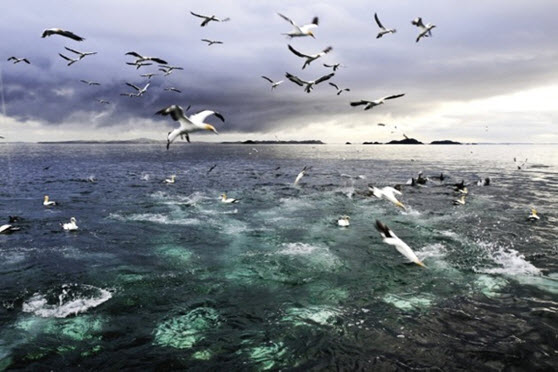
Every year about this time Paul Senior becomes excited about the upcoming spring work-up season and wants to write about it.
Work-ups have been written about a lot leading into spring, my writing colleagues tell me, but since I am on a constant journey of learning, I will cover the basics for fishers starting out in this form of fishing, before adding some new information and tips.
When?
Let’s look first at trip planning, which involves calculating the best times to go fishing in order to maximise the chance of finding active work-ups. For me the most important factor is the moon phase, the lunar cycle that starts with a new moon (dark of the moon) and ends 29.5 days later at the same point. I reckon there are two peaks in the monthly activity, the best one being just before the full moon and the second, slightly smaller peak, just before the new moon.
 The cycle works like this: on the day of the new moon or thereabouts, work-up activity is quiet, but from there it grows in intensity by the day. From about a week out before the full moon it intensifies further, gaining momentum each day to peak just before the full moon, when it suddenly dies for a couple of days. Then the same cycle happens again, leading up to the new moon.
The best time to go work-up fishing is the week leading up to the full moon, and the second-best time is the week leading up to the new moon. I avoid fishing on the days of the full or new moon.
Let’s break the timing down further so you can arrive on the fishing grounds at the best times and maximise your chances of seeing work-up action. For me, timing is the most important factor, and the good news is most of it, besides the weather, can be figured out months ahead using moon and tide tables.
With the tide, it’s vital the current is flowing – the stronger the better. Try and fish for a whole tidal movement from low tide to high tide or vice-versa. Avoid the periods of slack water between tides if you can, as this is when the activity stops.
Now we can break the tide down even further, as I have noticed two increases in activity during a single tidal flow. When the current first starts moving there’s a rise in activity (I reckon this is because it’s straight after the slow period of slack tide), probably because the fish are excited about feeding again. During the middle of the tide run, the flow velocity remains fairly constant out in the middle grounds, while the work-ups continue at a lesser intensity. Then, as the current starts to subside about two hours before stopping, the intensity really picks up for an hour or so.
So, to narrow it down, two hours before high tide and two hours before low tide should see the best work-up activity, but the two-hour period before low is usually more intense than the one before high.
Next is the weather, which unfortunately I cannot predict months out, so I will leave that one to you.
Where?
 Okay, so now you have planned when to take time off work or be sick during the next few months, the next thing you need to know is where to go.
For those new to work-up fishing, this section should be helpful. Generally, the first two areas I concentrate on early in the season are between Tiri and Kawau Islands, paying particular attention to the area around Flat Rock and the region between Gannet Rock and Coromandel township.
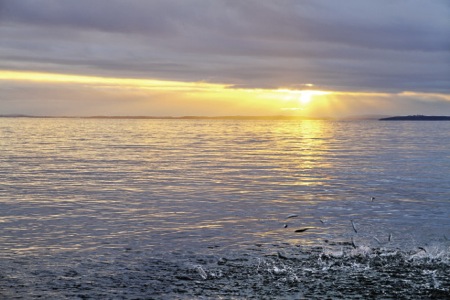
You’re looking for schools of pilchards – big schools of pilchards – using nature and human beings to help you find them. Please note that if you find work-up action over the foul around Flat Rock or the area between Gannet Rock and Waiheke Island in the early part of the season during September, I can almost guarantee that there will be XOS snapper involved.
I have caught large male snapper around Flat Rock during September for as long as I have been fishing work-ups – that’s over 10 years of charter fishing specialising in work-ups. I can also tell you that I still get very excited when I see gannets funnelling into the water.
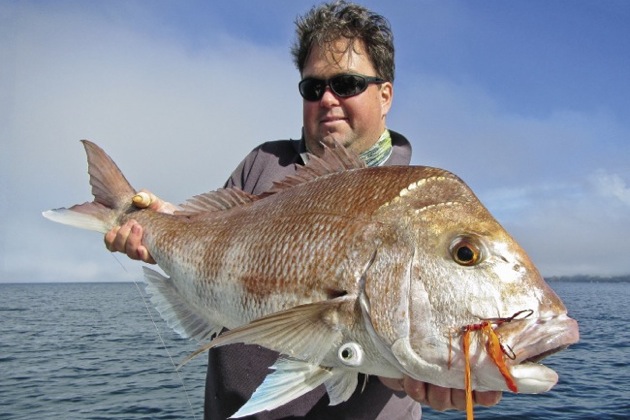
During October and November the action often moves to the more central parts of the Outer Gulf, with a few spots consistently providing work-ups during this time: eight nautical miles due east of Tiri; 3-5nm north of Gannet Rock; and 5nm south of Anchorite Rock.
The movement starts at each end of the Hauraki Gulf and then centralises as the season goes on. Work-up activity slows down a lot during the warmer months of mid-summer – which brings us to the effect of water temperature on the work-up action.
When you think about it, snapper don’t have a calendar to look at to figure out when it’s spring, but can feel a change in water temperature. So during spring, a period of warm weather or a slight increase in water temperature triggers their feeding instincts at this time. On the flip side, in autumn it’s the drop in water temperature that activates another burst of work-up activity. In short, changes in water temperature will intensify work-up action, while long periods of stable water temperature will slow the work-up activity.
The signs
Now we know where to start looking, let’s talk about the signs to look for out on the water, because the action does move around quite a bit.
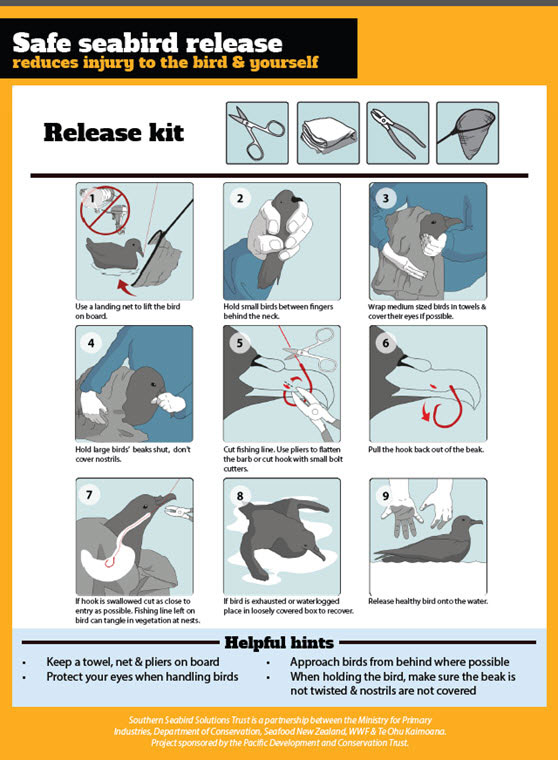
I have written about gannets a lot in previous articles, so will only briefly recap. Gannets will find the work-ups for you, so follow them, trust them, and you will love them like I do. And please, please, respect these fantastic fishermen, as they are your friends.
The Hauraki Gulf’s gannets live on Gannet Rock north of Waiheke Island, Gannet Island by Coromandel, the Broken Islands near Great Barrier Island, and there’s also a small colony at Motuora Island in Whangaparaoa Bay. It pays to start your work-up hunting close to one of the colonies so you can see which way the birds are going.
Gannets leave in the morning and play follow-the-leader searching for pilchards. Join in their game, pretending you’re a gannet, and you will be in.
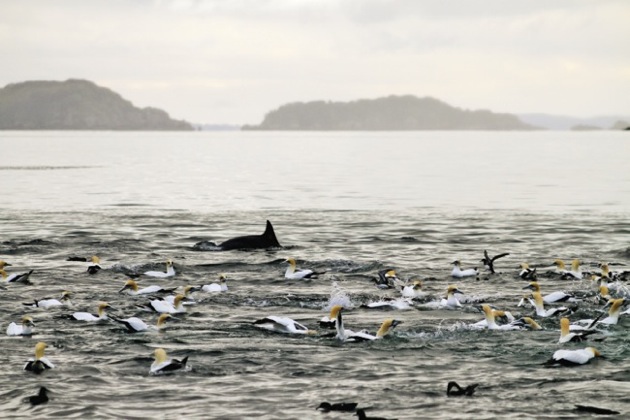
Dolphins and whales feed on pilchards, too. Dolphins use sonar to find them and whales use their acute hearing. Gannets follow the dolphins around and the whales follow the work-ups.
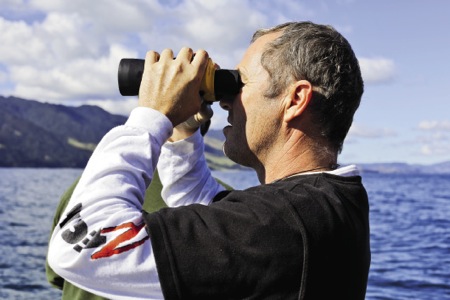 Binoculars are vital. Keep them clean and focused on the horizon looking for white specks, which are gannets. I reckon you can see about 3-5 kilometres when looking for gannets through binoculars, so my technique is to stop every three kilometres and scan the horizon for action. I am looking for any of the creatures that like pilchards. You must really concentrate if you want to find work-ups. You don’t want to miss anything. Then, once you’ve found the gannets and/or dolphins, you will soon figure out that everything is moving in a certain direction, showing you which way to go, too. Experienced work-up hunters will find the action 90% of the time while less experienced fishers or skippers and crews who remain unaware of their surroundings can miss the important tell-tale signs and drive straight past the action or go the wrong way.

|
|
Sections of this article are reproduced with permission of |

Fishing Reports Visit Reports
Outer Hauraki Gulf Fishing Report 17/09/26
Spring wind the handbrake. Spring is starting to make its presence felt in the outer... Read More >
Top of the South Fishing Report - 17/09/26
Early snapper in Tasman Bay. Well, spring is finally here, and the days are getting... Read More >
Bream Bay Fishing Report - 17/09/26
Good snapper catches reported. After Tangaroa turned off the fish tap for a month or... Read More >
Bay of Islands Fishing Report - 17/09/26
Pacific bluefin tuna for the lucky few. The last fortnight has seen more fishable days... Read More >


Friday 25 September 2026
Major Bites
 - -
- - Minor Bites
 - -
- - Saturday 26 September 2026
Major Bites
- - Minor Bites
- -
Comments