
Winter Snapper Fishing Techniques

As we move into the depths of winter, many anglers are inclined to hang up their rods until the following spring. Sam Mossman gives a run-down of methods for targeting inshore snapper in winter.
In some parts of the country, it is understandable that many sea fishermen stop fishing during the winter. Undesirable species like red cod, barracouta, spiny dogs (and other ground sharks) become prolific and in some areas flooded rivers pouring silt-laden fresh water into the sea, coupled with coasts exposed to rough weather conditions, can keep many off the water over June, July, August, and September.
Winter fishing is not always like this though. Sometimes we are blessed with crisp, cold, still winter mornings. If you want to get on the water on a more regular basis, the trick is to fish the weather windows. In winter these windows can be small – just louvres really – sometimes consisting of brief lulls of just four or five hours between systems. Early mornings often have the best conditions, sometimes with little wind at dawn and conditions only starting to get uncomfortable by mid-morning. If you are handy to your fishing grounds, you can launch at first light and be home with a feed by 10 or 11am as conditions deteriorate.
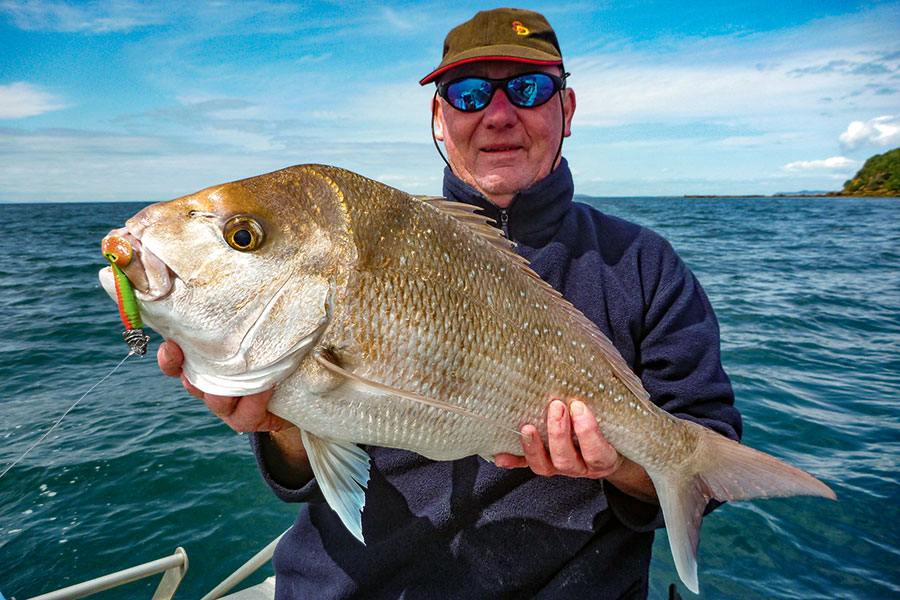
Smaller soft-baits work well when retrieved slowly.
The ten-knot clause
The ability to down tools and head out during weekdays at short notice – sometimes called the ‘ten-knot clause’ – will greatly increase the number of opportunities you can take advantage of. The self-employed and the retired certainly have it over the average wage slave in this regard. Picking these short opportunities requires good forecasting information and local knowledge. In this electronic age, we are spoiled for data. In some regions, Coastguard offers the current marine forecast as well as ‘now-casting’ – reports from automatic wind gauges that tell you what is happening at representative locations in the region. Add to this some excellent internet weather sites (such as Metvuw, Windguru, Swellmap, and windy.com), a decent local knowledge of fishing spots, ramp orientation, current directions etc, and you can make some informed decisions.
Even with all this, you will not always get it right, and there are times when discretion is the better part of valour. You need to be sensible and call off a trip if the conditions are not playing ball. There is always another day.
Taking advantage of short weather windows in winter works best in inshore waters that can be quickly accessed, and where you don’t have to travel far to get back to a sheltered landing spot if the conditions unexpectedly turn to custard.
The rewards
Winter even has some advantages. As previously mentioned, a lot of people stop fishing in winter, so there is less ramp congestion to deal with. It doesn’t get light until relatively late in the morning and evening comes early, too. This means that fishing in the lower light conditions at each end of the day need not mean getting up at some unpalatable hour, or it being midnight by the time you get home, clean the catch, and wash the boat. You can even flush the outboard without annoying the neighbourhood – too much – if it is only 7pm or so.
Winter Snapper
I own a small (4.3m) boat and tend to fish inshore. My home waters at the northern end of the Hauraki Gulf are largely a snapper fishery. There are useful numbers of kahawai, kingfish, gurnard, trevally, and other species to be caught, too, but snapper dominate.
I enjoy winter snapper fishing. As mentioned, with shorter days I don’t have to get up so early to fish the dawn and the same applies in the evening – I can fish the change of light and still be home and cleaned up at a reasonable hour.
When our waters cool over the winter months, reduced temperatures effect snapper in several ways. Firstly, in distribution: shallower waters have more of their mass exposed to the surface, so they chill (and warm up) more quickly. When the water cools down some fish will stay inshore, but the majority of snapper move from the shallows out to deeper waters, where the larger water mass stabilizes the temperature better. This varies from north to south as the southern waters are colder. Generally, snapper in the north do not move so far, or for so long as in the colder southern parts of their range.
The degree of movement seems to vary a bit depending on the severity of the given winter, too. I can remember some very cold winters in the Hauraki region when the water temperature dropped to around 11°C. Then, the snapper seemed to be pretty much non-existent in inshore waters. But that was around forty years ago. Climate change and recent milder winters have seen better numbers of our red friends lingering in the inshore grounds. (Barracouta and ground sharks are becoming less of a problem, too, so climate change has some upsides).
It is probably fair to say that, with the right approach, a reasonable catch of inshore snapper, right through winter, is an achievable thing from East Cape, north.
A second variable effecting snapper distribution in the colder months is the size of the individual snapper. The law of thermal mass means that the bigger a fish’s body is, the more heat it can conserve and the colder the water it can stand. Consequently, many smaller snapper move out to deeper water than big fish when the water gets cold. This thermal sorting sieve will help you catch a better size of fish on average. Although there are still small fish about in winter (mainly in the medium depth channels, 15-25m), the average size is better, and the biggest fish are often tucked up in the shallow foul.
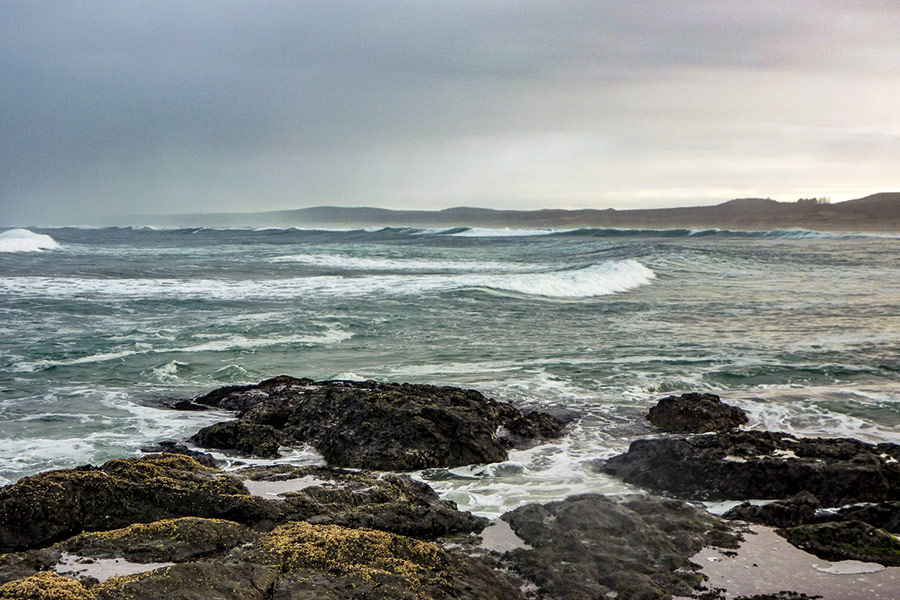
A storm smashing into a rocky coast will break up and disturb lots of food items.
Bait tactics for winter
Unfortunately, cold water slows the metabolism of snapper, making them less interested in feeding at this time. They may only come on the bite for short periods (i.e., the length of the ‘bite time’ is much reduced in winter), and they seldom feed very aggressively, often toying with and picking at baits. They can be frustrating to fish for, and a change of tactics may be required.
Berley can help get fish interested in feeding and tempt them out of the heavy foul where fishing for them is easier. However, if there is likely to be a barracouta presence in the area you are fishing, berley can be counterproductive. If you do decide to use it, release it on the bottom for minimum ‘snake’ attraction.
Winter fish must often be allowed to play with the bait for a long time before they will take properly and move off. This means that tough baits that can take a bit of a mauling and still stay on the hooks are required. Favourites that have produced the goods for me are salted skipjack, or half jack mackerel (these can produce a useful by-catch of john dory too if used as live baits).
Use a strayline with the lightest sinker weight and the lightest line and leader that you think is practical. Likewise, smaller baits can sometimes be more effective. A half-matchbox size is about right.
Let the fish run – resist the temptation to strike until the fish has finally taken the bait firmly and started to move off.
Use sensitive tackle and treat every tiny nibble as a decent fish. Often the very lightest bites are from the biggest snapper.
Because fish muck around with the baits, when straylining in shallow areas monofilament lines can be an advantage as their stretch means the fish is less likely to feel line drag.
Often the fish will only bite for a very short time, and you must take advantage of this. Check the bite times, change of light, and appropriate tide periods and plan to be on your spot and ready to go at the right time. You must make maximum use of the short feeding time, so have backup tackle ready to go should you get snagged or bitten off.
There are big fish in the shallows, but there are not many of them, and they are not feeding aggressively. Wrap up warm, take a thermos flask and be prepared for a long wait between bites if trying the skinny water. Keep noise and vibration to a minimum.
Soft-baits in cold water
The weedy, rocky inshore zone ordinarily gets little pressure – most boats won’t go right in there (often preferring to use berley to try and entice the fish out) and most shore anglers find the heavy, weedy foul eats terminal tackle for little result.
Fish tucked up in this heavy country in winter are often not really in a feeding mood for much of the time but will snap at a well-presented soft-plastic lure. In these shallow areas, the fish feel exposed and are more comfortable in times of low visibility, such as first and last light, or when there is a heavy shadow cast by the land (or it’s dark and overcast). A decent white-water wash for the fish to hunt under can offer cover and this usually means turbulence that will expose food for snapper as well. For these wary fish, approach quietly and cast well away from boat. Electric outboards are a real advantage here.
Standard soft-plastic tackle includes a spin rod and reel loaded with braid rated around 4-6kg (although it may well break at considerably more than this). Braid copes well with weed, often cutting itself free if snagged.
Surprisingly though, despite the gnarly terrain, I haven’t lost much tackle fishing the weedy shallows. Working lures a little above the bottom helps (lighter heads come into their own here as they don’t sink so fast), and lead-head jigs ride hook point up, reducing snagging further.
Often, if you do hang up, it is just the nose of the lead-head that has dipped into the weed. A sharp jerk will usually tip the jig up and it will pull free.
A ‘Texas-style’ rig with a worm hook and sliding head weight can be rigged ‘weedless’ too, with the hook point skimmed just under the surface of the tail and popping up to do the business under the bite of a fish.
At this time of year, sluggish fish require slower retrieves. I prefer smaller lures that fussy fish can inhale easily (4” is a favourite) and one with lots of action at the slow retrieve speeds required, such as a Z-Man Curly Tailz or the Gulp! Crazy Legs.
Fishing for snapper in winter is usually slower than in the warmer months and most fishermen are happy with modest catches at this time of year. But winter fishing is also more challenging and interesting, and the sense of achievement is greater when you are successful and can put a feed of fresh fish on the table in the coldest months of the year.
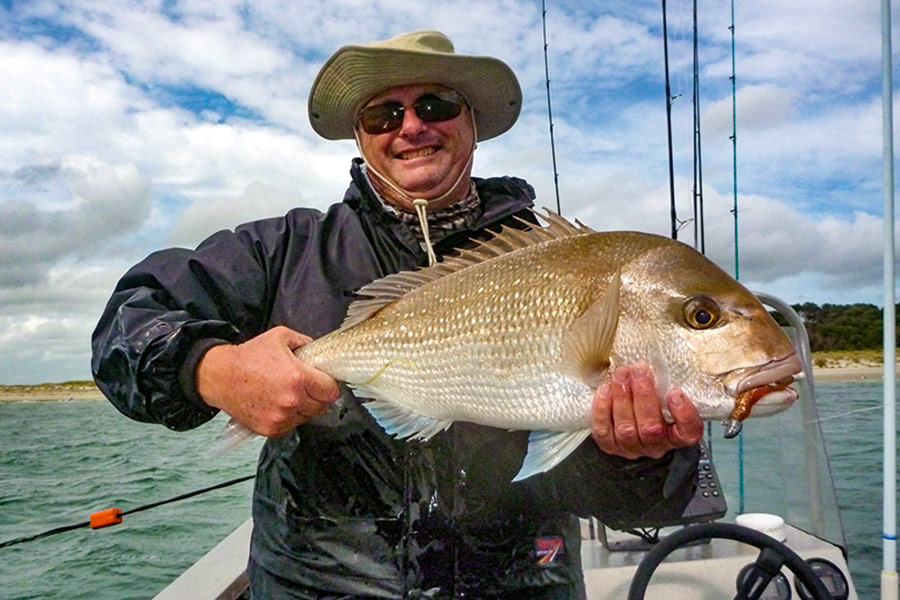
If soft-baiting during winter, use slower retrieves and smaller tails that fussy fish can inhale easily.
Finding Winter Snapper
There are several places to concentrate your search for inshore winter snapper in the north.
• The biggest fish will often be tucked up in areas of shallow foul (approximately 2-12m) with plenty of rocks and weed.
• ‘Funnel’ areas with nearby foul, where there is good tidal water movement (read: channel edges) in 12-25m can hold reasonable numbers of snapper in winter as there is always plenty of food to be had.
• Fish sometimes hold in shallow reef country near river mouths and in harbours in winter. They can feed well just after a winter flood has flushed out a lot of food and the water salinity is starting to return to normal. A couple of tidal flushes after the rain stops can be a good time.
• A storm smashing into a rocky coast will break up and disturb lots of food items. Try for big fish in close right on the heels of a storm. Don’t risk dangerous conditions though!

August 2022 - Sam Mossman
New Zealand Fishing News Magazine.
Copyright: NZ Fishing Media Ltd.
Re-publishing elsewhere is prohibited
Fishing Reports Visit Reports
Manukau/West Coast Fishing Report - 15/10/26
Big spring snapper in 60 metres. The El Niño weather pattern isn’t going to be... Read More >
Rotorua Fishing Report - 15/10/26
Solid start to the season! The Rotorua lakes have all started the season well, and... Read More >
Tutukaka Fishing Report - 15/10/26
Big snapper in shallow. Things remain relatively quiet on the fishing front out of Tutukaka,... Read More >
Tauranga Fishing Report - 15/10/26
Bait and temperature on the rise. It’s been great to get out and see some... Read More >


Friday 23 October 2026
Major Bites
 - -
- - Minor Bites
 - -
- - Saturday 24 October 2026
Major Bites
 - -
- - Minor Bites
- -
Comments