
White trout fishing
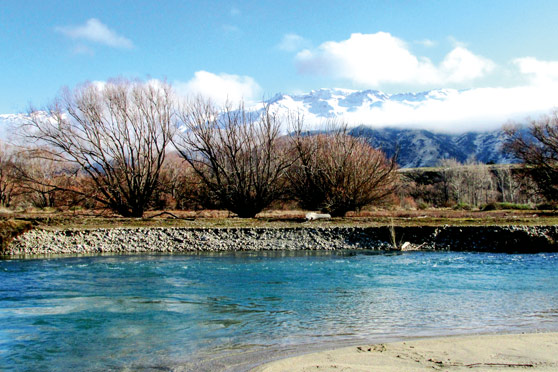
Winter is here. This morning was a minus-four frost, and a couple of other days have already been below zero. Extreme cold and trout fishing are not my favourite combination, but the fine day that follows a frosty morning may see me grab a rod to get outside for some sun.
Down in Otago there is a lot of available water, but success is not guaranteed. You have to prospect, and in general that means fishing big rivers, open lakes or tidal estuaries. A lot of the bigger spawning fish are safely tucked away in closed water.
As an aside, it was sad to see in the paper a couple of months ago that a number of spawning brown trout (16) were found dead in a Lake Hayes tributary (near Queenstown), probably due to some pollutant in the water. What a waste!
I winter-fish the Clutha River primarily for maiden rainbow trout that max out around a kilo. I know they are there, so target them accordingly. Occasionally, an early returned slab fish might also put in an appearance, or even a maiden brown trout.
The sorts of fishing water I look for are ripples, glides and side braids off the main river. When I find one rainbow I generally find more, as they seem to shoal.
The only problem with fishing the Clutha is getting the river flow right. In winter the flow can be quite low, which opens up a lot of fishing water that normally flows too fast. However, it can suddenly rise again without warning.
As an example, let’s look at a flow pattern earlier in the winter between June 8 and June 16. On June 8 it was 170 cumecs, then it fell to 100 cumecs on June 11, rose quickly to 240 cumecs on June 14, then dropped to 120 cumecs on June 16. (Sourced from http://water.orc.govt.nz/WaterInfo/Catchment.aspx?r=UpperClutha)
Forrest Gump would say, “The Clutha is like a box of chocolates: you never know what you’re gonna get.”
From that information I can see that June 9, 10 and 15 would have been great days to fish.
I had done quite well at a couple of spots in the past, so recently went back to one of them – a braid on the Clutha the size of a small-sized river in its own right. It fishes best at a moderate flow rate, as it virtually dries up when the rate is too low. The flow on June 9 was about the same as the day I visited – too fast to cross, but about right for creating ripples. (If the flow had been lower, I would have crossed over and carried on to the main river.)
During winter I seldom see any fish, even though they are there, so the technique is to blind-fish rainbow-type water until pay dirt is struck.
The weight of your lure is linked to water flow, so if the current is slow, a 7g spinner should be the job; if faster, use a 13g Super Johnson. Both are successful on the right day. The colours I lean toward are shades of yellow.
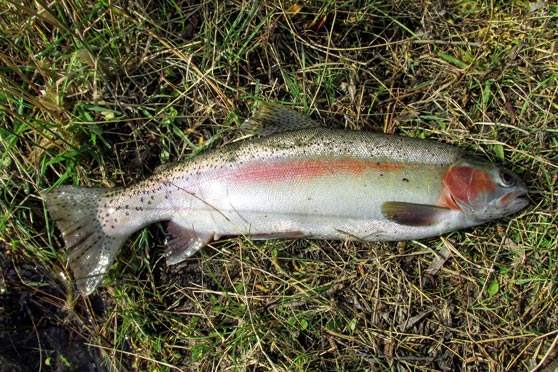
The rainbows are very silvery in the Clutha, with the red stripe more of a red sheen than a slash.
I began fishing each glide I encountered, concentrating on places where the current slowed or rippled. Success eluded me until I reached a pool with a half-submerged tree in it. Below that tree I found a small shoal of maiden fish.
Cast one was whacked, but no hook-up. Then, over the next half an hour I landed three pretty rainbows of about a third of a kilo – too small to keep, but good fun on a chilly morning. I also lost a couple. Small fish like these tend to hit hard, often don’t hook-up, and frequently follow the lure in. I carried on downstream, but found nothing as good again. Down where the water slowed I did land a longer, slabby rainbow and lost a similar skinny fish in the same pool.
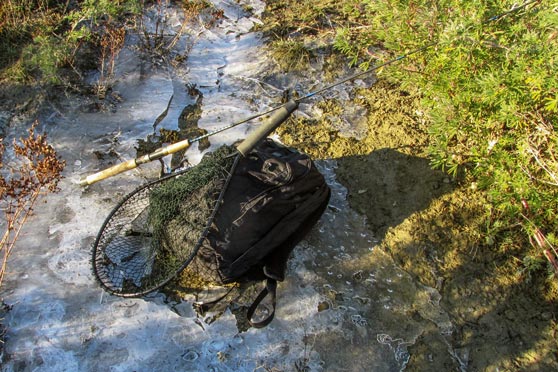
Wandering back to the truck, I flicked occasional casts into spots I had ignored on the way down, and on one such cast hooked my best fish of the day. This feisty half-kilo fish took to the air and fought above his weight category. I landed and released it, as it was not quite big enough for eating purposes.
The scenery when fishing in winter water is one of the plusses. Nearby mountains are snow-capped, ponds and shallow water areas are frozen, and trees have a leafless starkness. Crisp and clean are adjectives that spring to mind. You don’t see many other people and are more likely to encounter a duck or quail hunter than another angler.
In winter, it definitely pays to dress for the worst and hope you will be pleasantly surprised. I wear light waders, plenty of layered clothing, a warm beanie and fingerless fishing gloves.
A few years back, when fishing Lake Coleridge in winter, the line in my reel froze up and casting was virtually impossible. Each flick of the rod saw small slivers of ice fall off.
Winter fishing is different than in the warmer months, being an occasional treat when conditions are right, rather than a weekly activity.
|
|
This article is reproduced with permission of |

Fishing Reports Visit Reports
Tauranga Fishing Report - 28/05/26
Tarakihi on the bite Trips are few and far between at this time of year,... Read More >
Canterbury Fishing Report - 28/05/26
Fresh and salt turning it on! It is not very often I get to say... Read More >
Bay of Islands Fishing Report - 28/05/26
Lures paying dividends We finally had a break in the SE winds that have been... Read More >
Manukau/West Coast Fishing Report - 28/05/26
Snapper and gurnard in the harbour The weather has finally taken a turn for the... Read More >


Major Bites
Minor Bites
Major Bites
Minor Bites
Comments