
What do fish see?
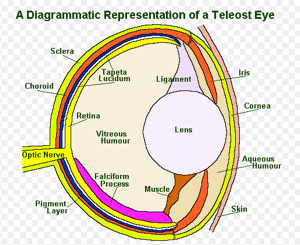
For many fish species, vision is considered to be the most favoured sense. It is used to gather information about the surrounding environment, to locate food, find mates and avoid becoming food.
To a great extent, what a fish is able to see is governed by the optical properties of water. Therefore, before looking at the visual adaptations of fish, it is necessary to get a feel for the environment they live in.
Fish have a hard time seeing because water decreases both the brightness and the contrast of objects. In basic terms, an object can be 'seen' when its brightness and contrast are great enough to distinguish it from the background. The brightness and contrast of an object in water are quite different. How bright something appears depends on the intensity of the light that is reflected from it, while the contrast of an object depends on the difference between the object and the background.
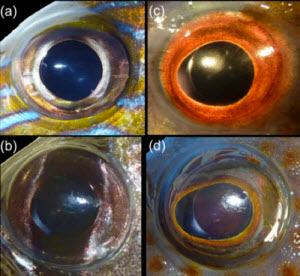
When light passes through water (fresh or salt), it is partially absorbed, reducing its intensity or brightness. The further the light travels the more it is absorbed, so it obviously becomes darker with increasing depth. Absorption reduces the 'usefulness' of vision in two ways. Firstly, it reduces the intensity of light throughout the water as a whole, and secondly, it reduces the intensity of the light that is reflected from objects. Both of these affects make it difficult to distinguish objects from their background.
Seeing an object under water is also dependent on its contrast, and this is in turn affected by a process called 'scatter'. Rays of light become scattered or redirected when they are deflected off the surface of suspended particles. This alters the direction in which the light rays had been travelling.
How much light is scattered is proportional to the amount of sand and silt suspended in the water. The effect of scatter is best illustrated on land by a foggy day. It becomes difficult to identify objects because light is scattered in all directions when it hits the small water droplets that make up the fog. The effect is to reduce contrast, making it difficult for the viewer to identify objects.
In water the same effect happens: rays of light are scattered between the object and the viewer and from behind the object being viewed. In the first instance a 'veil' of light between the object and the observer is created, while in the second instance a bright background of 'space light' is created. Both veiling and background space light mask the presence of an object, making it difficult to see. Light that is reflected from an object is also subject to scatter and this reduces the amount of information the fish receives, thereby making it difficult to construct an accurate image of what it is viewing.
Accordingly, many fish have developed hunting strategies that are specifically aimed at increasing the contrast of their prey, thereby making it easier to identify.
This is perhaps best demonstrated by mid-water fish such as the barracuda and kingfish. These types of fish often adopt an ‘ambush’ strategy, stalking and striking their prey from below. Such a strategy improves the contrast of their target. For instance, the barracuda no longer depends on the brightness or amount of light reflected from the mackerel. The body of the mackerel simply interrupts the passage of light immediately above it and it appears as a dark silhouette against a bright background. The affects of absorption and scatter have therefore been largely overcome. The barracuda then charges up from below to strike the mackerel. During the strike the barracuda is essentially unseen by the mackerel as it is viewed against the dark background of the sea bottom.
As a consequence of absorption and scatter, many fish have eyes that are specifically designed to enhance the brightness and contrast of objects. In subsequent articles we'll explore the eye structure of various species of fish.
A Blast From The Past!
|
February 1998 - by Guy Carton |

Fishing Reports Visit Reports
Canterbury Fishing Report - 01/10/26
Freshwater season underway. Wow, it’s October already, and our freshwater season is underway, and the... Read More >
Top of the South Fishing Report - 01/10/26
Snapper about but not yet firing. It’s certainly nice to see daylight savings upon us... Read More >
Hauraki Gulf Fishing Report 01/10/26
Big reds in the shallows. The weather has made getting out on the water challenging... Read More >
Bay of Islands Fishing Report - 01/10/26
Snapper moving in. A few Pacific bluefin are still gracing the weigh stations with last... Read More >



Monday 12 October 2026
Major Bites
 - -
- - Minor Bites
 - -
- - Tuesday 13 October 2026
Major Bites
- - Minor Bites
- -
Comments