
Using specialty lures
In the United States of America anglers take their fishing very seriously.
Some even go professional and make big money on the competition circuit through prize money and endorsements. For example, Zack Birge from Blanchard, Oklahoma won first prize of US$50,000 when he took out the 2014 FLW Rayovac National Championship on Wheeler Lake out of Decatur, Alabama on November 1.
The lures used by such winners come under incredible scrutiny, and many companies design baits created specifically for the Pro Circuit. In the case of Birge, this is what he said when standing on the podium:“I credit the Monroe Bling Spinnerbait for much of my catch, largely because the unique design of the blades produces stronger vibration patterns. The flash of the exclusive Bling blades helped pull fish from the cover better than other spinnerbaits of its size.”
Thousands of this bass lure have probably been bought in the months since he uttered these words.
Lure designs get more and more intricate, usually catching more buyers than fish, but we are all looking for ‘the one’ that will revolutionise our success rate. In the States, particularly, lifelike lures are often given the name ‘specialties’ because they are incredibly realistic and unique.
At different times, whether it is through Cabelas, River2Sea or Fish USA, some of these specialties have arrived by courier on my doorstep. The high Kiwi dollar has made this option viable and keeps the local businesses on their toes. Like everyone else, I am also looking for an edge.
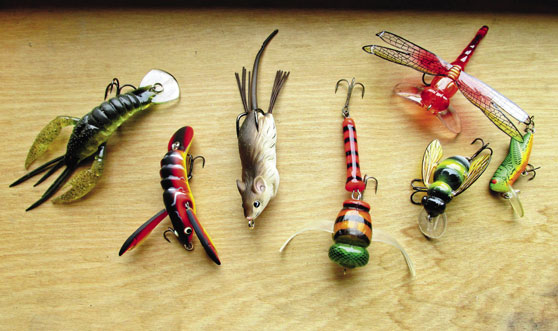
Using these ‘specialty’ lures I have thus far caught two trout, so no earth-shattering edge yet, but it is early days. My own ‘specialties’ collection falls into five categories – mice, dragonflies, bumble bees, grasshoppers and freshwater crayfish – which I think will pay their way eventually. (I have caught trout on artificial worms in the past but they are not intricate enough to gain the title ‘speciality’.)
At present a mast is taking place down here in the South Island’s beech forests, and the abundance of beech seeds means the mouse population has skyrocketed. The small alpine village of Arthurs Pass is inundated and mice have invaded every living space. Vacant holiday homes have become mice boarding houses and the floors are a sea of mouse droppings. It is a plague, and local trout will be on a mouse-eating binge.
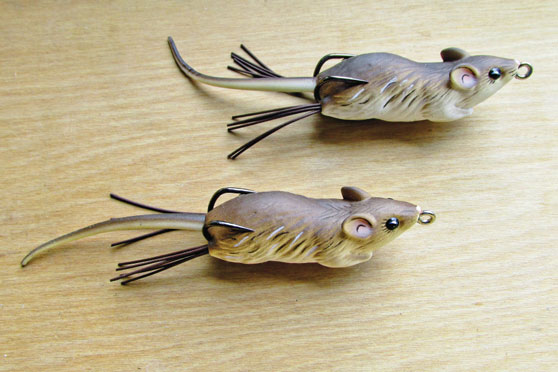
I have two ‘specialty’ mice ready to go, and one day I hope readers will see the fruits of their efforts on my behalf. They look so lifelike I expect them to squeak, bite me, or scuttle off at any moment. They have not been fishing yet, but the day is close.
Second category is the dragonfly, and I caught two trout when fishing Lake Brunner in Westland by using one of them. At the time I just happened to have this huge monstrosity of a lure in my bag as I waded back to my truck near dark. Results had been poor – and then trout began to make splashy rises all around me. I had no fly rod, so resorted to using the gaudy green-pink and striped dragonfly imitation instead (a mate had given it to me as a joke once). Its big cupped wings are designed to trap the water and make it flounder along the surface.
After dark it got whacked at least seven times, with two resulting in landings. I would hear a big splash in the general area where the lure was, and on lifting the rod would be hooked up – albeit quite briefly in most cases. I was amazed.
I still have that original and after that night have a soft spot for it. I don’t want to lose the lure as it’s earned its retirement. I have two new dragonflies ready for deployment this year – so watch this space.
The bumblebees and grasshoppers look incredibly realistic but have not been tried yet, so 2015 will test them out. They have bibs so are meant to be wound in slowly, representing an insect struggling as a river or stream washes it downstream. The angler turns the reel handle occasionally so the bug looks like it is trying to swim to the bank. The detail in the bumblebee imitation is amazing, though I imagine a big trout would change that look quite quickly.
Last on the list is the crayfish. They seem to come in two basic types: those with bibs for slow winding or trolling, and those designed for twitching back to the angler. I have several ready for action, and have high hopes for them, as many of the trout I target feed on koura or yabbies as a staple food. Often, when fishing with worms on Otago irrigation dams, my retrieved bait gets hammered. I believe the trailing worm ends looked like a crayfish swimming backwards, so the trout attacks. These trout were always bonuses, as they are not actively targeted in this manner.
The latest crayfish specialties have arms that flail loosely, beads that rattle, detailed colour, lumo eyes and tiny, sharp hooks. They look incredible, and I am looking forward to testing them on the water.
The best way to use most of these specialties would be after dark, particularly the mice and crayfish, as that is when nocturnal creatures and big predatory trout are out and about. Down south in the Mavora Lakes, anglers often fished with mice imitations and scored some huge brown trout. I am sure as this season advances we will hear of some trophy mouse-fed trout being landed – perhaps on a speciality!
|
|
This article is reproduced with permission of |

Fishing Reports Visit Reports
Outer Hauraki Gulf Fishing Report 17/09/26
Spring wind the handbrake. Spring is starting to make its presence felt in the outer... Read More >
Top of the South Fishing Report - 17/09/26
Early snapper in Tasman Bay. Well, spring is finally here, and the days are getting... Read More >
Bream Bay Fishing Report - 17/09/26
Good snapper catches reported. After Tangaroa turned off the fish tap for a month or... Read More >
Bay of Islands Fishing Report - 17/09/26
Pacific bluefin tuna for the lucky few. The last fortnight has seen more fishable days... Read More >


Friday 25 September 2026
Major Bites
 - -
- - Minor Bites
 - -
- - Saturday 26 September 2026
Major Bites
- - Minor Bites
- -
Comments