
Using downriggers
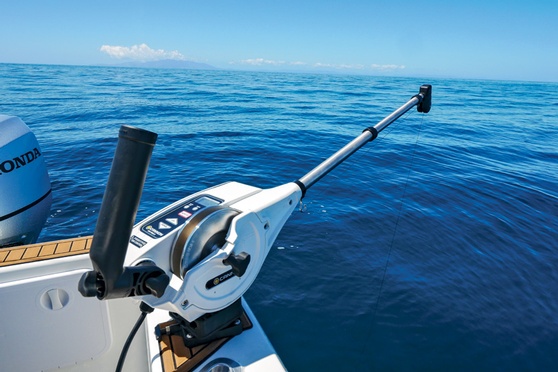
It doesn’t matter if you are targeting trout or a billfish, a well set up and deployed downrigger will enhance your chance of hooking up.
Many people think downriggers are quite difficult and technical to use, but that is far from the truth. I was first introduced to just how deadly a downrigger could be when they were trialing this tool on Lake Taupo. The late Keith Draper and I went out with DoC staff whose department manage the fishery in a boat fitted with a couple of manual downriggers.
Keeping an eye on the sounder for sign, we down-rigged conventional lures via a couple of spin rods, loaded with four-kilo mono. Once we sorted the tension on the rudimentary release clips we were away. Fish would be sighted on the electronics and the downrigger, which featured a line counter, was raised and lowered to intercept the quarry.
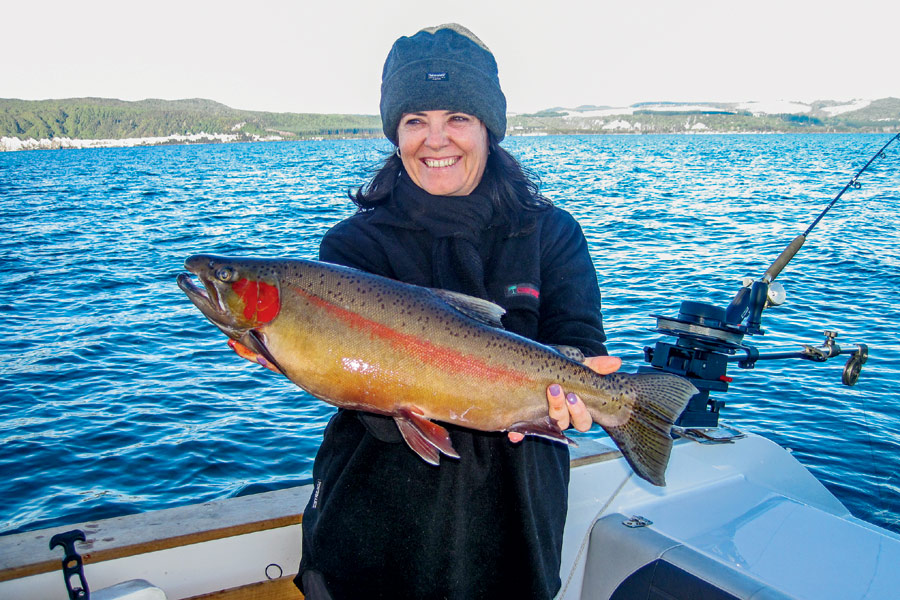
Used this way, the technique proved deadly, especially for targeting trout out of reach of conventional lead and wire trolling tackle. The ‘riggers we used on that trial day had extended cable capacity – 100 metres from memory. At one point in the depths of Western Bays we saw fish at 60 metres and were able to target them effectively.
DoC allowed outriggers eventually, after much debate, but wisely limited the cable length to 40 metres.
So began my love affair with downriggers, initially for trout trolling, but later for marine fishing as well.
My first saltwater success came when targeting kingfish around Sail Rock in Bream Bay. There had been kingfish busting bait on the surface and as I had been snapper fishing, I didn’t have a livebait.
We had been towing Rapalas for a short time to no avail because the fish had gone down. I lucked over them with the sounder, pinging them well below the trolling depth of the bibbed minnows.
Out came the downrigger and the lure was dropped to the depth where the kingfish were located over a pin 30 metres below. It had only been down a couple of minutes and was hit, the fish shaking the lure free.
Resetting the ‘rigger, the next bite stuck, resulting in a 16kg kingfish on ice. It had been an eye-opener as to the effectiveness of this tool.
Next up came a trip with the late Jeff Le Strange where we went from Tongatapu up to Vava’u via the Ha’apai Group aboard Hakula. At the Ha’apais we spent time targeting dogtooth tuna, getting absolutely smashed on conventional jig gear.
Out came the downrigger, down went the rigged flying fish and at last we put some runs on the board. We dropped the baits down to where the fish were sitting on the side of a drop-off and slowly trolled them past their noses. On hooking up we drove hard off the reef, the Tiagra 80Ws still in the rod holders in the covering boards. Even using these bully boy tactics, we only managed to hold onto a handful of these tough fighters.
In more recent times I have been on boats using a downrigger live-baiting for kingfish and marlin, as well as slow-trolling for swordfish. In Mexico it was common practice to deploy downriggers when targeting yellowfin tuna around the thermoclines.
On another trip to Fiji, fishing for wahoo, the skipper was a great fan of a natural bait (ballyhoo from memory) rigged inside a black and purple Ilander lure. This was particularly effective when the surface bite had gone off as the sun rose in the sky.
Downriggers have also been used to run the light dredges that have become increasingly popular on trailerboats chasing billfish.
I have used downriggers for targeting snapper. It is a great way to drop the berley pot/bag down to a reasonable depth. Make sure the pot is attached using wire as the bronzies are attracted to the berley, especially when fishing the harbour channels in summer. I have had several berley pots and their covering netting destroyed this way.
Downrigger options
Think of a fishing rod and reel, and you have the basic elements of a downrigger. There are ‘riggers available to suit a wide variety of needs and pockets. Cannon and Scotty are the two main brands available in New Zealand.
The least expensive, and sophisticated, are lightweight manual models which clamp onto the side of a dinghy. These are primarily used when trolling for trout and have limited depth range due to the size of the spool.
Downriggers allow offshore captains to fish deeper zones near thermoclines and bait balls to target pelagic species that might choose to feed well below the water’s surface.
You don’t have to be on the troll to fish downriggers effectively. You can drift your livebaits at different depths using clips that attach to the wire, keeping one trace short and making the bottom one longer. Using baits like jack mackerel or koheru, the drift of the boat and a reasonable depth separation will ensure the baits don’t tangle.
At the same time, you can run another surface bait under a balloon, covering several bases.
I have tried live skipjack on the rigger while drifting, but unless you have a bit of way on to keep weight on the trace, they are strong enough to tangle the gear. Best to slow-troll them.
Some charter skippers I have fished with have changed out the downrigger cable for 130lb braid for very deep dropping, as it does not ‘sing’ (vibrate) to the same degree as wire and offers less water resistance.
Balls, discs and wings
The three main options for getting the gear down there are lead balls and discs of various weights, and Z-Wings. The first two are self-explanatory. They are either a disc or a ball with an attachment and tow point set into them.
The Z-wing is a delta-shaped planer, some of which have several options for the tow point to increase or lessen the downward planning force.
I prefer the ball or disc option as the Z-Wing can impose a huge amount of tension on the rigger. I don’t recommend them for all but the heaviest-duty downriggers. The downrigger ball shape you choose usually depends on your intended trolling speed.
Transferable
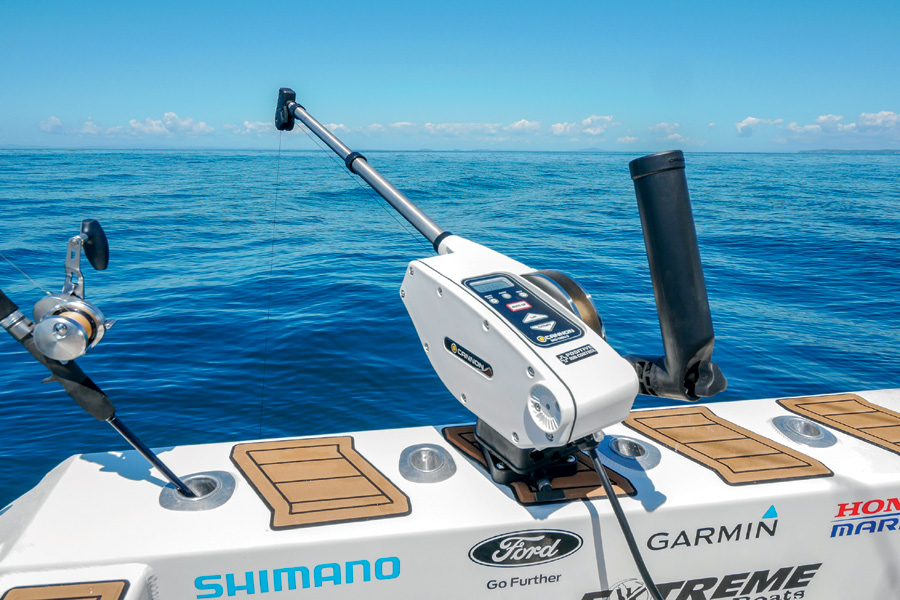
Several years ago, Extreme Boats made me a couple of downrigger bases that fitted into the rod holder, making the ‘riggers’ transferable from boat to boat.
The rigger mount is bolted to a plate which has a section of tube welded at the appropriate angle underneath it. There are several considerations when it comes to this system. The first, and most important is the ability of the conventional rod holder to take the strain a downrigger fully loaded will impart. The last thing you want is for the rod holder to fail, breaking out of the gunwale and tipping your rigger into the tide. It does happen!
Similarly, if you are mounting the base more permanently on the gunwale, is the covering board up to it? In the past we have had the manufacturer beef up the section of deck the downrigger base is attached to.
The third consideration is to ensure you have left enough space to sit the rod in the nearest holder unimpeded by the downrigger. This is less important for smaller and lighter trout tackle, which will safely sit in holders attached to the rigger itself, but when running the 80W there is not an option. A well-placed conventional rod holder is required for that.
Electric v manual
When you hook up, you want to get the ball or dredge up and out of the way quickly as possible, so you can get to work on the fish. Electric downriggers are great for this. Touch a button and the rigger is retrieved with no further involvement of the angler or crew – great when fishing short-handed.
For freshwater fishing, some downriggers are interfaced with their own sounders. You set the depth you want to run the lures above the bottom and the rigger detects changes in depth and retrieves or releases cable appropriately.
Obviously, with a manual downrigger, the skipper or crew must check the depth on the sounder against the line counter on the downrigger and make any alterations by hand.
When trout fishing, the helmsman must regularly call the water depth, so the crew can check it against the counter on the rigger. At trolling speed, there is very little time to make any adjustments because the ball is almost immediately beneath the transom. The crew need to be onto it, because running into a reef and fouling the ball, even at a 1.5-knot trolling speed, is a recipe for disaster.

Release clips
Like downrigger balls, release clips vary greatly in style, depending on need.
Regardless of their use, the clips need to be adjustable to the line type, boat speed and bait/lure size. Choosing the right ones is something that only comes with experience.
One skipper I fished with in Fiji used an Aftco outrigger releases to which he attached a rubber band wound around the mainline. We were trolling flying fish for wahoo around a FAD and couldn’t buy a bite on surface lures and baits, but the downrigger-presented flyers did the trick!
For trout fishing I have tied a short 10cm length of Dacron into the main line about 30 metres from the end because I am using light (4kg) mono as my main line which could be damaged by the clip. The Dacron is a far sturdier connection point between the line and the downrigger.
In conclusion
Downriggers are far more versatile than many people think. While in the United States recently I purchased a couple of lighter dredges I intend to tow via my Scotty downrigger when chasing billfish this season. Watch this space….
|
|
|

Fishing Reports Visit Reports
Manukau/West Coast Fishing Report - 15/10/26
Big spring snapper in 60 metres. The El Niño weather pattern isn’t going to be... Read More >
Rotorua Fishing Report - 15/10/26
Solid start to the season! The Rotorua lakes have all started the season well, and... Read More >
Tutukaka Fishing Report - 15/10/26
Big snapper in shallow. Things remain relatively quiet on the fishing front out of Tutukaka,... Read More >
Tauranga Fishing Report - 15/10/26
Bait and temperature on the rise. It’s been great to get out and see some... Read More >



Wednesday 21 October 2026
Major Bites
 - -
- - Minor Bites
 - -
- - Thursday 22 October 2026
Major Bites
- - Minor Bites
- -
Comments