
Trolling lures - tips & tricks

Adam Clancey loves his lures, so fishes a wide variety of them, enabling him to share some of his knowledge…
All forms of lure fishing add new dimensions to your fishing experience, along with some new complexities in many cases – but all can be extremely exciting, too.
The satisfaction of fooling a fish into striking something artificial as it travels through the water is followed by the immense pleasure you get once that solid thump becomes a screaming reel and buckled rod, indicating you’ve successfully completed the deception.
In many cases fishing with lures can be simple, without a great deal of finesse required; the trick is to be consistently effective, both when the fishing is easy and when it’s not. It doesn’t matter whether you are a fly fisherman, snapper angler or chasing big game fish, there are a lot of subtle yet highly effective ways to make your lures ‘sing and dance’.
Take me to your leader
The first and often overlooked part of any form of lure fishing is leader selection. Quite a few leader material choices are available, including: monofilament; fluorocarbon; multi-strand wire; singlestrand wire; and even assist cord. Obviously wire options mainly come into play when fishing for toothy fish that could bite through the line, although single-strand wire is highly effective when trolling swimming-type lures with bibs or erratic actions, having minimal effect on the lure’s swimming action and its ability to cope with towing speed.
In New Zealand mono or fluorocarbon are generally the preferred choices. There is debate over which of the two is superior, but for me a high quality leader material is essential. I prefer fluorocarbon up to about 50kg; when heavier than this, mono is more pliable and seems easier to work with.
Generally, good quality fluorocarbon is less visible than monofilament nylon because it refracts light at a similar angle to water and is also tougher than mono. As to which one ties the best knot, it’s probably mono.
In all cases though, the diameter of the trace chosen plays a massive part in eventual success – or failure. Too thick a leader can affect the action of the lure, slowing its natural movement, as well as being too obvious, leading to fish becoming suspicious of the lure on the end. Too light a leader on the other hand, especially when chasing gamefish, can lead to lost favourite lures and heartbreak due to snapped or chafed-through lines.
So what weight leader should you use when lure fishing? I suggest the following as a very rough guide: trout, kahawai and salmon – 2kg up to 15kg; snapper, kingfish and smaller tuna – 10kg up to 60kg; big kingfish, tuna and game fish – 24kg up to 300kg. As you can see, there is a wide range of options.
Making the connection
The next thing with leaders is how you attach them to your lure. Again, every choice has its pros and cons. Knotting directly to a lure is quick and reasonably reliable, but knots see the breaking strain deteriorating over time and can also affect the lure’s action. Using a seized loop knot is a way around this, especially in light tackle situations, but it does pay to renew this knot on a regular basis if the action’s hot or the lure has a strong action.
As lure size and leader thickness increase, your options can include using a swivel or specially-designed clip, or a combination of clips, rings and swivels, to attach lures to heavy leader. Attachments like these retain the lure’s free-swimming action, provided they’re not too big and bulky.
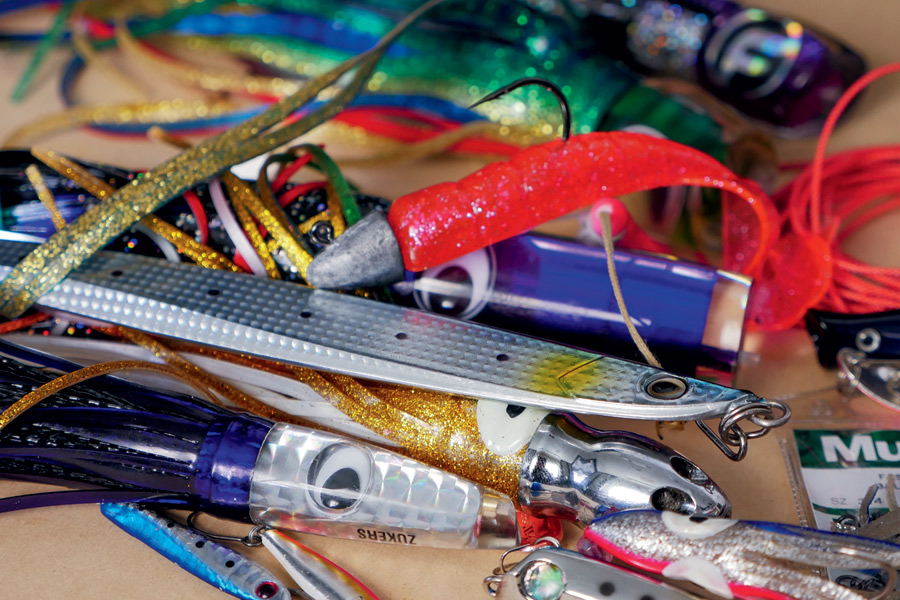
The key qualities with this sort of setup are quality and strength. Some incredibly strong clip systems are available these days at good tackle stores, and they are surprisingly bulletproof. However, there is also cheaper terminal gear that may look fine but doesn’t have the desired strength or durability, so it pays to check before purchasing (the relative prices usually provide some indication).
The heavier leaders used for trolling gamefish lures can be so thick that the only reliable way to rig them is by crimping. Alloy crimps are generally used with mono or fluorocarbon trace, and it’s important to use the right size and to crimp them with the right tool. Crimp them the wrong way and your leader could be damaged or the line might slip out through the crimp.
Hook up!
The next step in making sure you get the most out of your lure is the hook setup. Many lures these days come unrigged and leave you with a number of options to set them up. For example, poppers and stick-baits can be set up with single hooks, treble hooks and even single hooks rigged on assist cord. All the different styles of rigging have benefits in different forms of fishing.
The main point to think about is how the hook/hooks affect the lure’s action. Overly big and/or heavy-gauge hooks can act as a keel, causing the lure to lose some or all of its action.
Fortunately, the range of specialised hooks has increased dramatically in recent years, thanks to leaps in hook-making technology, with the same improvements also affecting the quality of the terminal tackle items the hooks attach to. Consequently, while the old treble hook attached by a split-ring is still functional for lures (and can be best for optimal performance at times, due to balance), other options of specialist single hooks – including inline-eyed models – are becoming more popular, due to their greater strength, a lesser affect on lure action, and the relative ease of releasing fish caught on them.
As a result, kingfish and snapper jigs now have massively strong assist rigs made with various cords, rings and added Octopus skirts. You can buy the components and make them up yourself, or get them ready-made, but in all cases the key being involves keeping the hook size in proportion to the size of the lure.
The right tools
The rod and reel can play a big part in how your lures work when jigging, casting and soft-baiting. Consider the retrieve ratio of your reel, the flex of your rod, and even the way you hold your rod.
For example, a fast-ratio reel enables lures to be brought in quickly without much effort – a key factor that often determines whether you get a strike or just a follow.
Also, by holding your rod high during the retrieve, the lure will stay higher in the water column, or even on the surface, whereas pointing the tip at the water will help it to swim deeper.
Trolling lure tactics
Trolling is a great go-to technique when chasing schooling fish and big game fish, and involves plenty of tricks that can make the difference between fish or no fish.
I like to think of trolling lures as telling a story behind the boat. The species of fish I am targeting dictates the lures I choose, the pattern run, the boat’s speed, and how far back they’re placed behind the boat.
If targeting tuna, for example, I select a range of lures that imitate what tuna typically feed on; these lures are also relatively straight-running, sit just below the water, and rarely fizz on the surface. Jet and bullet heads are prime examples. I sometimes tow a diving minnow as well, provided they will run at 6-8 knots.
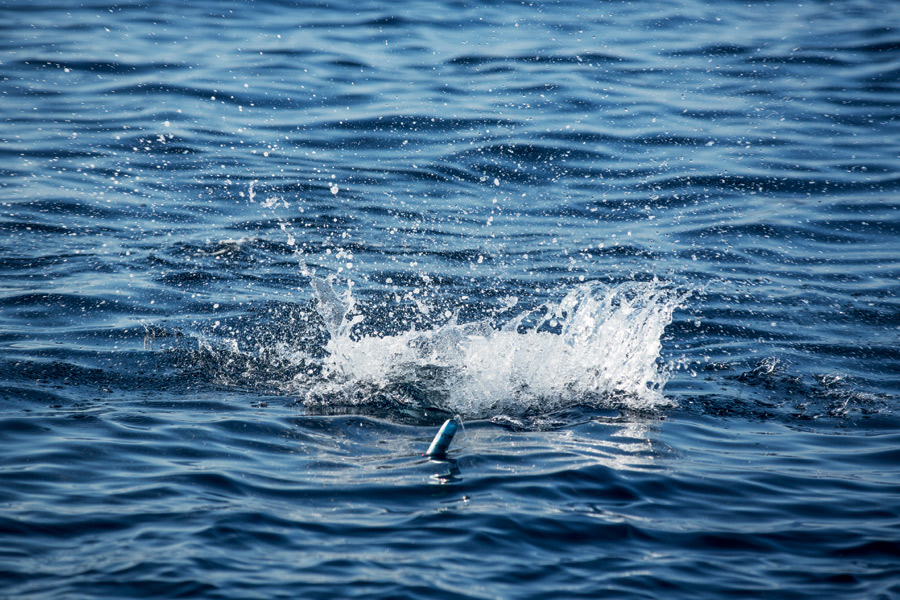
On the other hand, if chasing billfish I look for more active lures that splash and leave a trail of bubbles when trolled at the same sorts of speeds, including a few bigger lures, with the overall pattern set a lot closer to take advantage of the boat’s wake.
However, having several lures out in a relatively confined area can lead to tangles, so some control and a few basic rules need to be followed. For example, it pays to stagger where the lures are placed behind the boat so that they pass over or under each other when turns are made. Many skippers achieve this with V or W shaped lure formations (perhaps with one lure also set right out the back), with various devices that include outriggers, downriggers and flat-line clips helping in this respect.
NO DOUBT LURE FISHING will continue to develop, with new materials (some with light-emitting and special acoustic properties) leading to new designs and techniques to keep things really interesting.
|
|
|

Fishing Reports Visit Reports
Outer Hauraki Gulf Fishing Report 17/09/26
Spring wind the handbrake. Spring is starting to make its presence felt in the outer... Read More >
Top of the South Fishing Report - 17/09/26
Early snapper in Tasman Bay. Well, spring is finally here, and the days are getting... Read More >
Bream Bay Fishing Report - 17/09/26
Good snapper catches reported. After Tangaroa turned off the fish tap for a month or... Read More >
Bay of Islands Fishing Report - 17/09/26
Pacific bluefin tuna for the lucky few. The last fortnight has seen more fishable days... Read More >


Friday 25 September 2026
Major Bites
 - -
- - Minor Bites
 - -
- - Saturday 26 September 2026
Major Bites
- - Minor Bites
- -
Comments