
Trolling for kingfish
It is not surprising that kingfish are amongst the top three or four species targeted in New Zealand: they’re big, strong and tend to inhabit rugged territory so every hook-up has a far from certain conclusion. To land a decent yellowtail kingfish is cause for celebration – and they taste pretty good, too, when they’re fresh.

What type of lure suits trolling best?Most anglers are aware of the effectiveness of live bait when chasing kingfish, but livies are not always available or practical, for whatever reason. Then it’s time to bring out the lures. Although there are a number of ways to utilise lures, this article is about trolling bibbed and bibless minnows.
For most people, trolling for kingfish involves chucking a lure over the stern of the boat when travelling from A to B and hoping that a kingfish leaps up from the depths and impales itself on the lure hooks. These people are often disappointed and may think that trolling is largely a waste of time.
In reality, lures can be a very effective method of covering a lot of ground, either while doing the traditional A to B or by actively targeting them. In both cases, success hinges on effectively covering areas that are likely to hold kingfish with lures that work attractively at the speed you are travelling, or better still, travelling at a speed that works well on kingfish (4-7 knots, faster at times).
The most effective lures for kingfish tend to be those that wobble or wiggle instead of spinning. This narrows the field down to bibbed and bibless minnows, lead-headed rubber/plastic-tailed jigs, and specially designed and weighted lure-bait combinations such as Bait-o-matics.
Just which brand, colour and type of lure works best often comes down to personal choice and circumstance, with the eventual decision based on the size of the fish you are likely to encounter, the speed of the boat, the strength of your tackle, the type of territory, local baitfish species, the time of the day and of course your budget!
As kingfish are very curious, lures that produce plenty of flash and noise (internal rattles) are very likely to gain their attention, but once they’re in the vicinity, the action of the lure must still be attractive enough to trigger the strike.
In the past I’ve achieved good results using bibbed and bibless minnows made by such companies as Rapala, Halco, Cotton Cordell, Elliot, Killalure and Yo-Zuri. But there are huge numbers of other likely lures available. Provided they are equipped with strong rings, hooks and internal wiring, they may well be worthwhile options.
I have found some of the most popular colour combinations to be blue and silver, green and yellow (especially in fluoro tones), fluoro orange and gold and white with a red head. The preferred colour scheme can change according to the type of day, and even the time of day, so don’t be afraid to experiment.
Tuning minnows for maximum speed and action
Fishing success is dependent on how well your lure swims. Lures with lightweight bodies made from materials such as reinforced balsa tend to have a much tighter, vibrating action than heavier lures, which by virtue of their weighty construction are more likely to possess a slower, more rolling action.
Whatever type of lure you select, it may not initially stay in the water at the optimum speed, either because it has not been ‘tuned’ properly or, through use, it has fallen ‘out of tuned’. Although tuning sounds complex (and it can be on some lures), for the majority of cases it simply means slightly bending the bib or leading eyelet a little to straighten the lure’s tracking.
A poorly tuned and/or rigged lure will either track radically out to one side or else spiral right out of the water. To rectify, simply hold the lure with its head facing you, and firmly push down, with thumb and finger, on the same side of the bib that the lure is favouring. If the spiralling gets worse, you’ve tweaked the wrong side, and if it starts heading to the other side you’ve been too severe. Start gently and gradually increase pressure. If this means that a pair of pliers is needed instead of your fingers, so be it, but this should be a last resort: plier jaws can alter the shape of the bib and permanently affect the lure’s action.
On some lures, the bib is moulded so it can’t be changed. In these instances it is usually possible to make the lure swim correctly by gently bending the lure eyelet sideways with a pair of pliers.
The bigger the bib and the greater its downward angle (more acute), the deeper and slower the minnow is designed to run. Small, shallow angled bibs won’t take a lure as deep, but impart a tighter action and can often be trolled faster. The smaller the size of the lure, the harder it is to tune it to troll at higher speeds.
Bibless minnows, although needing less adjusting, are generally tuned by bending the line-attachment eyelet. If they still won’t run, check the weight of the trace and the means by which it is attached to the lure.
In all cases, do not judge a lure’s action by what it does close to boat in its bubbling wake. The propeller will often produce a powerful turbulence that upsets the lure’s natural action. Instead, carefully lower the lure into the water to one side of the boat, release some line from the reel until it is at least 10 metres back and then engage the reel. Often the lure will instantly fly out the water, either because one of the hooks is improperly positioned (usually snagged around the lure’s body or caught around the trace) or because it is has been affected by the uneven surface pressures. After initially flying out however, the lure (if untangled) will then settle down to its normal action, providing a better idea of how it is going to perform long-term.
As well as the shape of the lure and the angle of its bib, the grade and style of hooks will also have a bearing on the action. Big, thick, heavy hooks slow lure movement, so when replacing inadequate hooks (usually trebles) with stronger models, it may be necessary to go down to the next size of hook or try double (claw) hooks instead.
When using a claw hook, remove the lure’s split rings and slot the double hook directly onto the wire eyelets, the middle claw hanging down along the lure’s belly so that the hooks face away from the body of the lure when trolled. The rear claw is placed so that its points face upwards.
Although this style of hook and method of attachment enables fish to lever themselves off a little more easily, double hooks tend to be stronger than trebles, and by omitting the split ring the hooks sit evenly on the lure, so it tracks and hooks up properly.
Unfortunately, there are some lures that are of inferior quality and either their shape is not true or else their components cause them to be unbalanced. The remedy? Buy lures that have a reputation for quality and catching fish.
Connecting the Trace
Be aware that the way a lure is tied or connected to the trace can have a bearing on how well it will swim. A small knot or loop is best. Although a snap clip can make things a lot simpler, they can be levered open by a fish’s mouth. They also tend to interrupt the flow of the water onto the face of the lure, according to their size and style. McMahon clips, with their streamlined form, looped base and strong construction, would probably be the best of the clip options.
Excellent alternatives are to tie a ‘loose’ uni knot (a uni knot that is not completely tightened up to the eye of the lure) or else crimping the trace to the lure: in both cases endeavouring to create a small loop of trace for the minnow to swing on so allowing maximum lure action. When using crimps, a very fine armour spring around the nylon loop will help stop it wearing on the lure eyelet, as will a tightened perfection loop (achieved by placing the thumb and forefinger on either side of the loop and slowly pulling downwards).
The thicker the nylon trace, the more it will hold up in the current, affecting lure depth, slowing the natural action of the lure and making the trace easier to see. I find that 27kg suits small to medium-sized lures and that 37-45kg is about right for larger ones. The recent introduction of extremely tough and hard to see fluorocarbon leaders means that it is possible to use lighter traces than before, increasing the number of strikes without sacrificing the chances of actually landing the fish.
The longer the leader, the greater the insurance against being cut off on the rocks when fighting a kingfish. The ideal rig involves a short (one metre) 27 to 37kg nylon or fluorocarbon leader tied to a swivel, which is in turn attached to four or five metres of 18 to 27kg trace. If possible, the trace should then be joined to the doubled mainline with an Albright or No-Name knot (Baker Special).
If you can’t be bothered with all this rubbish, simply double over your main line and knot the swivel on with the doubled section of line, using your favourite knot. The doubled line will help to improve the strength and durability of the knot – but make sure you pull up evenly and slowly or friction may damage the line.
Next, tie on three to five metres of the appropriate trace and attach the lure. The only disadvantage with this set-up is that you cannot wind up close to the fish and therefore may require someone to gently handle the long trace for you. The ability to wind on the most of the trace means that the angler can wind the fish into gaffing range.
Where to Troll
Kingfish generally inhabit areas of reef and foul, with some current, baitfish and whitewater action. This means that trolling in the vast expanses of deep water between destinations is largely a waste of time. Instead, always push in as close as is safely possible to rocky coastlines, reefs and schools of baitfish. If in doubt about the terrain, consult a chart before coming in, keep an eye on your fish finder and use your polaroids to spot potential submerged danger.
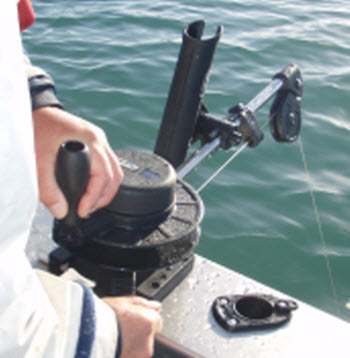
Should the reef be well submerged (say, 20 to 80 metres), the chances of strikes are greatly increased by using downriggers. This is because, in this type of situation, the larger kingfish prefer hunting near the bottom, preying on the wide range of reef and school fish found there. The only time they tend to visit the surface is when lured there by the vibrations and splashing of school fish such as trevally, pilchards, kahawai and maomao. While waiting to feed, they will usually hold just below the milling school fish.
To set your downrigger, check the depth of the shallowest point of the reef on the chart and drop the downrigger ball, with your lure attached, to that depth. If there are promising-looking signs on the sounder in mid-water, try to get down to that depth.
Keep in mind that by trolling at six or seven knots, the water pressure will cause the cable to bow, so let out a third more cable than actually indicated on the counter. At nine knots, the real depth of the lure will be approximately half that indicated on the downrigger depth meter.
If bait fish are present on or near the surface, leave at least two lures, in different colours, running on top. Most quality bibbed minnows will run between one and one and a half metres below the surface, and often this is all that is necessary to get a strike.
When it all comes together...
Having hooked up, continue moving forward on an angle that will help to pull the fish away from the danger area and into deeper water. At this stage, it is best to avoid upsetting the fish further by unnecessarily striking with the rod – the hook will already be set. A smooth, steady pressure is more advisable as this panics the fish less.
To keep lure and fish losses to a minimum, 15kg tackle is generally considered to be the optimum weight for fishing minnows for kingfish: strong enough to gain some control and leverage, thick enough to take some abrasion but not heavy enough to exert so much pressure that the hooks or split rings fail.
When a kingfish is brought to the side of the boat, either gaff big ones in the upper part of their bodies or net smaller examples for release (65cm is the current minimum size limit [now 75cm]). For safety’s sake, bigger kings should be despatched with a couple of firm bangs on the top of the head using a heavy instrument. Remove the hooks with a pair of pliers as multiple hooks and kingfish are a lethal combination.
A Blast From The Past!
|
May 1998 - by Mark Kitteridge |

Fishing Reports Visit Reports
Outer Hauraki Gulf Fishing Report 17/09/26
Spring wind the handbrake. Spring is starting to make its presence felt in the outer... Read More >
Top of the South Fishing Report - 17/09/26
Early snapper in Tasman Bay. Well, spring is finally here, and the days are getting... Read More >
Bream Bay Fishing Report - 17/09/26
Good snapper catches reported. After Tangaroa turned off the fish tap for a month or... Read More >
Bay of Islands Fishing Report - 17/09/26
Pacific bluefin tuna for the lucky few. The last fortnight has seen more fishable days... Read More >



Friday 25 September 2026
Major Bites
 - -
- - Minor Bites
 - -
- - Saturday 26 September 2026
Major Bites
- - Minor Bites
- -
Comments