
Trolling for albacore

During the 1990s my wife and I spent a total of seven weeks as volunteer rangers at Whale Island off Whakatane.
Our main duties involved being on fire and patrolling the sea around the island daily to prevent unauthorised landings. It was more like a holiday, even though paddling the small and slow Frenzy kayaks into the inevitable head winds was hard labour.
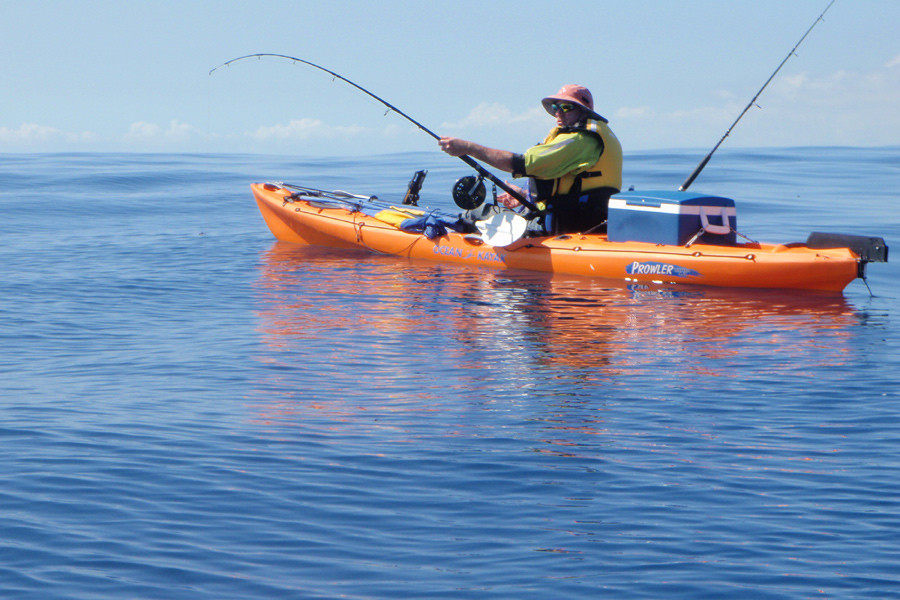
On one occasion we were paddling along the cliffs on the ocean side of the island when the sea erupted right in front of us. I could clearly see big fish porpoising like dolphins as the work-up quickly headed out towards White Island. Later in the week I mentioned this to our DoC minder, who suggested that I might have witnessed a school of big yellowfin tuna, which were then quite common in the waters off Whakatane.
How times change – and sometimes so rapidly! Notwithstanding the current ‘blip’ of mostly small yellowfin, in a mere decade or two, these once plentiful fish have become virtually extinct in our waters, not just commercially but, sadly, recreationally as well. The cause is popularly believed to be unsustainable fishing pressure in the tropical regions of the Pacific Ocean. As our seas are at the low temperature limits of several other tropical pelagic game fish, the demise of the yellowfin fishery is a timely cautionary tale about the potential fate of marlin and several other tuna species that seasonally visit our waters. I don’t want to be overly pessimistic, but what happened to the yellowfin could easily happen to the albacore and skipjack, considering the lack of control New Zealand has over the carnage that goes on in the tropical Pacific.
As a kayak fisher, I would have loved to have caught a yellowfin in our waters, but, alas, by the time the sport had expanded to the blue water, the yellowfin had already gone. Luckily, this is not yet the case with albacore and skipjack, which are still relatively plentiful around our coasts during the summer months. Both species make ideal blue water targets for the adventurous kayak fisher, and Taranaki happens to be an ideal place to engage with these chrome-plated torpedoes. Indeed, under favourable weather/sea conditions, success is almost a certainty. No wonder New Plymouth has become recognised as the best albacore destination for kayak fishers in the country, its growing reputation further enhanced by the first and only NZ ‘blue water’ kayak tournament, which is held annually by the Oakura Kayak Fishing Club.
Just looking at their muscular barrel shape, you can see that tuna are powerful fish. They are open water hunters built for speed. Despite such outward appearances though, tuna are delicate creatures. Wounds bleed profusely when hooks rip through soft mouth parts or thin skin. However, such challenges simply mean successes take on even greater value when achieved.
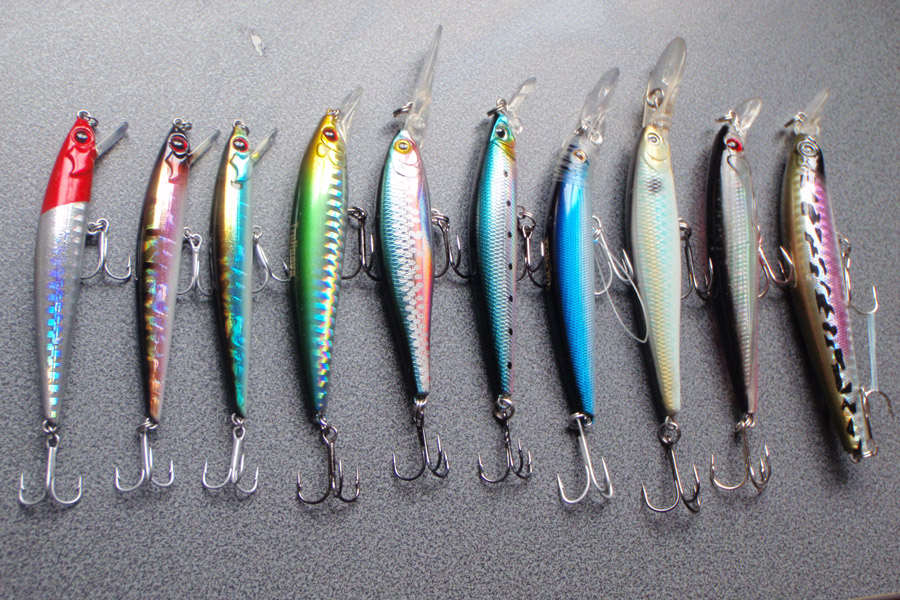
So far, most albacore tuna have been caught from kayaks by trolling, and while all manner of lures have been successful, the general consensus is shifting towards small hard-bodied bibbed lures of the Rapala type. Lures between 85mm and 140mm in both shallow- and deep-diving types do the business.
What makes these lures so effective for kayak fishing is their built-in movement, which activates even at relatively slow trolling speeds (the lures’ pulsating wiggle movement will also fool fast-moving skippies, which can often be frustratingly choosy about lures trolled at kayak speed).
Tuna are not fussy about lure colour, as long as there is plenty of bling – and when excited, they will attack some truly gaudily-coloured creations. However, these days I tend to stick with sizes and paint jobs that imitate the tuna’s natural prey – such as small baitfish and squid – more closely. However, if the action is slow, it often pays to try different lures. Genie clips make changing lures a breeze, but to prevent line twist the rig needs an additional swivel somewhere on the leader.
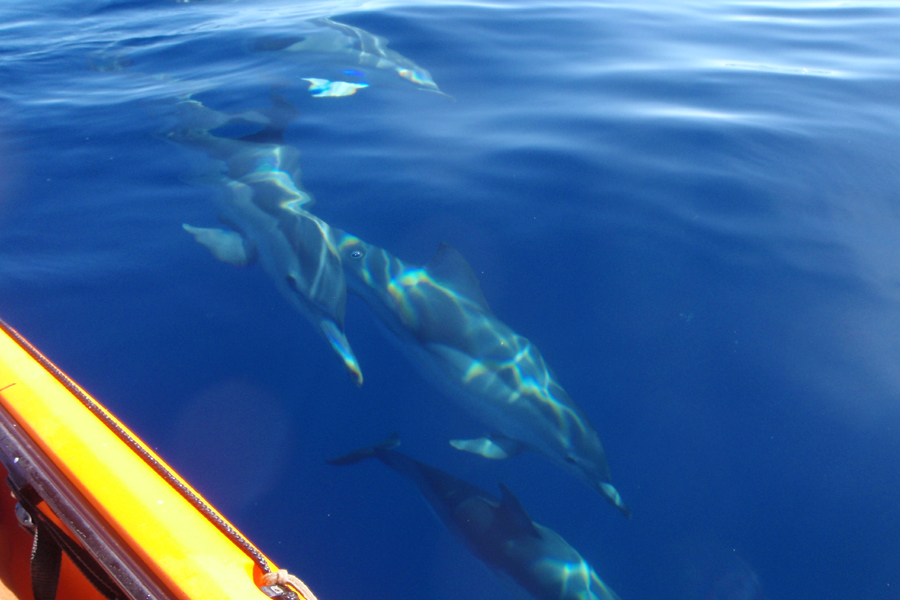
Generally these lures come with two trebles: one on the belly and the other on the tail. I used to think that one on the tail was good enough, so removed the belly treble, largely to avoid hooking myself while trying to remove the lure from a frantically vibrating fish. It took me a while to realise that this was one of my biggest mistakes. On one particularly memorable day, I hooked and lost eight fish in a row, some straight after a double hook-up, others near the end of a dogged fight. By the end of the trip I had largely lost all confidence in getting a fish to the boat.
A few days later I had a moan about it to a friend, who suggested that I put the belly treble back. This simple correction almost instantly turned my landing rate around. Even though a fish might initially only get hooked by one treble, during the fight there is a good chance that the super-sharp second set also finds the fish (often on the outside of the head), resulting in a more secure hold.
To further improve my fish-landing chances, I prefer to use relatively soft-tipped rods of around 6-10kg, and set a light drag on my reels. After all, when you drag lures all day and finally get a hook-up, it makes sense to take another five or ten minutes to tire a green fish, rather than trying to horse it in with too much pressure and end up pulling the hook.
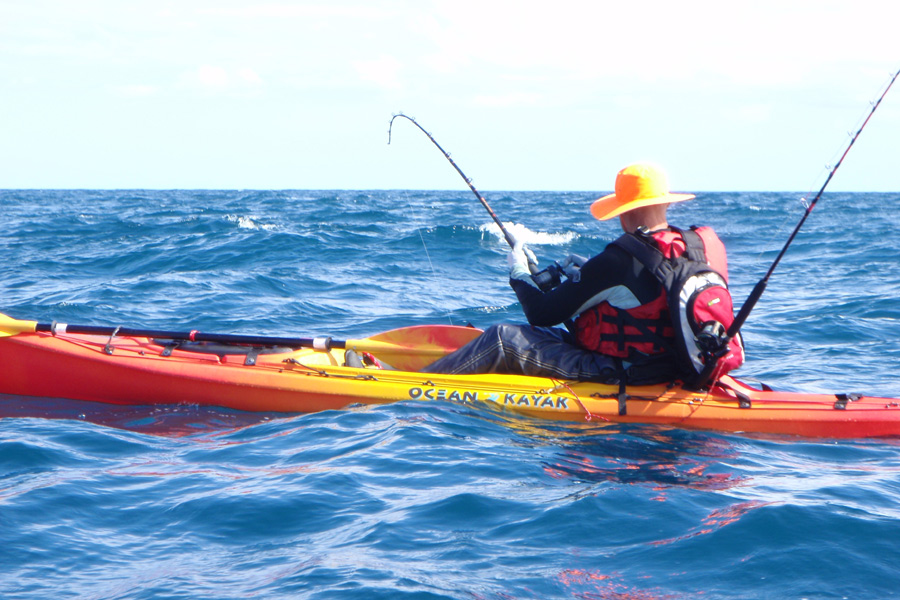
Over the years I have become a fan of braided lines for soft-baiting and bottom fishing, and initially used the same rigs for tuna trolling as well. This was another big mistake, resulting in several phenomenal line tangles when I trolled with two rods. By the time I realised that my rod tips were no longer ‘ticking’, reflecting the lures’ movements, it was too late, and the only way to deal with the mess was with the knife. (Imagine the frustration watching your mates fighting fish all around, while you are reduced to frantically cutting off Gordian knots of braid!)
Again, one of my mates had the answer: “Go back to mono,” which I am pleased to say has left me tangle-free since making the switch.
To reduce the tangle risk even further, I now run a deep-diving lure close to the stern and a shallow diving lure much further back. This keeps the lures separated in tight turns around work-ups.
It goes without saying that blue water kayak expeditions pose greater dangers – if for no other reason than such trips take you further offshore and, in deteriorating weather, it takes longer and requires more effort to get back. So bear this in mind over and above your normal safety preparations when planning a trip out wide.
Surprisingly, for such a commercially-valuable fish, there are big gaps in our knowledge about what these smaller tuna do in our waters. Aspects such as when they come, where they go, and when they leave. The commercial companies only fish for them when there are big numbers, and our big game fishers only notice them when chasing marlin. There is good evidence of an east coast winter run of large albacore. Do such fish come down the west coast as well? Nobody really knows, since nobody goes after them at that time of year. It was the same with west coast marlin: they were there all along, but remained invisible until some pioneers started looking for them.
As tropical/subtropical pelagic species, we tend to associate albacore with warm and purple-blue oceanic water. This is certainly a good starting point, but it fails to explain why the same fish are caught in the cold waters off Kaikoura or way down off Fiordland. Indeed, quite recently a captain of a commercial bluefin tuna boat told me that he has caught big albacore in nine-degree water!
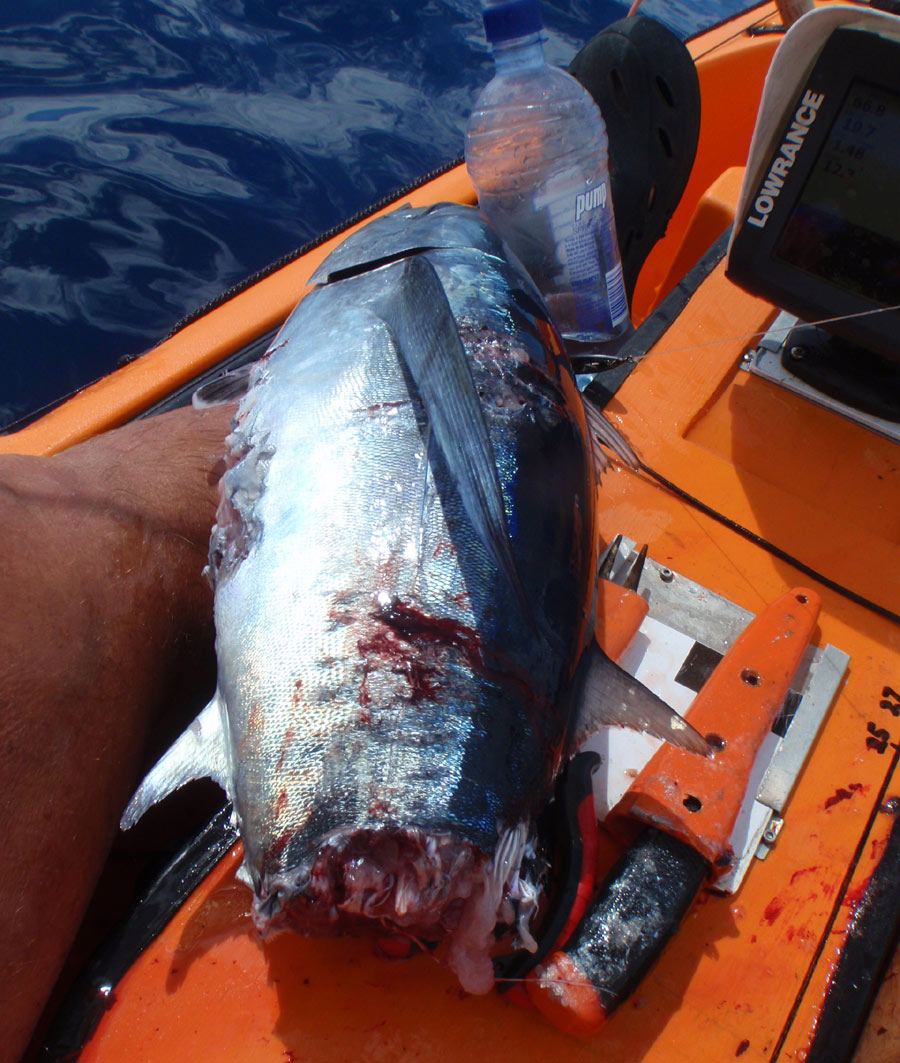 Despite such unresolved riddles, there is a general pattern for the Taranaki tuna season. They come in around the beginning of January and stick around until some time in May. During those times they follow the schools of bait fish that appear along our coast. Find the baitfish and you will find the tuna, sharks and marlin. This sounds simple – except that it often takes a 30km paddle to do so.
Occasionally we get onto tuna close to shore, but the majority of our tuna hunts involve long paddles well beyond normal fishing distances. To put this in better perspective, for the 41 tuna I landed during the 2014 season, I clocked up 650km on my chart plotter – plus two additional trips with no mileage record due to a flat battery. Not surprisingly, I shed 5kg of body fat and visibly toned up my upper body muscles without ever setting foot in a sweaty gym.
It is a sobering fact that the world population has tripled in my own lifetime and is well on its way to grow four-fold by the time I can expect to drop off my perch. Hungry people need food and don’t care whether it comes from the sea or the land, or how unsustainably it is produced. Preserving our recreational game fisheries is the last thing on their minds. The demise of our yellowfin is a timely warning that the future of other pelagic game fish in our waters is far from certain. So make the most of these great fish while they are still coming south.
|
|

Fishing Reports Visit Reports
Outer Hauraki Gulf Fishing Report 17/09/26
Spring wind the handbrake. Spring is starting to make its presence felt in the outer... Read More >
Top of the South Fishing Report - 17/09/26
Early snapper in Tasman Bay. Well, spring is finally here, and the days are getting... Read More >
Bream Bay Fishing Report - 17/09/26
Good snapper catches reported. After Tangaroa turned off the fish tap for a month or... Read More >
Bay of Islands Fishing Report - 17/09/26
Pacific bluefin tuna for the lucky few. The last fortnight has seen more fishable days... Read More >


Friday 25 September 2026
Major Bites
 - -
- - Minor Bites
 - -
- - Saturday 26 September 2026
Major Bites
- - Minor Bites
- -
Comments