
Trimming Your Boat
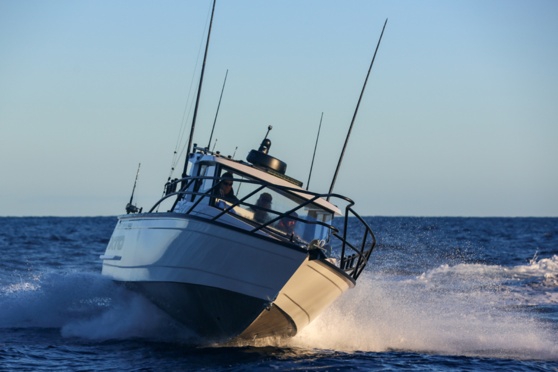
Modifying a boat's trim changes how the hull sits in the water when underway. Trim directly impacts handling, comfort aboard, speed, and fuel efficiency for planing vessels. Hulls achieve optimal performance when correctly trimmed in terms of both front-to-back (pitch) and side-to-side (roll).
Powerboats rely on adjustable thrust angles (drive trim), trim tabs and ballast to adjust their running attitude. Ballast is often in the form of fuel or water, but can include passengers and other heavy objects. Moving passengers to different seats or asking someone to stand closer to one side of the boat or the other often helps to keep the boat level, improving its ride and performance.
Drive trim
Most outboard-powered craft and sterndrive vessels have drives with adjustable trim, giving the skipper a great deal of control over the boat’s pitch.
Most outboards of 30hp and bigger come with power trim and tilt. Power tilt is used to lift the leg clear of the water for storage or trailering; power trim adjusts the angle of thrust while the boat’s underway. The majority of outboards and sterndrives use a two-stage hydraulic ram for both tasks, but some systems are electric.
Trimming the engine leg outwards, away from the boat’s transom, thrusts the transom downwards into the water, raising the bow. Trimming the engine leg inwards towards the transom lifts the stern and pushes the bow down.
The basics of Engine Trimming
Although trimming is a fundamental powerboat skill, some boaters never come to grips with it. The basics of using power trim are simple: tuck the leg in to keep the bow down before accelerating onto the plane and then trim it out a bit once you get going. This lifts the nose, allowing the boat to plane on the flatter sections of the hull towards the stern. Less wetted surface means less friction, more speed, and better fuel economy.
The faster the boat travels, the further the engine can be trimmed out, but only up to a point: too much positive trim can leave so little of the hull in contact with the water that the boat becomes dangerously unstable and difficult to control. Take care in windy conditions, too, as wind getting under the bow can cause a loss of control. Other symptoms of excessive trimming out include hull porpoising and the propeller sucking air from the water’s surface (ventilation).
Trim to the conditions
Altering your drive trim according to the sea conditions and travelling angle is an important boating skill. Trimming the bow up in a following sea or when overtaking waves to avoid ploughing into troughs. On the other hand, when heading into the sea (particularly when it’s rough) push the bow down so the deepest part of the vee slices through the waves first. This will help reduce slamming from water hitting the flatter sections of the boat aft of the bow. But be careful, as too much trimming in can result in bow-steer (when the bow is too low in the water and it catches waves, pushing the boat around and affecting steering) and poor performance/fuel economy.
On the tabs
Larger outboard craft and planing launches generally have trim tabs fitted at the intersection of the bottom of the hull and the transom. Conventional trim tabs are individually adjustable plates that can be tilted down to alter the hull’s angle of attack by lifting the transom and pushing the bow down.
Interceptor trim tabs are quite different. Interrupter trim tabs work by interrupting the laminar flow of water passing over a planing hull by extending a rectangular transom-mounted plate vertically into the water flow. The interruption to the laminar flow of water lifts the transom and lowers the bow.
Interceptor-type tabs have certain advantages over conventional tabs: when retracted they disappear completely into inconspicuous housings mounted flush against the transom where they are protected from damage. Conventional plate-type trim tabs can be bent or broken by being stepped on, contacting the ground, or hitting objects in the water.
Trim tabs are used to adjust both pitch and roll, and fine adjustments are possible, using one tab or the other, or both together. Make adjustments in small increments to avoid throwing the boat over on one chine or the other. Trim tabs are particularly useful for adjusting side-to-side trim, and are usually labelled: port and starboard bow, up and down, or similar. Automatic trim tabs systems are also available, making it easy for the user. Just be aware that some automatic systems tend to overcorrect in rough seas.
Trimming for turning
Tuck the leg in a touch before beginning the turn to ensure the propeller and hull maintain their grip on the water. When pulling water toys or skiers, keep the bow trimmed in a bit more than usual to help the boat maintain speed in sharp turns. Once the apex of the turn is reached, add some positive trim as you straighten the wheel and accelerate away.
Be careful not to overdo negative trim when turning because the boat’s chine could grab, throwing the boat occupants about and potentially pitching the vessel end for end.
Trimming Smaller Boats
Outboard motors under 25hp seldom feature power trim and hydraulic or electric trim tabs are expensive and unnecessary on such small craft. Nevertheless, small craft still benefit from trim adjustment. The easiest way to adjust the trim is to shift weight around inside it, including the bodies of its occupants. Shifting a spare fuel tank forward can help keep the bows down when negotiating a head sea; moving it back can help when running the boat downhill. Moving your buddy to one side of the boat can keep the boat riding level in a crosswind while shifting him forward or back can greatly improve the boat’s ride (or ability to get on the plane). Drive trim can also be adjusted on small engines via a pin on the outboard bracket that changes the angle of the outboard leg in relation to the transom.
You can’t beat experience
All boats react differently to different trim levels and conditions, so practice manoeuvres at different trim settings while slowly increasing your boat speed and repeat them as necessary to get a feel for the boat. There will be a sweet spot: a combination of speed and drive trim where the boat feels well-balanced and responsive in the conditions. Often a lessening of steering resistance felt through the wheel indicates the boat is trimmed correctly.
- NZ Fishing News
Fishing Reports Visit Reports
Tauranga Fishing Report - 28/05/26
Tarakihi on the bite Trips are few and far between at this time of year,... Read More >
Canterbury Fishing Report - 28/05/26
Fresh and salt turning it on! It is not very often I get to say... Read More >
Bay of Islands Fishing Report - 28/05/26
Lures paying dividends We finally had a break in the SE winds that have been... Read More >
Manukau/West Coast Fishing Report - 28/05/26
Snapper and gurnard in the harbour The weather has finally taken a turn for the... Read More >



Major Bites
Minor Bites
Major Bites
Minor Bites
Comments