
Tips on how to release fish
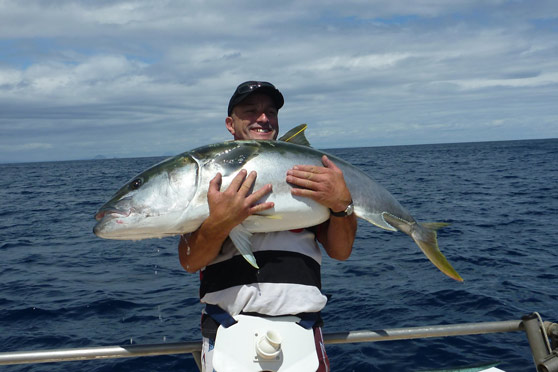
Since 2014, when the minimum size limit for snapper changed from 27cm to 30cm in the Snapper 1 fisheries management region (Northland and Auckland east coast and Bay of Plenty), the number of small snapper that recreational fishers are required by law to release back into the water has grown.
With more small fish being thrown back, the onus is on us to ensure those small fish survive to grow, breed and thrive.
While I’m sure most fishers obey the law and release any undersized fish they catch, I’ve seen with my own eyes that many fish returned to the water are in such poor condition they are unlikely to survive.
Too many anglers, either out of frustration at hooking ‘nuisance fish’ or through ignorance, handle undersized and non target fish disrespectfully, manhandling them roughly, allowing them to thrash on hard surfaces, burning them with bare hands or hot decks, and keeping them out of the water for much too long. Many of the fish treated this way don’t survive the experience, dying within minutes, hours, days or even weeks of release. These fish are wasted – lost to the system.
Handling fish of any size with respect is not difficult, but it is easier with small fish than with larger, stronger fish. Some handling is usually inevitable with undersized snapper, but always wet your hands first. Don’t squeeze the fish, especially around the gut area, and keep your fingers away from the eyes and gills. Don’t try removing the hook on a deeply hooked fish – cut the trace.
Time is of the essence, so slip the fish back into the water as quickly as you can. Don’t toss them high into the air so they impact the water with force, which can injure and/or disorientate them, making them easy prey for shags and other predators.
Where possible, it is best not to handle fish at all, other than to remove the hook(s). For a quick, easy release with minimal damage to the fish, use pliers to squeeze down the barbs on your hooks before starting fishing.
Bigger fish can often be unhooked in the water beside the boat, within the net bag (you can leave the net in the water), or inside the boat suspended in the net. If you must bring fish aboard, don’t place them on a hot and/or dry surface. Consider lying them on a freshly wetted towel, or at least wet the deck. I usually unhook bigger fish in the net because the rubber net bag gives some protection to the mucus layer on the fish’s skin.
If you want a photo, take it quickly and use wet hands to hold the fish.
Be prepared to ‘spear’ large fish into the tide to give them a head-start on their dive for the bottom; when fish are obviously exhausted, cradle them gently in the water (or in the net) until ready to swim away. If a fish is unable to swim away, or continually pops back up to the surface, you can try venting it, but if that doesn’t work, you’ll have to add it to your bag.
How deep is too deep?
As someone who fishes regularly for recreation, I practice catch-and-release all the time, on both undersized fish and fish I don’t need for the table. I seldom keep my limit and might release dozens of fish over a day when the fishing is good – so I need to be satisfied those fish are going to survive.
Since most of my fishing is done with lures in less than 20m of water, barotrauma is seldom an issue for the snapper, kingfish, kahawai and trevally I catch. I’m wellpracticed at handling and releasing fish at the boat, so I’m confident they live to fight another day.
Successfully releasing fish caught in deeper water, whether undersized or not, is more problematic.
It’s becoming increasingly clear that snapper (and many other species) pulled to the surface from deep water suffer the ill-effects of decompression. The associated physiological damage, called barotrauma, includes distended swim bladders that can push the stomach out through the mouth and may damage the fish’s internal organs and rupture the swim bladder. In severe cases, the eyes bulge and gas escapes through the skin, lifting the scales. The post-release survival of any fish suffering this degree of barotrauma is unlikely.
From what I’ve seen, if you fish for snapper in 20m of water or deeper, catch and release might not be a viable option (work-up fishers take note!). Consequently, when fishing deep water, I keep what I catch and stop when I’ve caught enough.
Venting fish usually allows them to swim back to the bottom after release, but one commercial fisher I talked to, who used to work in the live fish export trade to Japan a few years back, reckons most of these fish die.
He told me live fish were kept in holding tanks for three days before being air-freighted to Japan. Fish caught in shallow water mostly survived, but fish taken from water deeper than 20m, most of which had been vented using a hypodermic needle, generally died in the tanks.
However, there is evidence from several scientific studies, including work on snapper in Australia, that fish survive barotrauma after venting (see below). According to various studies on a variety of fish species, the most important aspect seems to be to get fish back into the water fast and down to a depth of at least 10m – something my commercial fisher with his holding tanks was not able to do.
To vent or not?
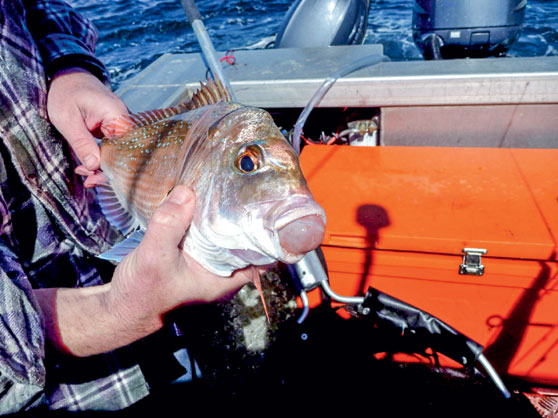
Studies in Australia indicate good survival rates for snapper taken in 37–50m of water, which were released after ‘venting’ – perforating the swim bladder, either through the everted stomach in the mouth, or through the side of the fish using a hypodermic needle.
Survival rates were 90 percent at 37–50m, 86 percent at 51–100m and 85 percent at 101–180m – surprisingly high, and better for fish vented through the mouth.
Researchers also noted that the perforations in swim bladders and stomachs of the fish they sampled healed rapidly: 64 percent of stomachs and 45-55 percent of swim bladders had healed within three days of capture.
Other studies have shown that three aspects are key to maximising survival rates for fish taken from depth. They are: using circle hooks (to hook fish in the mouth); minimising the time spent holding fish at the surface; and rapidly recompressing fish to at least 10m depth. Once fish get down to around 10m or so, they can usually look after themselves. Venting allows fish to quickly dive to this depth and deeper, but various fish-release tools do the same job without the need to puncture the fish’s swim badder.
Stop fishing or move away
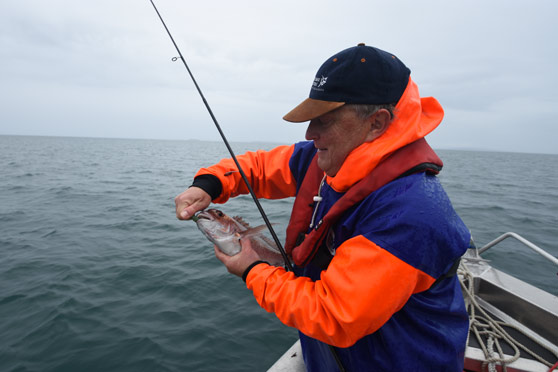
Whenever catches of undersized fish become a problem and/or catch-and-release is not feasible (or at least not ethical because the fish are going to die anyway), anglers should take action. Stop fishing immediately or move somewhere else, preferably to shallower water.
If fish are of legal size, but release is not a good option, stop fishing as soon as the legal bag limit is reached or you have enough fish for your needs: no high-grading or catch-and-release fishing.
For the well-being of the fishery, some people would argue that anglers should keep every fish they catch, regardless of size or species, until they reach the daily bag limit and then stop fishing. In some parts of the world, such limits already exist.
In the USA and Canada there are even stricter restrictions, including season limits for certain fisheries (i.e. three salmon per angler per season and no high-grading).
BAROTRAUMA EXPLAINED
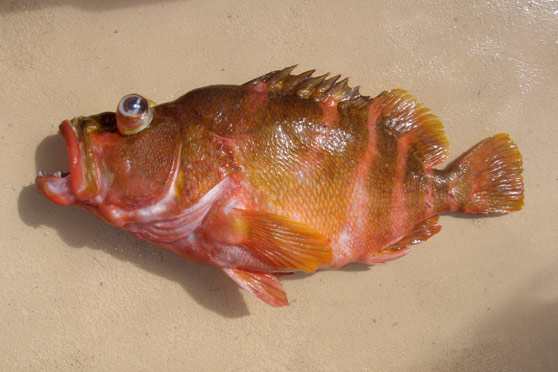
Many species of bony fish use swim bladders to control buoyancy, particularly bottom-dwelling and midwater (demersal) species. They can make vertical movements between deep and shallow water, but the movements must be slow enough to adjust the volume of gas in their swim bladders. In some cases, the transition between depths takes days. Rapid decompression releases so much gas from the bloodstream and tissues at once that it overwhelms the swim bladder’s ability to compensate for depth changes, causing the fish to ‘blow up’.
Susceptible to barotrauma
Susceptible species include most of the commonlycaught bottom and midwater species, such as: snapper, blue cod, tarakihi, hapuku, bass (but not bluenose), red cod, various wrasses, pigfish, maomao, banded perch and most reef-dwelling fish.
Less susceptible to barotrauma
Pelagic species, plus midwater and bottom-dwelling species which transition between deep-water zones and the surface (often at night), are less susceptible to barotrauma, as are sharks and bottom-dwelling bony fish without swim bladders (flat fish), or species with wax-filled swim bladders (orange roughy). Examples of less susceptible species include tunas, marlins, swordfish, oilfish, escolar, kingfish, jack mackerel, slimy mackerel, barracouta, various sharks, flounder,turbot and sole.
|
|
This article is reproduced with permission of |

Fishing Reports Visit Reports
Manukau/West Coast Fishing Report - 15/10/26
Big spring snapper in 60 metres. The El Niño weather pattern isn’t going to be... Read More >
Rotorua Fishing Report - 15/10/26
Solid start to the season! The Rotorua lakes have all started the season well, and... Read More >
Tutukaka Fishing Report - 15/10/26
Big snapper in shallow. Things remain relatively quiet on the fishing front out of Tutukaka,... Read More >
Tauranga Fishing Report - 15/10/26
Bait and temperature on the rise. It’s been great to get out and see some... Read More >


Tuesday 27 October 2026
Major Bites
 - -
- - Minor Bites
 - -
- - Wednesday 28 October 2026
Major Bites
- - Minor Bites
- -
Comments