
Tips for trout fishing in small streams
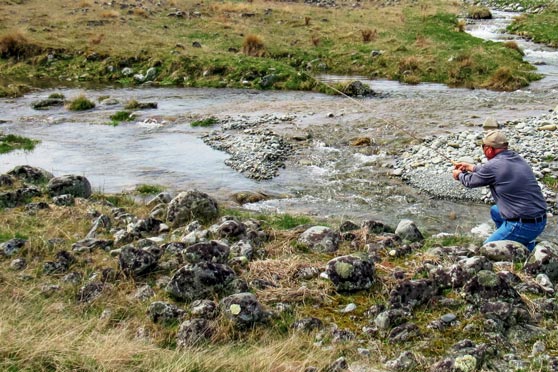
I recently read a Fishing Forum thread where the term skinny water was the focus. A member had asked what these words meant. His knowledgeable mates had immediately tried to put him right. Definition one was ‘a stretch of very shallow water’, while definition two was ‘water where the surface was very close to the bottom’. A third guy, a kayaker, said it was ‘water where his backside drags along the bottom’. Others then jumped in and the conversation became more general. One guy said if shallow water is skinny water, then deep water should be called ’fat water’, while another said that skinny water without fish should be called ‘thin water’. Before I also drift off task, let’s get back to talking just about skinny water.
Skinny waters tend to be more common in headwater areas. They consist of run-off or tributaries that eventually end up in a lake or major river. Common names for skinny water are streams or creeks. These small waterways can provide feeding areas, spawning grounds and refuges for fish at different times of the year. In spring, early summer or autumn, they can hold a lot of fish, while in mid-summer or winter they are often almost devoid of anything.

Years ago, when teaching in northern Southland, I lived near Five Rivers, a small crossroad settlement. Rivers was a rather grandiose name for some of the skinny waterways that made up the Five Rivers name. Three that I fished a lot – the Acton, Cromel and Irthing Streams – were small. But while small in volume, they held some brown trout (and had lots of mallards hiding under the willows in duck season).
Fishing techniques varied, but generally the humble worm worked well early in the season, dry flies over summer, and small spinners (such as the Veltic) as autumn approached. There weren’t many trout in these streams, but most of the ones I landed were big – though not always in great condition. Indeed, with their long bodies, lean flanks and an outsized head sporting sharp fangs and a hooked jaw, some of the jacks looked more like barracouta. Cannibalism was apparently rife, as small fish were rarely caught or seen.
The first of October was always a good time to deceive some of these stream fish, as they had not seen anglers since the end of April. Skinny water, such as these waterways, tend to mostly consist of shallow riffles with the odd deeper puddle under a willow tree or on a corner.
At the beginning of the new season, I would dig a few big milk worms, insert a little hook into one’s ‘tail’, stalk in close, and drift it over the drop-off into the deeper water where, if a big boy was home, the result was usually ’wham’. However, the fight was mostly unspectacular, as big trout are often comparable to eels when hooked, doing more head shaking and rolling than fighting. The challenge was hooking them, not landing them. One fish per long stretch was usually the norm, so a great morning might have seen three fish landed. The only ones I ever kept was the occasional fat specimen.
In more recent times I often encounter skinny water when hunting, so always make a point of taking a spinning or fly rod into remote locations. One place I often hunted had a fast running creek bubbling along the valley floor. Most times it was about ankle deep, but on others it could be virtually dry – or a raging flood. Occasionally, on corners, it deepened to about half a metre for a short stretch. Imagine my surprise when my hunting mate said there were brown trout in it – and a lot more than might be imagined. It was a ‘wink, wink’ sort of comment, so I pressed him to show me rather than tell me...
Consequently, next time in the valley we stopped halfway up and checked out the creek. Initially I couldn’t see anything, but with his help I began to make trout shapes out of the shadows and colours on the bottom of some pools. They blended in so well that a casual glance would never spot them. The accompanying photograph of one such fish was taken that day – and I was lucky enough to land him soon after on a dry fly.

Apparently, these are not resident fish, but visitors that ebb and flow with the prevailing water conditions. In the past, my mate landed a 3.5kg brown from a pool barely three times its length.
Like the skinny water down south, the challenge here is hooking the fish, not landing it, as the fish have few places to hide in or retreat to once the hook is set. A sprint up or down is about all they can do, so often quickly surrender and hope the angler kindly releases them.
Anglers fishing skinny water often have to walk a long way between drinks, as there is not much suitable holding water. Making the challenge harder, these skinny-water trout are very spooky, and rely on camouflage to deceive enemies and prey. Their chief defence is to bolt under the bank or flee to the head of the puddle, where the water is frothy. They do have to feed however, so can be easily caught by anglers who can cast well on the right day.
Skinny water suits fly anglers best, as the water is usually too shallow for baits or lures. A common technique involves approaching the trout from below, using the current to take out the required length of fly-line downstream. Then, using the current’s drag, the indicator and nymph are smoothly catapulted up to the side of the feeding fish. If the fish ignores the nymph, everything is allowed to continue drifting downstream, with the action repeated until the fish bolts or the indicator ducks under.
Trout are where you find them, so I find myself glaring hard into every trickle I pass these days.
|
|
This article is reproduced with permission of |

Fishing Reports Visit Reports
Tauranga Fishing Report - 28/05/26
Tarakihi on the bite Trips are few and far between at this time of year,... Read More >
Canterbury Fishing Report - 28/05/26
Fresh and salt turning it on! It is not very often I get to say... Read More >
Bay of Islands Fishing Report - 28/05/26
Lures paying dividends We finally had a break in the SE winds that have been... Read More >
Manukau/West Coast Fishing Report - 28/05/26
Snapper and gurnard in the harbour The weather has finally taken a turn for the... Read More >



Major Bites
Minor Bites
Major Bites
Minor Bites
Comments