
Tips for minimising bust-offs

Hi John, loved your article in the July edition of the NZFN, very useful. I have a question which may not have a ‘right’ answer. I predominantly fish soft-baits when in my kayak, and now that it is winter, it is almost always in the shallow and over foul ground using light gear – 5kg braid with a 7kg (15lb) leader. Although I catch enough decent-sized pannies for the table, a natural consequence of this type of fishing – as you will know – is getting busted off by bigger fish. Do you have any tips to minimise the bust-offs – e.g. pre-load the drag to maximum and ‘hit the fish hard and quickly’ after setting the hook? Thanks and regards, Rob Henson
Hi Rob, I’m glad you found my article useful. It can be tough to convert big fish hook-ups to successful captures in shallow water. As noted in my article (and your letter), it may be necessary to fish lighter to consistently get bites: 15lb leader and 4-6kg braid or lighter. Consequently, pre-loading the drag only works up to a point.
Soft-plastics fishing has become more and more popular, but I have noticed snapper are gradually becoming harder to catch on soft-baits. They appear to be more discerning and less naive than they were.
That shouldn’t really be surprising. These days there’s a very good chance a fish has seen plenty of soft-baits, especially if it lives in an area with heavy fishing pressure. So, to be consistency successful when fishing soft-plastics, I’ve found it necessary to regularly vary the lure type and size in an effort to show them something they haven’t seen. Fortunately, manufacturers are continually introducing new colours and patterns to their soft-plastics ranges, so there are plenty of available options.
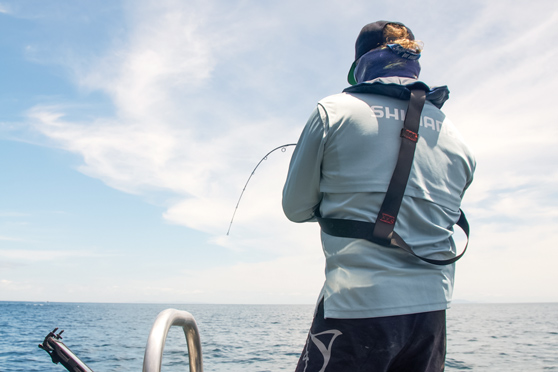
Presenting new patterns is one approach, but I think lure presentation is probably even more important. As fish have become harder to fool, I’ve worked harder at presenting soft-baits in ways most likely to get bites. One of the most successful is to scale down the tackle: light traces, light lines and, in shallow water, light jig-heads, as discussed in my article last month.
When I first started fishing soft-plastics, I tended to use heavier braid and I also advocated heavier drag settings than I tend to use today – in shallow water anyway; in deeper water I still set my drags pretty tight.
In my books on fishing soft-plastics (the first published more than 10 years ago), I favoured the ‘hit the fish hard and quickly’ tactic, which you mention in your letter, Rob. With rods often rated up to 10kg with matching braid, it was often possible to horse fish from cover, and when snapper did dive into the kelp or under sunken rocks, the heavier line and trace offered some protection against bust-offs.
The ‘go hard’ approach worked fine then and works fine now whenever fish are happy to bite on heavier gear, which in my experience tends to be in more remote, lightly-fished areas. But in most places I fish I’ve had to take a more subtle approach in order to regularly hook snapper in shallow water. That’s meant lighter line and finer-diameter traces. It’s a trade-off to get the bites.
The downside of light tackle in shallow, rock-strewn water is that it’s much easier to break fish off on underwater obstructions. A big fish hooked on light soft-plastics tackle amongst the bricks and kelp is a real challenge in shallow water.
Obviously, with such light lines, you can only screw the drag up so far before the mainline or trace lets go, and anyway, if using light jig heads with fine-gauge hooks, too much drag also risks straightening or breaking the hook. Either way you lose the fish.
There is really no option but to moderate the drag setting and accept that the fish will run.
The key to success is to shorten the distance between you and a hooked fish as quickly as possible. The more line there is in the water, the less the angler can control the fight and the greater the chance there is for the line to foul on the sea floor.
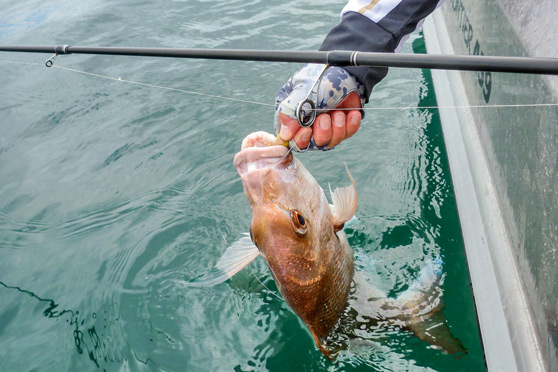
Big snapper hooked in shallow water will charge around all over the place, changing direction and taking powerful runs. They’re really good at burying themselves in stands of kelp or bulldozing their way under rocks and into crevices. They are just as likely to charge off towards the shore as they are to head for deep water.
To have any real chance of boating such fish on light tackle, you need to follow them with the boat/kayak. Get on top of the fish as much as you can and try to minimise the line angle. A longer rod can help control the fish and, more importantly, allows you to lift more of the line clear of the water when it is running.
Although desirable, it’s not always possible or safe to follow the fish too closely, because big snapper sometimes head into shallow areas of broken foul and reef where a boat can’t follow. Nevertheless, the tactic should always be to try and keep the line short and work on the line angle so it’s harder for the fish to break you off on a rock.
Staying on top of a fish can take some clever boat work and is difficult if fishing solo. It’s easier with a kayak, but care should be exercised: if kayaks have a disadvantage, it’s that hooked fish can drag them into danger. A big snapper can easily pull a boat around, so a lightweight kayak presents much less of a challenge.
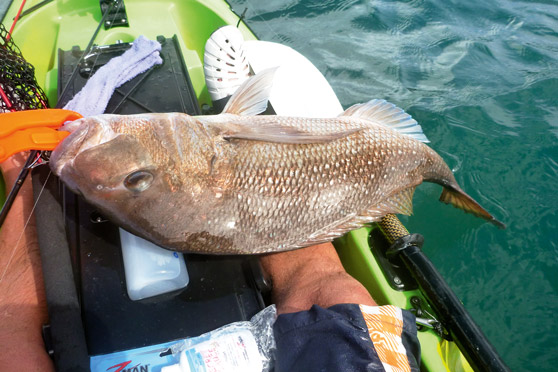
On the other hand, it’s hard to think of a better tool for fishing inshore shallows than the quiet, low-profile kayak. With a kayak you often hook fish at closer range than you do from a boat, and because hooked fish can tow the kayak fairly easily, drag settings are less critical.
Using the rod and reel, I find it’s usually easy enough to ‘wind’ the kayak over the top of a hooked fish and then put pressure on it from almost directly above.
When fishing rocky coastlines in shallow water, light tackle allows you to present soft-plastics so they get bites, while fighting fish on a short line allows you to boat most of those you hook. Hope this helps, Rob…
|
|
This article is reproduced with permission of |

Fishing Reports Visit Reports
Manukau/West Coast Fishing Report - 15/10/26
Big spring snapper in 60 metres. The El Niño weather pattern isn’t going to be... Read More >
Rotorua Fishing Report - 15/10/26
Solid start to the season! The Rotorua lakes have all started the season well, and... Read More >
Tutukaka Fishing Report - 15/10/26
Big snapper in shallow. Things remain relatively quiet on the fishing front out of Tutukaka,... Read More >
Tauranga Fishing Report - 15/10/26
Bait and temperature on the rise. It’s been great to get out and see some... Read More >


Tuesday 27 October 2026
Major Bites
 - -
- - Minor Bites
 - -
- - Wednesday 28 October 2026
Major Bites
- - Minor Bites
- -
Comments