
Ten Fly-Tying Tips
 There is nothing more satisfying than catching a trout on a fly you tied yourself.
Better still, as each season goes by and your skills improve, you can design new fly patterns to give you the edge over other anglers.
So whenever the days are too horrible to head out, but especially when your favoured waters are closed for fishing, it’s time to turn your ideas into reality at the fly-tying vice. Here are a few tips and suggestions to try when sitting down to tie flies.
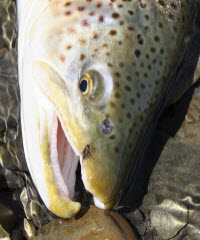
[Photo:Soft-hackle flies are often deadly a trophy brown caught on a #16 soft-hackle nymph. Use Hungarian partridge for best results]
1: Place a board behind the tying vise.
A board or screen placed behind the tying vise creates a background that is not too distracting. I like to use an off-white backing with a matt finish, so there is not too much glare.
2: Use a lighter to burn off the head and stray fibres off the nymph.
Once you’ve finished tying, a few loose fibres or a piece of thread can end up sticking out the front of your fly. It takes a little practice, but a careful sweep of a lighter across the head of your fly will easily burn off any fibres – a good way to tidy up your fly. Be careful not to get too close to the tying thread holding it all together. Now you can finish off the fly with fly-tying cement.
3: Use a magnetic knife board to hold and arrange hooks.
Keep an eye out for magnetic knife boards at garage sales, as they are ideal for holding and organising hooks, thanks to their magnetic strip and smooth, uncluttered space. Once the hooks are magnetised, your tying scissors will be able to pick out individual hooks, which otherwise tends to be a fiddly exercise. A magnet can also be very useful for picking up stray hooks.
 4: Use ultra-finely-stretched audiotape to rib flies.
Music cassette tapes, when finely stretched, make a strong ribbing for flies. The tape can also be wound onto a hook to imitate the horn-cased caddis. When used against a nymph tied with white thread body, the dark-coloured audiotape offers a strong contrast, and is ideal for tying zebra-type nymphs. The tape is also good when tying flies possessing minimal flash (the flash of shiny wire on nymphs often alerts educated trout); the audiotape has a very natural finish and is less likely to spook cautious trout. Audiotape is dirt-cheap and also lasts a long time. Take care when stretching the tape; pull it gradually so that the tape does not break. By repeatedly stretching the tape, you can get it ultra-fine.
5: Use hackle pliers to rib
lead-wire finely and evenly onto the hook.
Two pairs of hackle pliers will enable you to rib a nymph with lead-wire without your hands touching it; lead is a highly toxic material. The piers will also allow you to quickly wind the lead onto the hook.
6: Use thread to colour-code nymph weights.
Once a fly is tied, it is important to mark it so you know how much lead was used. I have a colour-coding system to indicate the thickness of lead used when tying a fly, because once the fly is dressed it’s hard to know. It is important to have flies of varying weights, so that you can choose a nymph that drifts just above the riverbed (the most consistent strike zone). Once nymphs of different weights are tied, take the time to organise them carefully in your flybox by weight. Often, being able to choose the correctly weighted nymph – quickly – is important.
7: Use tungsten beads/sleeves for extra-heavy, but small, nymphs.
Often trout are wary of larger nymphs, but will freely take a smaller fly. Obviously, these still need to get down though, so must be heavy if the water is deep and/or swift. Small but very heavy nymphs can be deadly at times, so are well worth taking the time to tie.
To make small but heavy nymphs, use a tungsten sleeve or bead and conceal it within the nymph body. When a tungsten sleeve is used in conjunction with a bead, you will have an ultra-heavy fly. Alternatively, you could incorporate two tungsten beads to make a tandem-bead nymph. Use a minimal amount of dressing on the nymph to further maximise its sink rate. At times, fishing two heavy #16 nymphs will be more effective than fishing one larger nymph with a dropper. Small flies deceive trout more easily!
8: Use empty kitchen utensil trays to arrange materials for different fly patterns.
Kitchen utensil trays make ideal units for arranging the different materials used in each stage of a fly pattern – especially when tying large batches of flies. The trays are also stackable, so you can store the required materials for a specific fly pattern together – a good time – and space-saving system. Opportunity shops often have the trays for next to nothing.
 9: Add some soft hackle to the head of nymphs to add movement and life to them.
I avoid tying rigidly-dressed nymphs. Consequently I like to put a collar of soft-hackle at the front of the fly so the feathers move in the water and imitate the legs or emerging wings of an aquatic insect. Also, I prefer flies tied with soft hackles as opposed to rubber legs, because the feathers have less water resistance and allow the fly to sink more effectively. It is personal preference, but I’ll hold back on the rubbers!
10: Give luminous nymphs and lures a go in discoloured water or low-light conditions.
Use some luminous strips (Aurora skirt strips) on your nymphs. Luminous nymphs charged up by a camera flash are great when fishing in low light or discoloured water conditions, and are well proven in the UK, especially on rainbows. So why not give luminous nymphs a go when the river is discoloured or when nymphing during low light? Of course, luminous material is often very effective on lures when fishing for rainbows at night and also for large browns in the tannin-stained West Coast lakes – or so rumour has it…
 |
This article is reproduced with express permission of written by Peter Langlands - 2011 Originally published in New Zealand Fishing News ----- Advertisement -----
|
Fishing Reports Visit Reports
Outer Hauraki Gulf Fishing Report 17/09/26
Spring wind the handbrake. Spring is starting to make its presence felt in the outer... Read More >
Top of the South Fishing Report - 17/09/26
Early snapper in Tasman Bay. Well, spring is finally here, and the days are getting... Read More >
Bream Bay Fishing Report - 17/09/26
Good snapper catches reported. After Tangaroa turned off the fish tap for a month or... Read More >
Bay of Islands Fishing Report - 17/09/26
Pacific bluefin tuna for the lucky few. The last fortnight has seen more fishable days... Read More >



Saturday 26 September 2026
Major Bites
 - -
- - Minor Bites
 - -
- - Sunday 27 September 2026
Major Bites
- Minor Bites
 - -
- -
Comments