
Targeting trout with soft baits

Earlier this year Herb Spannagl encouraged me to join him on Lake Rotoiti to target trout using jigging methods that involve a set of three flies.
This method worked well for me, producing some great fish and helping uncover the potential for other lures and techniques. The highlight of the day was fishing a three-inch minnow soft-plastic on a light rod and reel, the same as I would use fishing for snapper.
The morning conditions were perfect and the trout were playing ball. A long-term addiction to soft-plastics had me curious about their potential and first up, I attempted to put a small minnow in front of my quarry. Trout fishing is something I have limited experience with, so this was a real experiment.
The lure was cast well ahead of the kayak and allowed to sink slowly to the bottom, much like fishing for snapper. The plastic was worked upwards with only small twitches of the rod. As my lure travelled into the strike zone, it got attention and then a hook up.
Surprised at the result, I cast out again and then moved a little up from the bottom and left it to hang in the water column. The rod tip bent over while sitting it was in the holder, resulting in another trout. It was clear this had some merit! Fish continued to come on board and the experience gave me plenty to think about, starting an addiction to freshwater fishing in the process.
Later, a phone call from Herb made me aware of Troutpro Sportfishing NZ on Facebook. Angler Trent Hayman is using soft-baits with success, so the page is well worth checking out.
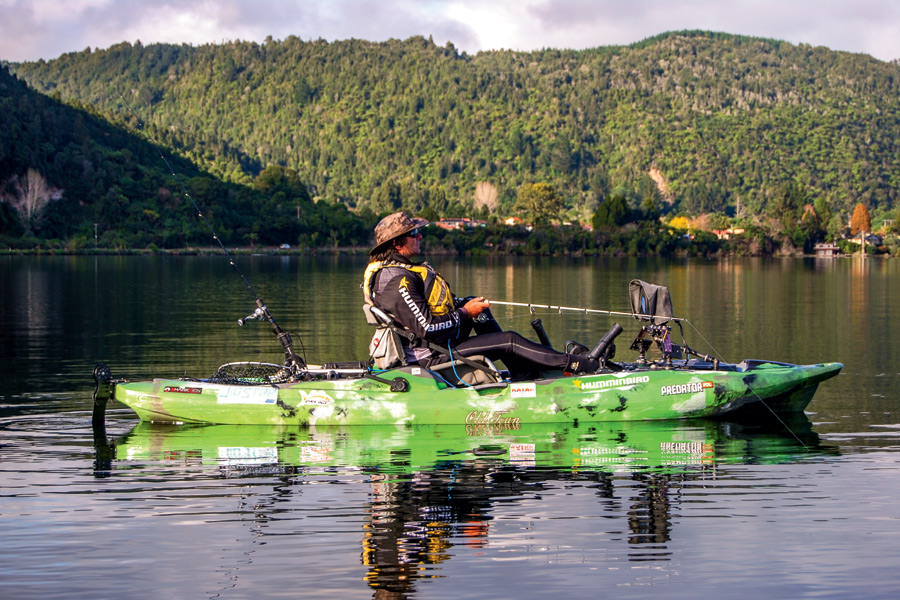
Armed with the limited experience gained on the first trip, my soft plastic equipment and techniques were refined slightly during the lead up to my next trout chasing adventure. The first day of this trip proved tough going with the trout off the bite and hard to convince during the early part of the day. This was compounded even further by the fish being more dispersed, making it much harder to find concentrations of them.
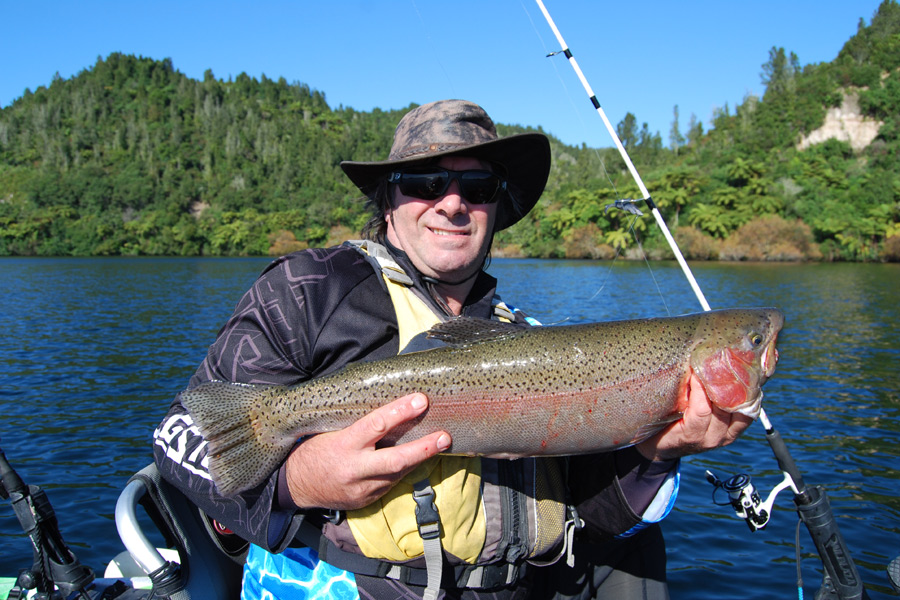
Another kayak angler jigging using flies was doing no better, so I persevered with the plastic, eventually producing a solid 3kg specimen. The most valuable lesson of the day was coming to terms with what the trout are doing and finding the technique to get these fish interested.
Trout can be a very tricky to catch at times, with individuals holding at various depths. As well as roaming different depths, they can be timid on the bite. Soft-baiting for trout is challenging, but they do bite and a clear pattern is starting to emerge. Much like in the ocean, soft-plastics seem to attract larger fish in my limited experience, but there is still a lot to learn.
Equipment
Either spin or overhead tackle can work, depending on the technique used, conditions and depth. A spin set is the most versatile and rod lengths of 6’3” to 7’ are ideal, with the shorter lengths better suited to dropping directly below the vessel. Longer rods work better for casting, but can also be used for dropping down.
While 4-8kg rated ‘snapper’ gear is workable, a softer 2kg-4kg rated rod is a better choice. With regards to reels, lighter is better, s0 a 2000 to 3000 size reel is ample for the job, as long as its drag is silky-smooth to compensate for any sudden bursts from the trout. I found the ideal spin combination in an Abu Garcia Veritas rod and a Revo reel. Fireline Crystal 6lb is a good line option, providing some invisibility for when softplastics are cast and worked through the depths.
In terms of overhead options, the Jig Star Slow Jerk 2oz rod matched with the Maxel Hybrid reel I normally use for micro jigging can be utilised. Line choice is crucial, with finer diameter lines the best to minimise the amount of drag in the water. Choose multicoloured, depth-indicating braid line of between 6lb and 10lb breaking strain.
At the business end, use fluorocarbon leader because it’s almost invisible in water, especially in suitable breaking strains of 6lb to 10lb.
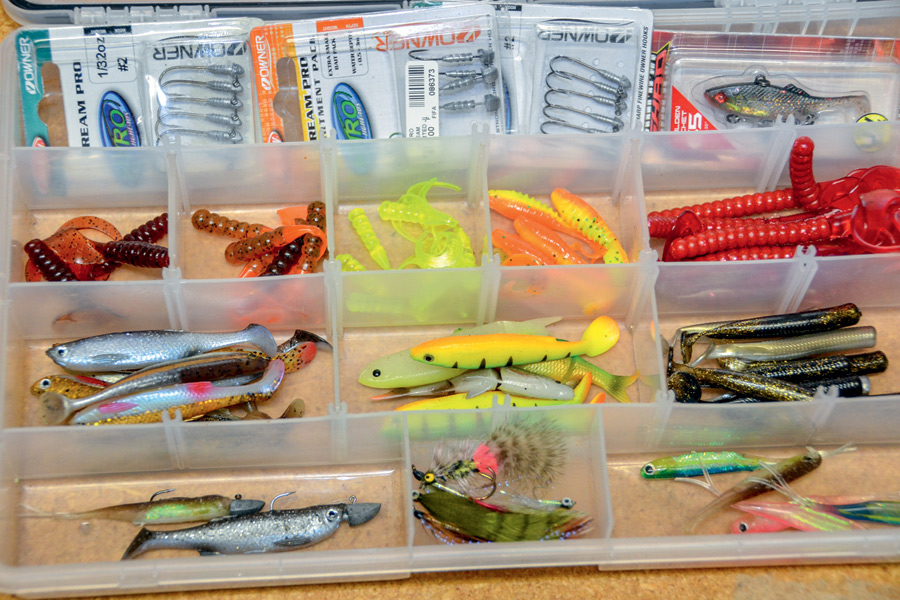
Finding jigheads that work with the soft-plastics and trout is the most difficult part. Berkley produce the perfect type: their Bream Pro range with a number of weights and finer gauge hook options. Jigheads from 1/6 to 1/2 an ounce and hook sizes of #2 and #4 cover the bases.
Knots and rigging
The set-up for soft plastics is much the same as for saltwater use, so rig up in the usual way by joining braid to about 1.2 metres of leader. It is possible to attach the jighead with a small clip like those designed for micro jigs, although tying a loop knot is my personal preference.
Suitable soft plastics
Selecting the right soft plastic for the job requires an understanding of the supply of food available in the lake. In the Rotorua lakes smelt are the most common, but juvenile trout are present too. Selecting colours, shapes and patterns close to these (matching the hatch) is a step in the right direction.
Three and four-inch minnow patterns are a close match to smelt, but paddle tails in these sizes also catch fish. Natural colours like browns, olivegreen, black, silver and gold are excellent choices. It’s also a good idea to have an assortment of colours and sizes in the tackle box.
Grub tails that offer a lot more movement in the tail section could also be viable, but I need more time with these.
|
|

Fishing Reports Visit Reports
Outer Hauraki Gulf Fishing Report 17/09/26
Spring wind the handbrake. Spring is starting to make its presence felt in the outer... Read More >
Top of the South Fishing Report - 17/09/26
Early snapper in Tasman Bay. Well, spring is finally here, and the days are getting... Read More >
Bream Bay Fishing Report - 17/09/26
Good snapper catches reported. After Tangaroa turned off the fish tap for a month or... Read More >
Bay of Islands Fishing Report - 17/09/26
Pacific bluefin tuna for the lucky few. The last fortnight has seen more fishable days... Read More >


Saturday 26 September 2026
Major Bites
 - -
- - Minor Bites
 - -
- - Sunday 27 September 2026
Major Bites
- Minor Bites
 - -
- -
Comments