
Targeting trout with soft-baits

Being a keen angler who predominantly fishes from a kayak I am always searching for new challenges. In part two of my feature, I look at the techniques for catching trout on soft-baits.
Methods for trout require a slightly different approach to what has already been established with saltwater. Being a cast and retrieve angler, the early stages of using soft plastics in freshwater involved this also. Other trout techniques involve placing the lure/fly at a certain depth were the highest fish concentrations are. Yet trout can be all over the place and by casting a lightly weighted soft plastic out from the vessel and allowing it to slowly sink to the bottom caters better to this.
Yes, trout can hit a descending lure although achieving hook up is quite difficult. It’s not until you start moving the soft plastic up away from the bottom and through the water column that you have a much better chance.
Do this by slow winding the reel combined with the occasional slight lift of the rod. In terms of how much the slight lift of the rod tip should be it’s only about three to five inches and at a much slower pace than normal. As the plastic is travelling away from the bottom of the lake it is also moving back towards you. Eventually, if you haven’t had a strike it will get close to your location where it will show up on the fish finder. This can allow the plastic to be adjusted to the best depth where it can be worked or retrieved for another cast.
When casting and working the soft plastic, most often strikes occur at different depths which is why this works so well. For best results use either 1/6 or 1/4-ounce jighead. These weight choices provide very slow sink rates yet will get the soft plastic down to thirty metres or more when given time to do so.
The other benefit with this weight is when a trout takes the soft plastic in its mouth. Too heavy a jighead can cause the trout to feel the weight and become suspicious to the point where it lets go of the plastic. When everything feels right, an individual trout will often return several times to strike, eventually being hooked. These jighead sizes can also be used for lowering a soft plastic down below the kayak with heavier 3/8 and ½ ounce also suitable, especially in windy conditions. When lowering down directly below the kayak, use the fish finder to track the soft plastic until you reach the desired depth. It’s possible to do this without the need for coloured braid and can also be useful in observing fish movements.
I have found that placing the plastic around one metre above the fish works well and will cause them to move upwards for the strike. One of the best things is watching trout show interest, which can assist with enticing and hooking a fish. If a trout starts moving away, react by slowly lifting the soft plastic about three to five inches. This can get the tail moving to give the impression it is swimming away and trying to escape. The result of this small movement is the trout returning for another look and strike.
Use the fish Finder
Fishing fresh water lakes for trout requires use of a decent fish finder to not only locate fish but also track the movements of them and the soft plastic.
On the kayak we get some of the clearest images on screen so it’s possible to achieve stunning results especially with the right unit. High frequency chirp sonar is the most useful, however down-imaging can also be worthwhile. As mentioned, it is possible to track the soft plastic when it comes into range of the sonar beam. Not only does this allow me to watch in real time but also anticipate any potential strike. On screen images will also show when a fish is shadowing the plastic or loses interest by moving away, allowing you to work the plastic and get further interest.
Controlling the vessel
One of the key aspects to successfully catching trout in the lake with soft plastics is holding the kayak over the fish. This is easy to do when the wind is low, however this isn’t always the case which can make things more challenging. When winds of ten to fifteen knots are present there are options to get out on the water. Find areas with shelter and less wind if possible to place yourself in the best situation. When holding over fish the most ideal tool for the job is an electric Minn Kota motor with spot lock and track plotting capabilities. Although this is an expensive addition, some kayaks are capable of mounting one which offers huge advantages on the water. Pedal powered kayaks are an excellent alternative for the job and are excellent for keeping on top of the soft plastic. The legs are used to hold position allowing the rod to stay in hand which keeps the angler in touch with happenings below.
When paddling it is possible to overcome wind by placing the rod in the holder while using the paddle and rudder to maintain position. This works well when the soft plastic sits at a certain depth with the motion of the kayak moving it just enough. When a fish strikes and gets hooked, the rod loads up its time to stop paddling and fight the fish. There is a point where the wind can make holding the kayak in position difficult when powering manually. In this situation it is worth considering a drift chute to slow the kayak which will keep you in the hit zone for longer.
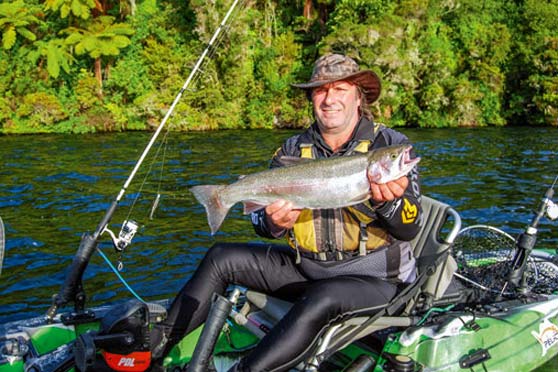
Catching trout from the kayak on soft plastic lures has added a whole new element to my fishing pursuits. It has created enthusiasm to learn and discover a new fishing challenge plus provide delicious food to eat. If you are looking for a new challenge, then this could be that point of difference you’ve been looking for.
|
----- Advertisement -----
|
This article is reproduced with permission of |

Fishing Reports Visit Reports
Outer Hauraki Gulf Fishing Report 17/09/26
Spring wind the handbrake. Spring is starting to make its presence felt in the outer... Read More >
Top of the South Fishing Report - 17/09/26
Early snapper in Tasman Bay. Well, spring is finally here, and the days are getting... Read More >
Bream Bay Fishing Report - 17/09/26
Good snapper catches reported. After Tangaroa turned off the fish tap for a month or... Read More >
Bay of Islands Fishing Report - 17/09/26
Pacific bluefin tuna for the lucky few. The last fortnight has seen more fishable days... Read More >


Friday 25 September 2026
Major Bites
 - -
- - Minor Bites
 - -
- - Saturday 26 September 2026
Major Bites
- - Minor Bites
- -
Comments