
Targeting Maomao
BLUE MAOMAO
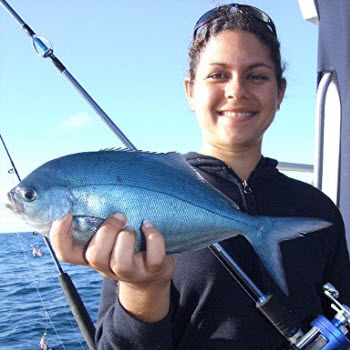
Although maomao do not grow to a particularly large size, they are a surprisingly game little fighter and delicious to eat. Found in schools that vary from a few dozen to thousands, they are very abundant in northern waters, preferring rocky shores in clear water around headlands and offshore islands, to a depth of around thirty metres.
Blue maomao will feed, from mid-water to the surface, on a wide variety of marine organisms, including planktonic crustaceans, salps, fish eggs and larvae. At night adults swim slowly but remain alert.
Spawning occurs in winter and maomao reach a maximum length 40cm
Daily bag limits
Blue maomao have no size limit and form part of a combined 20 finfish bag limit.
Fishing methods
TACKLE: Blue maomao have saved many trips from disaster, providing great sport on light tackle and a superb meal afterwards. A light spinning rod and reel (similar to one used for trout) is perfect, but for those just wanting a ‘feed’, maomao are usually both numerous and willing enough to take baits on much heavier tackle, provided the hooks and sinkers are kept small.
RIG: A light ledger rig with three branching traces and small sinker works well, as does a floating or lightly-weighted bait. Both rigs are made even more effective when berley is used to attract maomao to the scene, get them feeding and then keeping them there.
BAIT: As maomao eat a wide variety of food, almost any fish bait works, as long as it is the right size and not too old or stale. The best baits, however, are squid, tuatua and skipjack tuna. The squid works well as it is very visible and tough enough to withstand the hard nibbles of maomao. Although skipjack and shellfish are much softer baits, the tuatuas can be hardened up with un-iodised salt, and freshly caught skipjack is a very different animal to the soft, mushy frozen ones we mostly buy and use.
HOOKS: Hooks should be around #6 to #12, in either fresh or saltwater patterns, but all should be of a size that maomao can get their mouths around.
LURES: Surprisingly, although maomao do not generally eat whole baitfish, they are still regularly caught on a jig. The fact that they are hooked all over the body seems to support the theory that they swim down curiously after the descending jig and are foul-hooked on the uplift. Smaller Flasher rigs and larger bait flies can also be effective, especially when sweetened with small, thin strips of bait.
Description
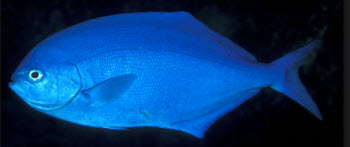
Body form compressed and deep with evenly arched profile, small head, mouth and teeth, bright blue colouration (duller in juveniles). Anal fin yellow until they reach 17-19cm, covered in small scales, whitish blue to greyish below, long dorsal soft, spinous dorsal base short, spines low and not easily seen, anal fin has short spines in front.
Distribution
Kermadec Islands, Three Kings to Kaikoura. Most abundant at the Kermadec Islands and around northeastern North Island. Very similar in appearance to sweep and bluefish.
This article appeared in the May 1998 edition of NZ Fisherman.
A Blast From The Past!
|
May 1998 |

Fishing Reports Visit Reports
Outer Hauraki Gulf Fishing Report 17/09/26
Spring wind the handbrake. Spring is starting to make its presence felt in the outer... Read More >
Top of the South Fishing Report - 17/09/26
Early snapper in Tasman Bay. Well, spring is finally here, and the days are getting... Read More >
Bream Bay Fishing Report - 17/09/26
Good snapper catches reported. After Tangaroa turned off the fish tap for a month or... Read More >
Bay of Islands Fishing Report - 17/09/26
Pacific bluefin tuna for the lucky few. The last fortnight has seen more fishable days... Read More >


Friday 25 September 2026
Major Bites
 - -
- - Minor Bites
 - -
- - Saturday 26 September 2026
Major Bites
- - Minor Bites
- -
Comments