
Tarakihi Catching Tips
Tarakihi Catching Tips
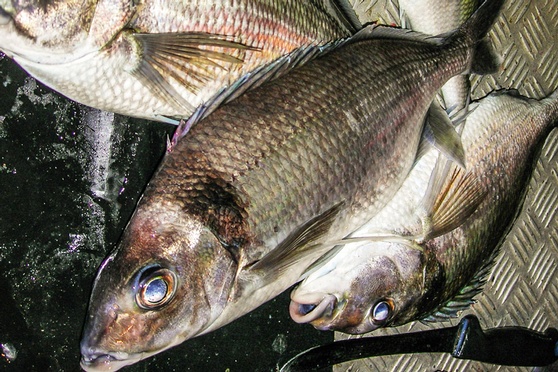
Although tarakihi fishing can be easy, some days you catch plenty and others practically zero. Here are some tips to improve your fishing, using knowledge that spans from hand lining them in Cook Strait in the 1950s right through to the current day where I'm armed with a GPS, sounder, a lot more experience and beautiful tackle. Probably the most important requirement today is your fishing location. Not just anywhere will do and this was the case in the past too, when landmarks were used, and although these were often reasonably precise, you still had to be right on the spot. Today, the GPS is able to take a lot of the skill out of it if you log in the location. However, you plan to find your location, though it is always a good idea to keep a diary of where and when the fishing has been good as well as when it has been bad in past seasons. Tarakihi are an extremely important bottom species for much of New Zealand. Where would we be without snapper as the basic catch in the north, tarakihi in the centre and blue cod in the south? Here in Gisborne this species is abundant, and from October and on through the summer it is our "bread and butter' fish. On a nice summer's a morning or sunset, catching a limit bag can be very enjoyable, and the whole family can participate, too. While in the past I caught huge tarakihi on a handline in places such as Vern’s Rock (named after one of Pop McManaway's sons) in the Cook Strait, we now use super-braid lines, soft-tipped rods that still have grunt, level-wind reels, a harness, super sharp hooks, a GPS and sounder, and have reliable boats.
Gearing up
Although I am a great believer in heavy tackle and putting the fish in the boat as opposed to 'playing with your food', with tarakihi fishing it's a case of fine lines and well-presented terminal tackle for best results.
The basic rig:
Use a sinker that is streamlined and of the least weight you can get away with. If snagging is likely to be a problem, attach the sinker with a lighter breakaway line. The trace should also be reasonably light if you want to attach hooks directly to it. Personally, I have a trace of around 50kg as the 'backbone' in case a big hapuku or the razor gang is about. Off the heavy dropper loops I attach lighter 15kg slip-on traces that are looped onto the hooks. use two to four hooks for tarakihi fishing, as we never use berley, with the additional baits helping to create a scent trail that attracts the tarakihi.
The hooks:
In the past, I liked long-shanked hooks that held the strip baits well when handlining. Now, 50 years later, I have progressed to fine-gauge circle hooks, which I use exclusively when bottom fishing. Do not to listen to any arguments that conventional hooks are better. My own preference is for Black Magic's KL range, with the 3/0 KL hook suiting tarakihi well. Some anglers call these 'auto hooks' because they hook the fish for you, and as the long curving point acts as a very effective barb, the fish only fall off if the hook tears out of the fish's mouth. Even better, these circle hooks snag on the bottom less than conventional hooks. Decorating the hook with fly-like material certainly helps. Sam Mossman once wrote that this method outfishes conventional bare hooks two to one, and since then I have observed that it's true. We used to make up our little flies by using Krystal Flash and sealing the thread with nail-polish while watching TV at night. But now we simply thread about 5mm of lumo tube above the hook. By all means, buy the ready-made flasher rigs if you prefer, but the sheer time we spend fishing means we often have to take a bit of a shortcut, and we find lumo tubing is quick and effective.
The line:
In shallow water, mono line will do, but we find superbraid works well in both deep and shallow water. Initially, I used this line on heavy stump-pulling rods and found it rather harsh and brutal, SO I tried tying about 15 metres of lighter, stretchy, sacrificial mono from the trace swivel to the braid and this helped. It also acted as a weak point when snagged. The rod: I now use a Kilwell Jellytip 15 24kg rod, which is longish and excellent. It has a soft tip but plenty of grunt in the butt section. It's used to fish anywhere from 400 metres for bass and bluenose, to 25 metres in depth for snapper and tarakihi. It is the perfect all-rounder in my opinion. I still use 80-pound braid for tarakihi, as it is thin, strong and durable.
The reel:
After lots of experimenting I now use a level-wind reel as it spreads the braid line evenly for you; using your finger to do the same is asking for cuts and skin wear. The level-wind reel is the way to go. Mine is a Penn 345 with a moderate retrieve, and I believe this outfit would catch me a broadbill if the chance presented itself in daytime.
Bait:
Tarakihi are not fussy eaters, so shellfish and strips of squid or a good fish bait will usually do the trick.
Tactics
Late winter through summer is best. Tarakihi school in large numbers, but it is still important to spend time finding them and positioning the boat correctly.
Tarakihi can be found in most depths, but they seem to be most abundant in 30-90 metres. The larger fish prefer the deeper spots, but not always. Most times the largest schools accumulate over higher parts of reefs or foul ground. If a current is running, as in Cook Strait, they move forward onto the reef faces and use the current and reef structure to funnel the food towards them. Divers sometimes see this, and it is the same for groper, too.
Care of the catch
Keep your lovely fish in good order, as tarakihi is one of our nicest fish to eat. It pays to take a bag of ice and mix it with a bucket of sea water in your chilly bin.
Fish kept this way are superior in every way. When it comes to filleting them back home, they are as stiff as planks, making it easier to deal with them. They'll keep longer, too. Good luck.

Alain Jorion - January 2004 P94
New Zealand Fishing News Magazine.
Copyright: NZ Fishing Media Ltd.
Re-publishing elsewhere is prohibited
Fishing Reports Visit Reports
Manukau/West Coast Fishing Report - 15/10/26
Big spring snapper in 60 metres. The El Niño weather pattern isn’t going to be... Read More >
Rotorua Fishing Report - 15/10/26
Solid start to the season! The Rotorua lakes have all started the season well, and... Read More >
Tutukaka Fishing Report - 15/10/26
Big snapper in shallow. Things remain relatively quiet on the fishing front out of Tutukaka,... Read More >
Tauranga Fishing Report - 15/10/26
Bait and temperature on the rise. It’s been great to get out and see some... Read More >


Tuesday 20 October 2026
Major Bites
 -
-  -
- Minor Bites
 - -
- - Wednesday 21 October 2026
Major Bites
 - -
- - Minor Bites
- -
Comments