
Surfcasting with Softbaits
A fisherman I met in a shop today told me that soft-baits are useless for surfcasting.
I said, “How did you work that out?”
“I used them for half an hour and didn’t catch a thing,” he replied.
I must be getting old, but that sort of statement makes me irritated and defensive. I wondered if he’d ever fished with cut bait without getting a bite for half an hour?
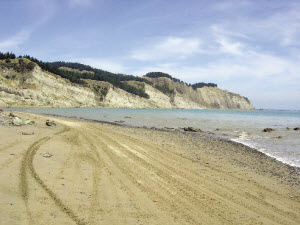 Some thought needs to go into fishing soft-baits from shore. While a few anglers will quickly discard them after little use, I suggest you give them a fair go. They are not the silver bullet for surfcasters, but do offer a good alternative to natural bait, are much easier to use, and in the right circumstances are just as effective.
The most important thing is to get your presentation right. You have to present the soft-bait in front of the fish you want to catch and then make it look tempting. The smell, taste and feel will confirm to the fish that it is something worth eating.
There are many ways to achieve this. It could be as simple as just replacing the bait you use now with a soft-bait. While this can work though, it won’t be as effective as making the effort to enhance the attractiveness of a soft-bait.
Keep telling yourself that there are soft-baits and there are ‘soft-lures’. The former will catch fish for you when sitting static in the water, while the latter requires some activation to get the best from them.
Let’s look at the soft-baits that will catch fish for you just hanging off a hook with no movement. Gulp! crabs fall into this category, and are a firm favourite with knowing surfcasters New Zealand wide. They will catch a wide range of species, from kahawai and snapper to blue cod and blue moki. Other ‘baits’ include sand worms and sand fleas. These all have little movement in still water, so rely on the attraction of shape, texture, smell and taste.
I believe that smell is the most important aspect, bringing in fish from some distance to bait. The shape may offer confirmation in clear water, but is probably not as important as the smell. The taste of the bait is essential. Some baits obviously smell, feel and taste better than others, and fish will hang on to them longer than others.
To take that to the extreme, which do you think a snapper will hang onto the longest – a hard-bodied jig with a flash paint job or a sweet-smelling, soft-to-the-touch, nice-tasting soft-bait? OK, as I said that’s extreme, but it makes the point, and scientific studies overseas have produced some figures that support this notion, too.
Seven soft-baits were tested with USA’s top freshwater sportfish, the largemouth bass. They were testing to find the average retention time for each bait. This is the amount of time that the fish held onto the bait before spitting it. This retention time is critical in a fishing situation. I have had numerous fish hold onto the bait and swim off with it before hooking up. The fact that they held on means that circle hooks, for instance, have time to do their work.
Circle hooks are the best approach when surfcasting with soft-baits (or any bait for that manner), where the angler may be 150 metres from the bait. It won’t matter how hard you strike at that distance, you won’t make much impression at the hook end 150-metres away. Better to use circle hooks and let the weight of the Break-out Sinker set the hook for you as the fish swims off.
If a fish feels that it has picked up something other than what it thought was food, it will spit it out. The baits tested were USA favourites, but included two brands available in New Zealand, and had one category that was unflavoured plastic. The results were very interesting, with one scented soft-bait held for an average of 18.78 seconds before being rejected. The lowest performer was unflavoured plastic, which was rejected after an average of just 1.4 seconds. It shows that fish do have some senses that we can monitor.
You may say (because largemouth bass were the study subject) that this means little when we are fishing for snapper and trevally, or salmon and cod. I believe it is worth keeping in mind though. Longer retention time can mean more hook-ups. Isn’t that what we are after?
The other side of the game with soft-baits from shore is that they become more attractive when you retrieve. And for similar reasons, if current is present, it will give soft-baits more life. The grub style gives you all the action you want when fished static in a current or retrieved at a steady rate. They have a curly tail that is activated by movement. These are the type of lures I started my soft-bait fishing with. They were unscented plastics (all that was available at the time), but they still worked well. A 16lb (7.25kg) snapper near Tauranga Bay on an orange Mr Twister cast from shore convinced me of their effectiveness. Now, with flavoured baits, we are even better off.
Jerk Shads need to be worked during the retrieve. These fish-shaped baits are best fished on leadhead jigs. To get the best from them, cast and retrieve, giving them plenty of action by lifting and dropping the rod tip. Try casting up and down current if there is any. Cast them around structure such as wharves, shallow reefs, bridge piles and breakwaters. Sink them down, twitch them and hold on, because it probably won’t be long before you are hooked into a snapper, salmon, gurnard, mackerel, barracouta, kahawai, trevally, kingfish, moki, or john dory.
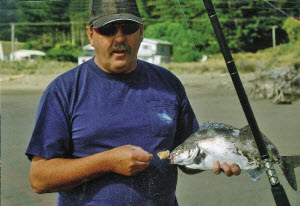
Gary Kemsley with a blue moki taken on a Gulp! crab fished from the beach.
 |
This article is reproduced with permission of |
Fishing Reports Visit Reports
Outer Hauraki Gulf Fishing Report 17/09/26
Spring wind the handbrake. Spring is starting to make its presence felt in the outer... Read More >
Top of the South Fishing Report - 17/09/26
Early snapper in Tasman Bay. Well, spring is finally here, and the days are getting... Read More >
Bream Bay Fishing Report - 17/09/26
Good snapper catches reported. After Tangaroa turned off the fish tap for a month or... Read More >
Bay of Islands Fishing Report - 17/09/26
Pacific bluefin tuna for the lucky few. The last fortnight has seen more fishable days... Read More >


Friday 25 September 2026
Major Bites
 - -
- - Minor Bites
 - -
- - Saturday 26 September 2026
Major Bites
- - Minor Bites
- -
Comments