
Surfcasting - Using the moon
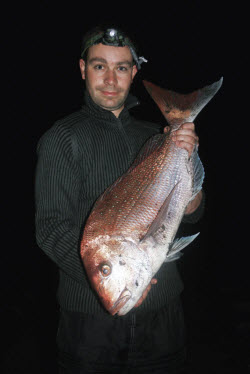 Catching snapper off the beach is one of life’s great privileges and pleasures as far as I’m concerned, but it’s easier said than done in the lower North Island.
However, in the recent off-season my Wellington-based surfcasting club voted to expand its west coast fishing boundaries northwards to Patea, opening up the exciting shore-based snapper fishery stretching from Manawatu to South Taranaki.
Keen members have reacted enthusiastically, exploring the opportunities available on this vast stretch of coastline. A few snapper trickled in to start with, but with the arrival of autumn and more frequent weather from the east, catches started to boom. This, of course, is old news to our nearest rivals from the Fielding Surfcasting Club!
My first personal experience of the true quality of this fishery caught me very pleasantly by surprise. On a balmy Saturday afternoon, my mate Felix Wenzel picked me up for a flying visit to the coastline out from Wanganui. We both had Sunday morning duties, so agreed to keep it short and sweet, fishing through dusk and the first hour or two of darkness before returning home.
At 5pm we were bouncing up State Highway One along the Kapiti Coast in picture-perfect conditions, with a blazing sun and not a breath of wind. And, better still, these conditions were no different when we arrived at our destination two hours later.
Our first baits arced over a close sandbar and into a deep channel at 7pm. We sat and waited, and I remarked to Felix that my expectations were not sky high, but that it would be nice to get a pannie snapper or two. Right on cue Felix’s rod bent over gently, and he reeled in a just-legal specimen, which was released to fight another day. We then had just enough time to reflect that this particular beach – which neither of us had ever fished before – might have some potential. Then sixty minutes of bedlam began.
My rod bent over, and moments later I reeled in a snapper of 2kg, which raised the bar higher – but not for long. Preparing my rod for a return cast, I heard the ratchet on Felix’s overhead reel scream, and immediately he announced he had a good snapper on. A stubborn arm wrestle followed before a big red flank emerged, prompting me to wade out, grab the fish under the gill, and escort it to dry ground, where it was weighed at 6.3kg.
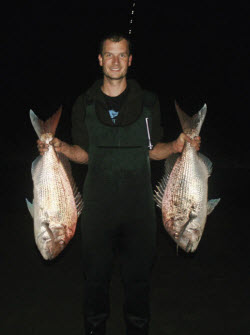 I rushed back and recast, but even before I could get my rod back in the beach spike, it was hit by something with heavy nodding thuds, so with a quick whip I sent the hook home. I remained focused throughout the fight, knowing (probably) what was at stake, and apart from a few anxious moments bringing the fish over a sand bar, the fight went to plan; soon I had a 6.3kg snapper of my own on the beach.
About this time we noticed a very big moon lighting up the eastern horizon, and we were wary what effect this would have on the fishing. Well, it made no difference for the next half hour, as we landed three more snapper, including the biggest of the night, a 6.4kg fish to Felix. If it hadn’t been for a fast-rising spring tide that forced us off the beach, who knows what we might have ended up with? As it was, we’d caught seven snapper in about an hour, fishing only a single rod each.
We drove along the beach to the exit point, and when we were safe from the tide we took a few photos of our catch. Only then did things begin to sink in. Snapper fishing is not like that every day, and with my habit of leaving nothing to chance, it all felt a bit ironic. How many times had I gone surfcasting armed to the teeth with fishing gear and all manner of baits, and endured slow fishing?
The following weekend I experienced exactly that, arriving well prepared and putting in twelve hours on the same beach, in the same conditions, for a return of just a single 1kg snapper. All of this reinforced that the most important factor in fishing is: having a line out when the fish are biting.
There are numerous possible reasons why those two weekends, spent in the same place and same conditions only a week apart turned up wildly different results. However, my mind turned to the large moon that lit up the horizon on the first weekend. Was it responsible for the hot snapper bite? Maybe or maybe not… Perhaps it was the spring tide?
All this got me thinking about the impact the moon has on beach fishing. I’m not a big believer in any ‘complete’ theory for how the moon affects fishing, but over time I have developed some firm ideas about the ‘big cheese’ in the sky.
Big moons
A big moon (a few days either side of full) has a pronounced effect on fishing, and I’ve had my best and worst fishing around this time. However, overall my results at this time of the month have tended to be less productive, so this is a time I’ll think about getting the lawns done. A bright night under a big moon normally has a negative effect when fishing shallow beaches, so on such nights I will seek out deeper water that moonlight can’t penetrate to the same degree. That clearly wasn’t the case for Felix and me ‘that night’, but there’s always an exception!
But … big fish don’t mind big moons so much
Despite my previous comments, big moons definitely bring aggressive, predatorial species – such as sharks, rays and conger eels – onto the bite during night-time hours. Elephantfish, big trevally and kahawai will also feed at night under a big moon. Kahawai are normally a daytime catch, relying on their keen sight to stalk baitfish, but they will use the light offered by a big moon to feed effectively at night. Indeed, my theory is that all these species use the extra light on the water to stalk their prey visually.
Small moons
A few days either side of the new moon (i.e. no moon) is the time when I’ve most consistently had good fishing. For this reason a thin crescent moon in the sky always gets me excited, and I will generally plan to get out and do some serious fishing at this time of the month. Around Wellington this is a good time to fish for blue moki and tarakihi, two species that seem to be particularly sensitive to a bright moon. However, bang-on the new moon I’ve often found fishing to be slow, and I’ve often wondered if this is because the fish lack that signal in the sky to trigger their feeding patterns.
Rising and setting moons
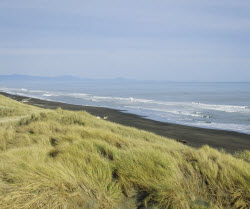 It is generally regarded that when the moon is on the horizon, or thereabouts, it is a good time to fish, and I agree with this. At the front of my mind are some good moki bites, a couple of nice trevally and, of course, that hot snapper bite at Wanganui. Added to that I am certain a rising or setting moon changes feeding behaviour. My background in competition fishing through the wee small hours has proven this to me time and again. Previously ravenous fish will shut their mouths, or vice-versa, with the rising or setting of the moon. With this in mind it is always worth sticking it out through tough fishing if you know a moonset or moonrise is imminent.
There is a lot more I could say about the moon, but these are the things that I genuinely believe in and use to reach my fishing decisions. I’d also like to make it clear that my observations relate to surfcasting, and I believe this is significant because the water that us landlubbers fish in is generally shallow, and therefore more vulnerable to the lighting effects of the moon.
Now and again I experience fishing that goes against the patterns I have observed, and at these times it is important to remember that we don’t know for certain how it all works, and the moon is only one variable that affects fishing. Factors like barometric pressure, sea conditions and water temperature also play their part.
 |
This article is reproduced with express permission of
written by Andy MacLeod - 2012 Originally published in New Zealand Fishing News ----- Advertisement -----
|
Fishing Reports Visit Reports
Outer Hauraki Gulf Fishing Report 17/09/26
Spring wind the handbrake. Spring is starting to make its presence felt in the outer... Read More >
Top of the South Fishing Report - 17/09/26
Early snapper in Tasman Bay. Well, spring is finally here, and the days are getting... Read More >
Bream Bay Fishing Report - 17/09/26
Good snapper catches reported. After Tangaroa turned off the fish tap for a month or... Read More >
Bay of Islands Fishing Report - 17/09/26
Pacific bluefin tuna for the lucky few. The last fortnight has seen more fishable days... Read More >


Friday 25 September 2026
Major Bites
 - -
- - Minor Bites
 - -
- - Saturday 26 September 2026
Major Bites
- - Minor Bites
- -
Comments