
Surfcasting for Snapper
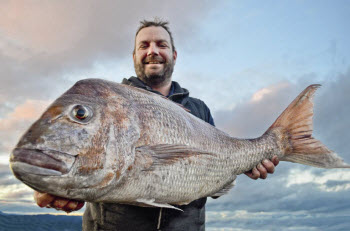 As spring arrives and the westerlies roll in, accompanied by the pohutakawas coming into flower, I can’t help but become excited; these signal that east coast snapper are coming on the bite!
Yes, it’s that time of the year where the lambs’ tails are crackling away on the chicken mesh over driftwood fires, and the fun and beach festivities have begun in the warm sunshine. Hopefully, hours of planning and looking at inshore depth charts through the cold months are about to pay off.
The bulk of my surfcasting is based on the east coast from Wairarapa to North Cape, primarily because this coast is more sheltered from New Zealand’s prevailing westerly conditions and therefore fishable more often. It can be difficult to plan a trip in advance on the west coast because of its unpredictable conditions, although the fishing on the west coast is fantastic when conditions are favourable.
Over the years, while sitting on the beaches around the North Island, I have noticed a few consistencies that help me to catch snapper in most of the locations I visit. These tend to be really small things, but can all add up and make a difference to the catch bag.
Anyone can catch a snapper when they put in the time and effort, but to catch them consistently off the shore takes a little bit more skill than just turning up and casting baits blindly at the waves. So here are a few tips and reminders that will help you get a few more snapper on the table for dinner when targeting snapper off the beach.
First off, we’ll take a look at the bite times, baits, rigs and terminal tackle side involved when surfcasting for snapper, and in the next issue I’ll cover off what to look for in a snapper fishing spot.
Bite times
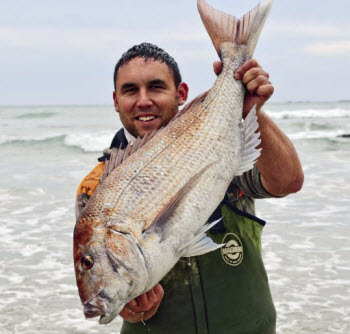 It’s well known that snapper bite hard early in the morning and evening over the change of light, but it’s often forgotten that snapper also feed vigorously throughout the night. The key periods to look for are around the tide changes at night – the periods of little or no current, when the fish come on the bite. Usually the fishing will pick up over these periods, so it pays to have an idea of the tide times.
Something else I have noticed over the years is how good the fishing can be before the moon rises. When it’s pitch-black, just as the moon peeks over the horizon, the snapper go ballistic and bite hard. However, once the moon makes its way into the night sky the fishing fizzles away, so make a note of that next time you’re out in the surf at night.
Some of the best snapper fishing we have had through Bay of Plenty, Exhibition Bay and Hawkes Bay has been through the night, between 11:00pm and 1:00am in particular. I get home at all hours in the morning; some of the looks I get from my partner at 3:00am are priceless, but with a fresh feed of fish assured for the following night, most of her objections are soon forgotten.
Bait
 Having a good bait selection when you go on a fishing trip is important for success. Snapper are not fussy and will take almost anything – but, having said that, some days they will only take certain baits, which can make for a long day if it’s one you’ve left at home.
I tend to take either crab or crayfish with me on most trips; a lot of the snapper are feeding on them, so they make great baits. However, these are not always easy to get hold of, so it helps if you have a few mates who are into their diving. Crab is good through spring and autumn, and crayfish works well prior to Christmas when the crayfish are shelling.
Squid and octopus are very similar baits and can run hot or cold, but when they do work they tend to catch the bigger snapper, so it pays to have one of these baits available when out fishing.
Try to have at least two oily baits in the bait bin, too – a mixture of skipjack, pilchards and anchovies is good. If only heading out for a couple of hours, any one of those baits is fine, but if heading away for a few days, take a good selection, because there is nothing worse than watching the next guy along catching all the snapper on a bait you haven’t got.
When you arrive on the beach, make the most of fresh baits. I always use the conventional stuff first, such as pilchards and cray, but when it’s tough going and these are not really working, start looking at fresh tuatua, pipis and kahawai, and keep going until you get a hit. When the fishing is tough, the fish are often still there, but they’re being very selective.
Obviously you can’t take the whole freezer with you, but you can still cover the likeliest scenarios by taking pilchards or anchovies, squid or octopus.
Bait presentation
It is important to take your time when baiting up, so it’s done properly. This can make a difference when the fishing is slow/hard. By rigging up specifically for snapper and casting baits that are perfect for them, you’re more likely to entice a bite.
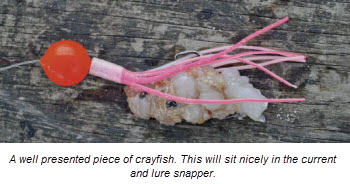
In spring, snapper love crayfish; it’s a good part of their diet and a great substitute for crabs. The small red float shown below is there to lift the bait from the bottom and catch the attention of the fish, while the ‘needlefish’ dangles around and catches the current, often proving tempting to most fish, too.
I have found snapper love the crayfish in more of a ball, which is very soft. I use a little bit of bait-elastic to ensure it’s not going to come off, but not so much I make it firm up. This bait, when flicked out on the edge of a reef or over the sand, will get smashed if snapper are around. Because it is a soft bait, the hook’s barb can be hidden a little more than with firm baits, but ensure the point is well exposed as this will increase your chances of a hook up.
Rigs
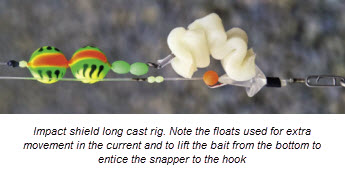 An important aspect of surfcasting is the ability to cast long distances if necessary, which is much more achievable if certain long-cast rigs are used. Most of the North Island’s beaches are flat, varying from shelving shingle beaches to open surf beaches. I believe that distance casting is an important tool for luring snapper to your bait in such scenarios, especially during daylight hours. When fishing surf beaches, you can often see a dark line around 150m out to sea, where the water hits a certain depth and the colour changes. This darker water is most likely where the snapper will be feeding during the day, due to greater security offered.
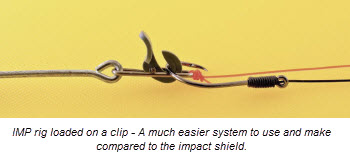
There are a number of long-cast rigs available these days. I favour the Breakaway ‘Imp’ product because it’s so simple to make. Using Imps to make a pulley rig is the easiest long-cast rig to make.
Casting this rig correctly will add 10-15% to your casts, depending on your casting action. One of the biggest advantages when using this rig is the lack of instant tension felt by the snapper when it takes the bait; using rigs such as ledgers mean direct pressure on the mainline, which is not ideal when snapper are feeding tentatively. The length of your backbone will give the snapper enough weightless bite time to engulf the bait without the rod pressure pulling the hook early.
Terminal tackle and rig components
 It’s important to trust your equipment – gear you can use over and over and know it’s all going to hold up when the weight really comes on. I have used cheap hooks and tackle in the past, and it always ended in tears. There’s nothing worse than cringing after a fish has busted you off at your feet, thinking, ‘Why on earth did I buy that junk?’
Black Magic’s barrel swivels are excellent; I use the 10kg to 15kg Rolling Swivels as they are small, lightweight and very strong – I have never had one fail me yet. Consequently they give me confidence, which is important when fishing gear under heavy loads.
Black Magic also shines with its fluorocarbon trace line. I find 60lb is a good weight: it’s not too heavy and holds its shape very well, lasting longer than normal trace line and being harder to see underwater. It’s also abrasion resistant, making it hard for bycatch such as sharks to bite through, which means you don’t lose as much gear or have to retie traces as frequently.
Gemini ‘Genie Clips’ are fantastic multi-use clips that are very strong and reliable – but buy the original Gemini ‘Genie Clips’ and not the cheap knock-offs, because the latter are made from cheaper steel that bends easily and may cost you a good fish.
Gamakatsu hooks might be expensive, but they are also reliable and an excellent hook pattern to use. However, there’s another very likely looking contender on the scene now, thanks to Black Magic’s latest ‘C-Point Hook’ addition. These hooks are very sharp with a fine gauge in the smaller sizes, and unlike Black Magic’s other hooks, they will not rust because they’re nickel coated.
Off the beach I tend to use hooks in the 3/0 to 5/0 size range; anything bigger limits your catch a little bit too much. Besides, even small hooks can catch big fish.
Skirts and floats are a great way to entice snapper to take your bait. Using a mixture of small, bright floats and brightly coloured ‘Needlefish’ skirts works much like soft-baits underwater, only it’s your bait that carries the scent. These items give your bait that X-factor where there is current or turbulence, and can make all the difference. Very rarely do I fish without them. No particular brand in this case, though more or less just whatever catches your eye will likely catch the eye of your target species, too.
Breakaway impact shields and Imp clips: The IMP is much simpler to rig up in comparison to the Impact Shield, but both do a great job of adding distance to your cast. These products can be found online or in most good tackle retail stores around the country.
It’s one thing to buy gear and go fishing; it’s another thing entirely to buy quality gear and know you can trust it under heavy pressure in tight situations. This is often the difference between catching and not catching.
So now you know when to go fishing for snapper and what to catch them on.
 |
This article is reproduced with express permission of
written by Chad Prentice - 2013 Originally published in New Zealand Fishing News |
Fishing Reports Visit Reports
Outer Hauraki Gulf Fishing Report 17/09/26
Spring wind the handbrake. Spring is starting to make its presence felt in the outer... Read More >
Top of the South Fishing Report - 17/09/26
Early snapper in Tasman Bay. Well, spring is finally here, and the days are getting... Read More >
Bream Bay Fishing Report - 17/09/26
Good snapper catches reported. After Tangaroa turned off the fish tap for a month or... Read More >
Bay of Islands Fishing Report - 17/09/26
Pacific bluefin tuna for the lucky few. The last fortnight has seen more fishable days... Read More >


Friday 25 September 2026
Major Bites
 - -
- - Minor Bites
 - -
- - Saturday 26 September 2026
Major Bites
- - Minor Bites
- -
Comments