
Surfcasting for Sharks
There are probably a lot more sharks present in the waters you fish than you imagine and this is certainly the case in Hawkes Bay, where quite a number of sharks are available to the surfcaster. They can be classified in categories from 'annoying' to 'awesome!'.
At the bottom of the surfcaster's shark list we find the spiny dogfish. These are quite an attractive fish, with classic shark gray coats and large white spots. They have a nasty spine at the front of the dorsal and the anterior dorsal fins. Watch out for these when handling these fish.
The spinys are a real pain when they come in to feed on the beaches. They are generally small, with few over 4kg being caught by surfcasters — and most are considerably smaller than that. The worst aspect is that spinys arrive at your beach in plague proportions. When present, they will take every bait you cast out. There are only two ways to avoid them. The first is to pack up and drive 100 kilometres up the coast and try another spot. This is not guaranteed to work as they can turn up anywhere. The other way is to use crabs for bait. The crabs are still attractive to species such as snapper, gurnard and moki — which you may be targeting — but are seldom taken by spinys.
Still in the annoying list are tope. These sharks are a uniform gray with long, pointed noses and a good set of teeth. In larger sizes they are a fast, challenging sportfish, but unfortunately the ones most often encountered by surfcasters are under a metre in length and will swallow baits set for other species.
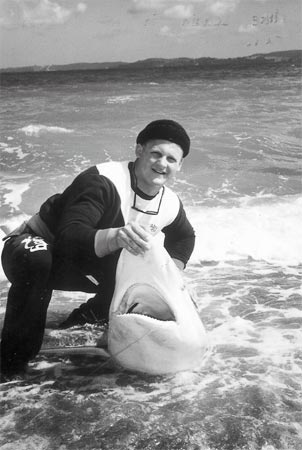
The hammerhead shark is another species often taken by surfcasters in lengths under a metre, and when they are around they can be there in big numbers.
The bronze whaler or 'narrow-tooth' sharks as they are officially known, are regular summer visitors to our beaches. These sharks are a bright bronzy colour and have a rounded nose. They grow to a large size in New Zealand waters and have no fear of the shallows. These are generally the species spotted on the swimming beaches during the summer months. Bronzies in Hawkes Bay run up to 100kg and are common at half that weight. They are a good sportfish, giving anglers a serious tussle right up on the beach. They will also jump on occasion. They feed well in low light periods and on overcast days.
The spotted smooth hound — known elsewhere as rig or lemon fish — is one of the premier sharks in the bay. They are seasonally common, average around 4 to 5 kilos, and grow to a maximum of around 35 kilos. These guys are great sportfish. They feed on the abundant paddle crab population. A few are caught by surfcasters using pilchards or tuna for bait, but if you want to bend a rod on a smoothy, then crabs or crayfish are the best baits to use.
The fact that this member of the shark family will feed in the roughest of conditions means that keen surfcasters have a quality target species in any conditions. Clean water or dirty, flat calm or waves to the horizon, the smooth hounds will be looking for crabs in trouble. We love them here because they are so available, fight well and grow to a good size.
Hawkes Bay beaches are visited annually by the 'glamour' species of the shark family, too. Blue sharks show up in the spring and are around all summer. While they are never common, they can show up at any time. The clean water beaches seem the best spots to look for them. Places like Ocean Beach south of Napier and Whakaki and Tahaenui to the north. Blues are unmistakable with their bright blue coloration and very long pectoral fins. They can put up a fair fight in the surf and are a desirable sportfish for surfcasters.
Mako sharks are common in the bay during the summer months, too — even to the point where we hear the boat fishers complaining about the numbers of them. They are seldom close enough to shore for the surfcasters to latch onto them, but there are exceptions.
This summer I was fishing at Whakamahi Beach near the mouth of the Wairoa River north of Napier when a small mako jumped three times only 500 metres away. Close enough to think that a serious attempt to berley one in could well be worthwhile. I have caught makos from shore and livebaits seem to be the best approach. Given a good offshore wind when they are around, a small livebait under a balloon could be a successful technique. Look for clean warm water for the makos.
Thresher sharks are another toothy proposition here in the bay, with specimens caught by surfcasters most years. I think all the surfcasting thresher records are held by 'Bay anglers.
They have been caught here on dead and livebaits and are great sportfish for the surfcaster. They are very fast and tend to jump after hook-up. You need well maintained, high quality gear to handle the speed and power of these chunky, powerful, predators. They can show up anywhere in any water conditions.
One my wife hooked at Awatoto Beach was feeding at low tide in shallow dirty water. Another was in clean water with a strong current off the Napier breakwater. They can show up anywhere, which makes targeting them a difficult proposition. So be ready, because when the line screams out and you see a big fish take to the air, it will probably be a thresher — even if it feels like a marlin!
Article provided by:
 |
Fishing Reports Visit Reports
Outer Hauraki Gulf Fishing Report 17/09/26
Spring wind the handbrake. Spring is starting to make its presence felt in the outer... Read More >
Top of the South Fishing Report - 17/09/26
Early snapper in Tasman Bay. Well, spring is finally here, and the days are getting... Read More >
Bream Bay Fishing Report - 17/09/26
Good snapper catches reported. After Tangaroa turned off the fish tap for a month or... Read More >
Bay of Islands Fishing Report - 17/09/26
Pacific bluefin tuna for the lucky few. The last fortnight has seen more fishable days... Read More >



Friday 25 September 2026
Major Bites
 - -
- - Minor Bites
 - -
- - Saturday 26 September 2026
Major Bites
- - Minor Bites
- -
Comments