
Surfcasting basics - gear selection

Getting the gear right
Have you ever watched a surfcaster reeling in good fish time after time, and wished you could do the same?
I once watched an older surfcaster wind in a number of beautiful snapper at Napier’s Awatoto Beach. He wasn’t doing anything fancy, just sticking to basics.
He was using an old bamboo rod, a wooden Alvey reel and what looked like about 100lb line. His sinkers were two old spark plugs and he was using ‘cat meat’ for bait. You can’t get more basic than that!
Just as in any sport, recreation or occupation, success always starts with a good solid background covering the basics. Once established, the basics can be built upon through learning or good info from others a little more advanced than you are. That’s why surfcasting clubs can be a mine of valuable information.
Sometimes the ‘trial and error’ method works, but, more often than not, it leads to disappointment brought about by a poor catch rate. Over many years I’ve come to realise that new surfcasters are often lost to the sport through incorrect advice and/or equipment. Consequently, I’m so thankful I picked that guy’s brain that day before deciding that surfcasting was for me!
Over the next month or two I will endeavour to steer those intending to start out along the productive and enjoyable surfcasting trail, and help those a little further along to keep improving by ensuring they’ve got the important basics right. If I can get at least one or two more aspiring surfcasters onto the path of success I have enjoyed, I’ll consider my job well done.
Rods and reels
Because surfcasting reels fall into three different types, the surfcasting rods are similarly divided. Each type of reel works best with its specific rod partner, with a huge drop-off in performance if mismatched.
Probably the most common reel is the fixed-spool or spinning reel, also called an ‘egg beater,’ ‘cake mixer’ or ‘coffee grinder’. Suitable rods will have the reel seat mounted an arm’s length or so from the bottom of the rod, and have six or seven line guides fitted.
Next comes the free-spool or overhead reel, which is mounted on the rod at much the same height as fixed-spool reels. Because this reel is mounted ‘on top’ of the rod, more line guides are required to stop the line rubbing on the rod when bent under load.
Some surfcasters mount both reel types low down on the rod and swear they get better performance from such setups. Many years ago I tried the same thing and found they are right! The low position certainly helps casting distances, that’s for sure!
The third reel type is the Alvey or side-cast reel, which must be mounted low on the rod. They have been my preferred reel for many years now due to their ease of maintenance and use,longevity, and ‘hard to kill’ character! They cast like a demon, too!
Like any reel mounted low on the rod, a rod bucket strapped round the angler’s waist makes fish-fighting sessions much easier, especially when larger species are involved. Most of the fight’s pressure is taken by the rod bucket rather than a certain ‘delicate part’ of the human anatomy – which tends to happen with higher-mounted reels! (Have you ever noticed how anglers with high-mount reels walk funny after a scrap with big fish? Enough said!)
One word of warning when purchasing any rod and/or reel: cheapest is definitely not best if you want to develop into a reasonable surfcaster. But on the other side of the coin, purchasing the most expensive gear will not automatically make you the best surfcaster, either. Start off with a mid-range combo and upon deciding you’re going to stay with surfcasting or wish to progress, go upwards.
Rigs, traces and hooks
There is an absolute plethora of different rigs and traces, both pre-made and homemade – and I think I’ve used them all at one stage or another. However, it didn’t take me too long to realise that it’s the tried-and-true basic rigs that so often ‘do the business’.
For short-range casting I use a running rig or a ledger rig with a single/double dropper. Mid-range distances see me using a short, single-dropper ledger rig, Ninety Mile rig or pulley rig (which is the best for long distances by far).
Whatever rig you use though, it must be in conjunction with top quality, very sharp hooks. It’s no secret I have used Gamakatsu hooks since the early 1990s, with my personal favourite style being the 5/0 Octopus. The Octopus range features ‘almost circle’ hooks that are kirbed so you’ll catch almost anything on them.
I keep all my pre-tied rigs and traces in a rig wallet, ready for quickly attaching. Each separate rig or trace is placed in a zip-lock plastic bag before being placed in the wallet. No frantic tying of new traces whilst on the beach for me!
Sinkers

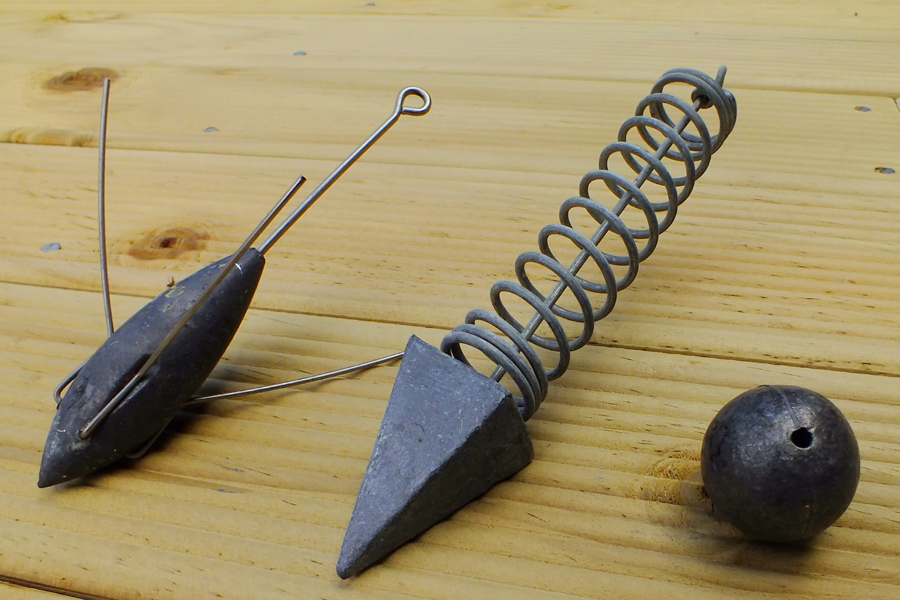
You can make choosing the correct sinker a scientific exercise if you wish, but it’s actually pretty simple, despite the different shapes and sizes available. Torpedo sinkers fly well and are good for distance fishing, while those incorporating wire grips work best by far in the sometimes swift currents in the surf zone. The BOS range has both attributes, so occupies a permanent place in my tackle pack. Even better, the wires fold away on retrieval, making reeling them back in a much easier job!
I also use wire-grip sinkers in low-energy surf situations, as I believe the fact they hold fast in the sand can help set the hook into the fish.
Sometimes I use berley sinkers – sinkers with a coil of wire built in so you can squeeze berley inside. When cast, the berley gets released in very close proximity to your bait, which serves to attract fish in closer so they’re more likely to find your offering, and as the berley also gets them feeding, they’re more likely to bite, too.
However, I occasionally use ball sinkers when I want my baits to move about and cover a bit of extra ground.
Next month: where to find the fish.
The three types of reel include: (from left) the fixed-spool or egg beater; the free-spool or overhead; and the side-cast Alvey.
The BOS wire-grip sinker, the Depth Charge berley sinker, and the ball sinker.
|
|

Fishing Reports Visit Reports
Outer Hauraki Gulf Fishing Report 17/09/26
Spring wind the handbrake. Spring is starting to make its presence felt in the outer... Read More >
Top of the South Fishing Report - 17/09/26
Early snapper in Tasman Bay. Well, spring is finally here, and the days are getting... Read More >
Bream Bay Fishing Report - 17/09/26
Good snapper catches reported. After Tangaroa turned off the fish tap for a month or... Read More >
Bay of Islands Fishing Report - 17/09/26
Pacific bluefin tuna for the lucky few. The last fortnight has seen more fishable days... Read More >


Friday 25 September 2026
Major Bites
 - -
- - Minor Bites
 - -
- - Saturday 26 September 2026
Major Bites
- - Minor Bites
- -
Comments